🔄 Updated 21 Jun 2026
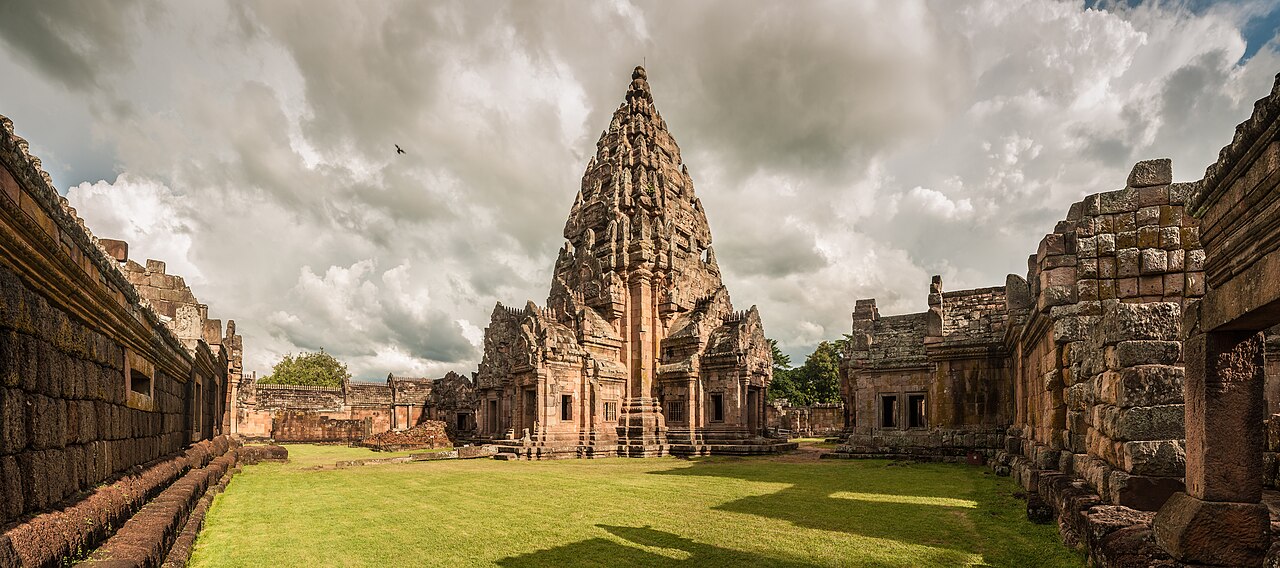
If you're coming to Buriram to take the stone temples seriously, the three you shouldn't skip are Phanom Rung, Mueang Tam and Khao Angkhan. Lucky for you, they all sit in the same zone in the south of the province, only a few dozen kilometres apart, so it's easy to make them one route. Phanom Rung is the grand temple on top of an extinct volcano. Mueang Tam is a lowland temple ringed by reservoirs, a completely different look. Khao Angkhan is a colourful temple on the rim of another volcanic crater. Cover all three and you get the full picture of Khmer civilisation in Buriram.
This plan is written for two styles. If you only have one day, you can squeeze it all in as long as you leave early. But if you'd rather walk slowly and shoot photos at an easy pace, we suggest spreading it over two days with one overnight, so you catch both the morning and evening light on the temples.
Why it works as one loop
The heart of this plan is how surprisingly close everything is. Phanom Rung is in Chaloem Phra Kiat district. Mueang Tam sits at the foot of Phanom Rung hill on the Prakhon Chai side, only about 8 km from Phanom Rung. Khao Angkhan is in Charoen Suk subdistrict, around 20 km from Phanom Rung. The three points form a small triangle. From Buriram town centre it's about 60–65 km to this zone, a little over an hour's drive.
The honest advice: you really want your own car or a rental, because public transport to these three spots is awkward and the connections are hard. If you're not driving yourself, the easier option is to charter a car from town or join a day trip that already runs this route.
Book the activities in your Buriram trip ahead
Booking online ahead on Klook or GetYourGuide is usually cheaper than the gate and skips the queue. Pick only the experiences you actually want — prices and availability are shown live on each site.
Combo ticket and opening hours, check before you plan
The thing that saves money and makes planning easier is the combo ticket. The Fine Arts Department sells a single ticket covering both Phanom Rung and Mueang Tam: 30 THB for Thais, 150 THB for foreigners, cheaper than buying each separately. Bought separately, Phanom Rung is 20 THB for Thais and 100 THB for foreigners, and Mueang Tam is priced similarly. So if you're going to both anyway, the combo ticket is the better deal. Khao Angkhan is a temple, with no admission fee, just a donation if you wish.
- Phanom Rung — open daily 08:30–16:30 · Thais 20 THB, foreigners 100 THB
- Mueang Tam — open daily, hours close to Phanom Rung's · similar price, combo ticket available with Phanom Rung
- Phanom Rung + Mueang Tam combo ticket — Thais 30 THB, foreigners 150 THB, one ticket gets you into both
- Wat Khao Phra Angkhan — open daily, roughly 08:00–17:00 · no admission fee
Before you set off
All three spots are out of town and food on the hills is scarce. Fill up the tank and eat a proper breakfast before leaving town. The temple grounds have no shade and you'll be walking in the sun, so pack a hat and water. Khao Angkhan is a temple, so covering your shoulders and knees will keep things comfortable.
Plan A — the two-day, one-night temple loop
This is the version we like best, because you catch the morning and evening light on the temples without rushing. Day one is all about Phanom Rung and Mueang Tam at a full, unhurried pace. Stay the night around Nang Rong or head back into town, whichever you prefer. Day two you take in Khao Angkhan plus an extra stop or two. Great for anyone who likes photography and hates being rushed.
Phanom Rung mid-morning, Mueang Tam in the afternoon
Khao Angkhan in the morning, an easy finish
Plan B — squeezing the temple loop into one day
If you only have one day, it's doable, but you have to leave early and not dawdle. Line the route up so it flows one way: start at Phanom Rung mid-morning while the light is still good, stop at Mueang Tam right next door, have lunch around Prakhon Chai or Nang Rong, then head up Khao Angkhan in the afternoon. Cover all three before driving back into town in the evening.
Phanom Rung–Mueang Tam–Khao Angkhan in one loop
Food stops along the way, so you don't go hungry
The temple zone is out of town and food on the hills is limited. The sensible refuelling points are around Nang Rong and Prakhon Chai, both on the way through, with plenty of choices. To be blunt: don't wait until you're starving on the hill, because finding food up there is harder than you'd expect.
Kha Mu Nang Rong
A long-running stewed pork leg shop in Nang Rong on Chok Chai–Det Udom road, right on the route between town and Phanom Rung. Handy to fill up before or after the temples.
Lang Wang, Prakhon Chai
A half-cafe, half-restaurant in Prakhon Chai with Thai food and noodles, open late. A good stop after Mueang Tam.
Roadside spots on Highway 24
Around Nang Rong there are plenty of stir-fry and rice spots along the highway, easy to find as you drive in and out of the temple zone.
Want special light? Aim for the sun-through-the-doorways event
Phanom Rung is famous for the moment when the sun shines straight through all 15 doorways in a perfect line. It only happens a few times a year. The sunrise alignment falls on 2–4 April and 8–10 September, and the sunset alignment on 5–7 March and 5–7 October. Those days draw huge crowds, so you have to claim a spot well before dawn or before sunset. If you can plan your trip to land on those dates, you get a shot that's genuinely hard to come by. But on any ordinary day you can still enjoy the temple just as fully, you just won't catch the light through the doorways.
If you come during the doorway alignment
Rework the plan so Phanom Rung is your first stop before dawn or your last stop in the evening, depending on the light window, and fit Mueang Tam and Khao Angkhan into the rest of the day. The special light window only happens once, and if you miss it you wait a year.
Get the full range, how each temple differs
These three have different moods, they're not repeats of each other. Phanom Rung is the hilltop temple, with a long axis to walk up, grand in scale and rich with carved lintels. Mueang Tam is the lowland temple, its highlight being the four L-shaped reservoirs that surround it and the five-headed nagas at the water's edge, with lovely reflections and easier walking than Phanom Rung. Khao Angkhan is a later-era temple built on an old sacred site, remembered for its boldly coloured hall and the Buddha images lined up around it, plus the Dvaravati-era sandstone boundary stones that show this place was sacred even before the Khmer period.
Honestly, if you're expecting thousand-year-old stone temples at all three, Khao Angkhan is a different thing, because the architecture you actually see is later work, not an ancient Khmer monument like Phanom Rung and Mueang Tam. But seen as a temple with a good view on a volcano, where you can pay respects and take photos, it's worth the stop, and it sits right on the same route.
Want to add a little more? Extra stops on the same route
- Khao Kradong — an extinct volcano near town, with a suspension bridge over the crater and the Phra Suphatbophit Buddha on top. A good stop on the way out or the way back into town.
- Prasat Plai Bat — a group of Khmer temples in the same area, for temple enthusiasts who want to dig deeper.
- Ban Khok Muang community — the community around Mueang Tam, with woven textiles and local life to drop in on if you have time to spare.
Wrap-up: how to prep so the trip runs smoothly
Transport
Your own car or a rental is best; public transport to these three spots is awkward. If you're not driving, charter a car or join a day trip.
Tickets
Get the Phanom Rung + Mueang Tam combo ticket, 30 THB for Thais and 150 THB for foreigners, better value than buying separately. Khao Angkhan is free.
Departure time
Leaving before 8am lets you cover everything without rushing. With two days it's even more relaxed, with both morning and evening light for photos.
What to pack
Hat, water, comfortable walking shoes, and a wrap for your shoulders at Khao Angkhan temple. There's no shade at all on the temple grounds.
Plan the rest of your Buriram trip
See the Buriram travel guide →