🔄 Updated 21 Jun 2026
Chiang Mai is ringed by mountains, so there are a lot of waterfalls here — from easy, kid-friendly walks to ones where you have to push through a bit of forest. The most important thing to know is the season. Most waterfalls run full from late rainy season into early winter (July–December), while in the hot months (March–May) some dry up to little more than rocks and a few small pools. We'll tell you when to go for each one.
Waterfalls Near Town — Easy to Reach, No Long Drive
If you only have half a day or don't feel like a long drive, these three are along the Doi Suthep–Mae Rim side, between 30 minutes and an hour from the city center.
Huay Kaew Waterfall
The closest waterfall to town, at the foot of Doi Suthep behind Chiang Mai Zoo, near the Kruba Srivichai monument. It's just a few minutes' walk from the parking area, so it's an easy stop before heading up Doi Suthep. The falls aren't huge, but it's shady and green, and locals come to hang out here.
Monthathan Waterfall (Mon Tha Than)
A 9-tier waterfall inside Doi Suthep–Pui National Park, on the same road up to Doi Suthep. Clear water drops into pools, and it's shadier and quieter than Huay Kaew — good if you like a gentle forest walk. In the dry season (Jan–May) the water drops off a lot, so aim for late rainy season.
Mae Sa Waterfall
A 10-tier waterfall in Doi Suthep–Pui National Park on the Mae Rim side, about 30 minutes to an hour from town. A wooden walkway runs alongside the falls so you can climb tier by tier — doing all 10 takes about an hour each way. You can swim in the lower tiers, and there are picnic areas, so it works well for families.
About National Park Entry Fees
Waterfalls inside national parks (Mae Sa, Monthathan) charge separate rates for Thais and foreigners — foreign adults around 100 THB, children 50 THB, Thai adults 20 THB, plus a vehicle fee of about 30 THB per car. Prices can change, so bring cash just in case.
Want more out of Chiang Mai? Book tours & activities
Booking online ahead on Klook or GetYourGuide is usually cheaper than the gate and skips the queue. Pick only the experiences you actually want — prices and availability are shown live on each site.
Bua Tong — The Waterfall You Climb Barefoot
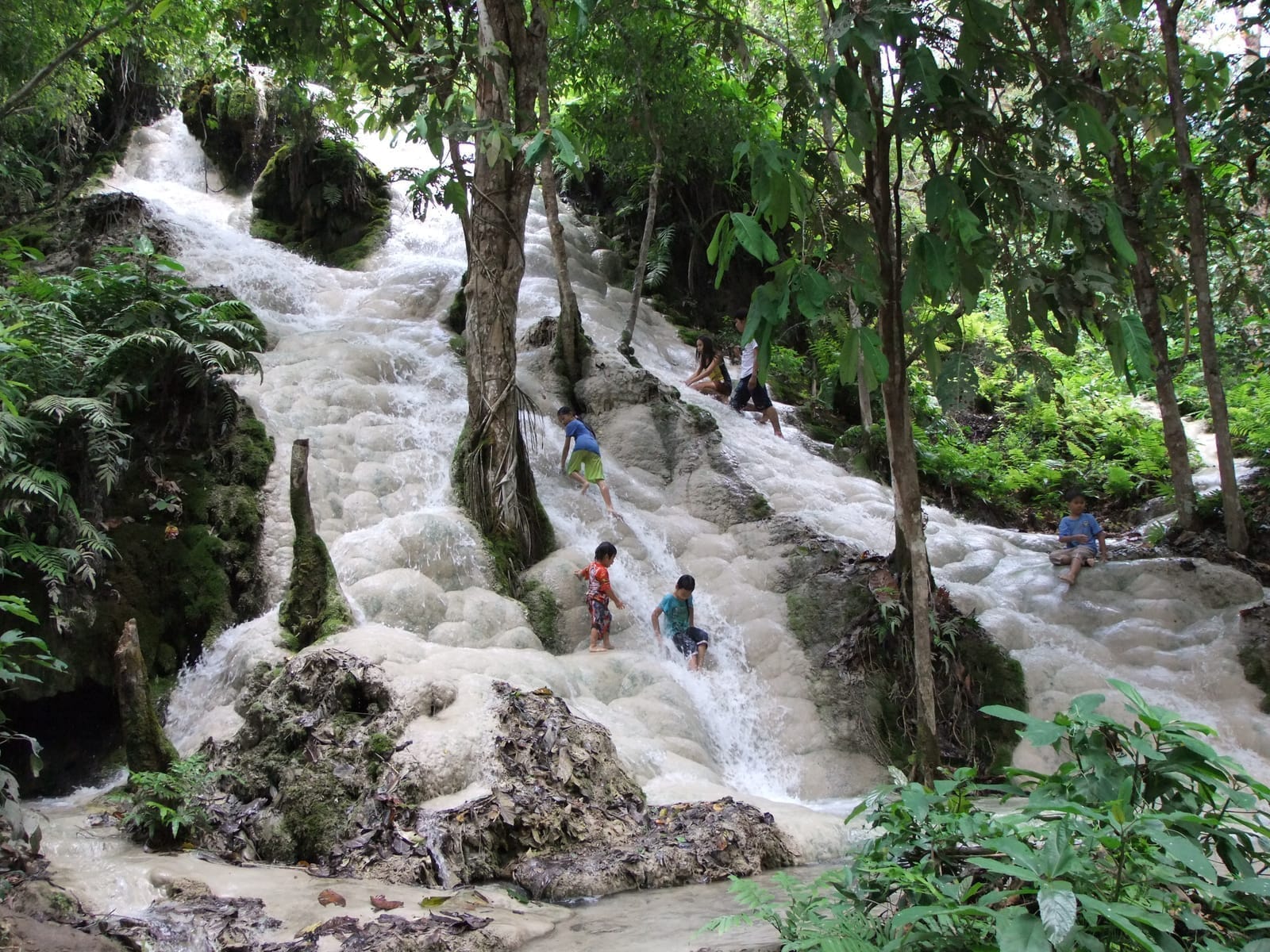
If you had to pick one of the most unusual waterfalls around Chiang Mai, it would be Bua Tong, which many people call the "Sticky Waterfall." It's in Mae Taeng district, about 60 kilometers from the old town — roughly an hour and a half by car.
What makes it special is that the rock here is coated in limestone (calcium carbonate), giving the surface a rough, sponge-like texture that doesn't get slippery underfoot. So you can climb straight up against the flow of the water barefoot, with ropes along the side to grab at intervals. Kids and older folks can manage it too, as long as they take it slow.
- Free entry, open daily 08:00–17:00, with parking and restrooms.
- Barefoot is best — sandals tend to be slipperier, so just leave them at the bottom.
- Watch out for the green patches where there's algae on the rock — those spots are slippery and don't grip like the brown rock, so avoid them.
- At the top there's the Chet Si (Seven-Color) Spring (Huay Tad Spring), where the source water bubbles up from underground — you can keep walking past the top of the falls to reach it.
When to Go to Bua Tong
The rock grips best when the water isn't running too hard. Early winter (Nov–Feb) is the sweet spot — the flow is just right and the weather is cool and pleasant. In the rainy season the water runs harder and the rock is slipperier, so you have to be more careful climbing.
San Kamphaeng Hot Springs — Soak Your Feet, Boil Eggs
Heading east out of town about 35 kilometers, around Mae On district, you'll find the San Kamphaeng Hot Springs, a natural hot spring that shoots up in a tall jet. People come to soak their feet in the warm channels and buy a basket of eggs to lower into the boiling pools — wait a few minutes and you've got freshly cooked eggs to eat on the spot.
- Open daily ~07:00–19:00, entry around 100 THB for foreigners and around 40 THB for Thais.
- Private mineral baths available for an extra charge per person — good if you want a proper soak, not just a foot dip.
- Eggs are sold by the basket near the pools, with signs showing cooking times for each style — soft-boiled with a runny yolk takes about 7 minutes.
- Pairs well with a trip around the San Kamphaeng–Mae On side, like adding Mae Kampong in the same day.
Trekking and Mountain Villages
If you want nature that goes deeper than a roadside waterfall, Chiang Mai has mountain villages with real trekking trails, where the air stays cool and pleasant because of the altitude.
Mae Kampong Village
A village in the forest at about 1,300 meters in Mae On district, roughly an hour's drive from town. It has the 7-tier Mae Kampong Waterfall, about a 30-minute walk up from the village. The village grows miang (fermented tea leaf), tea, and coffee, and there are cafes tucked in the forest to relax at. The air stays cool all year.
Doi Suthep–Pui Park (Trekking Trails)
Beyond the temple and the waterfalls, there are nature-study trails through the forest, good for people who want a gentle walk close to town. They start around Monthathan or behind Chiang Mai University.
If You Want Serious Trekking
For deeper-forest trekking, like the Mae Kampong route or inside the park, we'd hire a local guide. Some stretches of trail aren't signposted, and the paths get slippery in the rainy season. A guide knows where the hidden waterfalls are and helps with safety.
Planning a 2-Day Nature Trip
If you have a car and two days, this is a route that covers the nature around Chiang Mai without wearing you out — splitting the west side (Doi Suthep–Mae Rim) and the east side (San Kamphaeng–Mae On) across two days.
Doi Suthep–Mae Rim Side (Waterfalls)
San Kamphaeng–Mae On Side (Hot Springs + Mountains)
Before You Go
- Check the season — water is fullest July–December. In the hot season some waterfalls dry up, so if you come then, pick Bua Tong or the hot springs, which don't depend on rain.
- Bring cash — park entry and the hot springs mostly take cash only.
- Shoes and clothes you don't mind getting wet, especially for Bua Tong and Mae Sa — bring a spare set.
- Rent a car or motorbike — most spots have no public transport to the waterfall itself. A sedan runs about 1,000 THB a day, a motorbike about 200–300 THB, or you can charter a songthaew.
- Slippery in the rainy season — especially the waterfall rocks and the roads up the mountains, so drive and walk carefully.
Looking for a place to stay near nature or in central Chiang Mai?
See the Top 10 Chiang Mai Hotels →