🔄 Updated 21 Jun 2026
Ask anyone from Chiang Mai where to take an out-of-town friend to feel real cold, and the first answer is usually Doi Inthanon, because it's the highest peak in the country. In winter the morning temperature drops close to zero, and on some days you get mae kha ning (hoarfrost) clinging to the grass — a sight that's genuinely rare in Thailand. Best of all, it's an easy day trip from the city.
The main route is Highway 1009, the Chom Thong–Inthanon road, paved all the way up the mountain. The sights line up by the kilometre marker as you climb: start with the waterfalls lower down, head up to the park headquarters and Ban Khun Klang at km 31, then the twin royal pagodas, finishing at the summit and the Kew Mae Pan trail. Plan it in this order and you won't have to double back.
Doi Inthanon Summit — the highest point in Thailand
At the top there's a "Highest Spot in Siam" sign for photos, just a few steps from the car park. The air up here is far colder than in the city — even on a winter afternoon you'll still want a jacket. Right beside it is the memorial stupa of Phra Chao Inthawichayanon, the ruler of Chiang Mai whose name gave the mountain its "Inthanon".
Straight talk
Plenty of people come hoping to catch the sunrise from the summit, but the top is usually socked in with thick fog in the morning. Your odds of a clear sea of fog are much better from other spots like Kew Mae Pan or the pagoda car park. Don't pin too many hopes on the summit itself.
Want more out of Chiang Mai? Book tours & activities
Booking online ahead on Klook or GetYourGuide is usually cheaper than the gate and skips the queue. Pick only the experiences you actually want — prices and availability are shown live on each site.
Ang Ka Luang nature trail — cloud forest near the summit
Right near the summit is the Ang Ka Luang nature trail, a short boardwalk loop of about 360 metres that's an easy walk for any age. Both sides are mossy montane forest, with ferns and moss covering the trees in deep green, and a cool, humid air that feels like a fairy-tale forest. It's open year-round, no guide required, and makes a good stop before or after the summit.
Kew Mae Pan — the ridge-line trail you shouldn't skip
Kew Mae Pan is the hiking highlight of Doi Inthanon. The trailhead is around km 42, and it's a loop of roughly 3 kilometres that runs through montane forest out to grassy meadows on the edge of a cliff, where you look out over the ridges and a wide sea of fog. Walking it unhurried takes about 2–3 hours, and the difficulty is easy to moderate.
- A local guide is required — the park requires you to hire a Hmong guide to lead the way, around 200 THB per group (up to about 10 people), paid at the trailhead.
- Open only in cool to early hot season — open 1 November to 31 May, closed during the rainy months (June–October) to let the forest recover and prevent landslides.
- Go early — open roughly 06:00–16:00. Late morning is clearer, but early dawn gives you the best chance of a sea of fog at the cliff edge.
- Shoes and a warm layer — the trail has ups and downs and gets slippery when damp, so wear trainers or hiking shoes. The wind on the ridge is strong and very cold.
The twin royal pagodas — Naphamethanidon & Naphaphonphumisiri
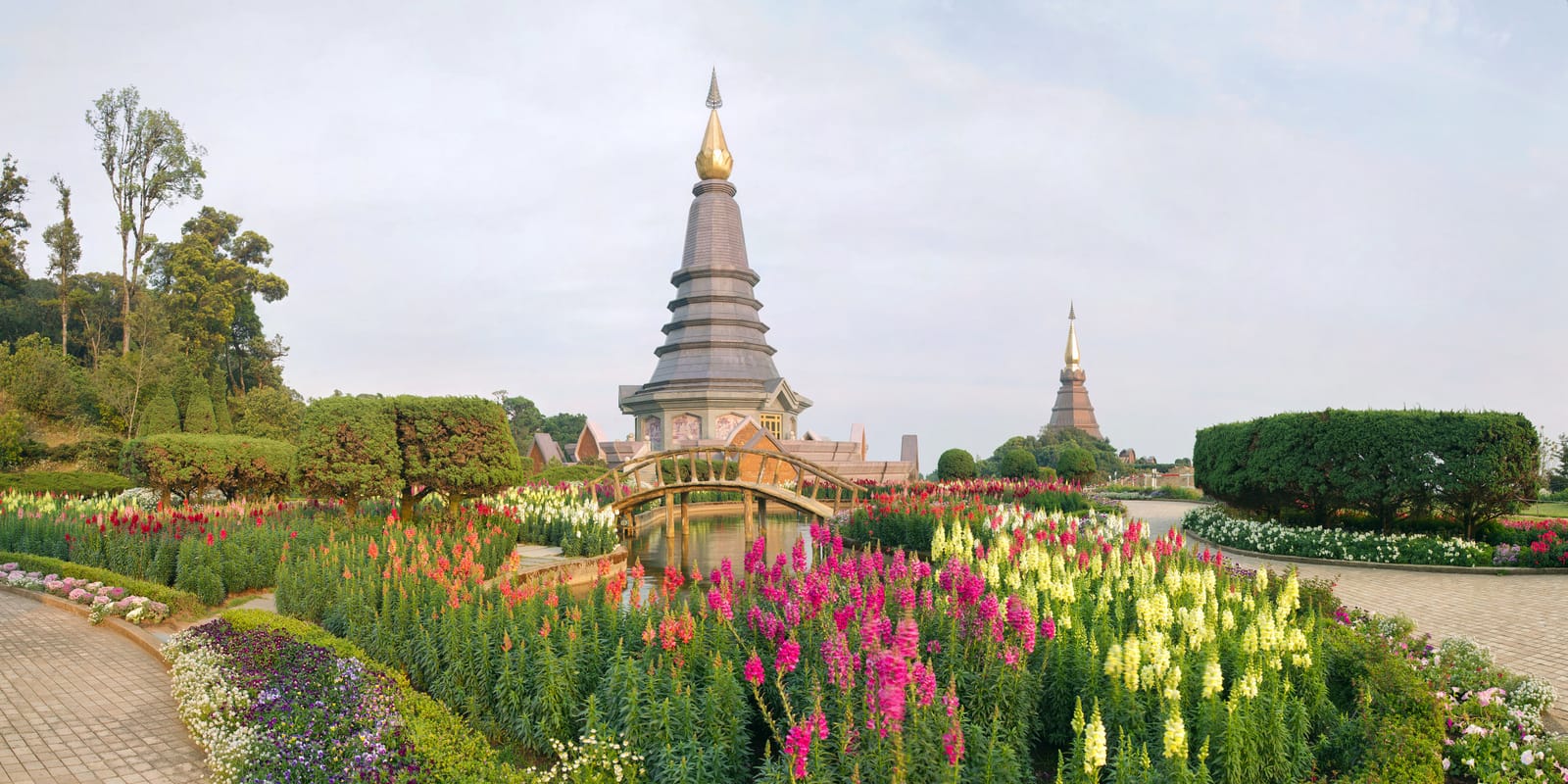
Just before the summit you reach the plaza of the twin royal pagodas, standing as a pair on a high hill. The first is Phra Mahathat Naphamethanidon, built in 1987 to mark the 60th birthday of King Rama IX; the other is Phra Mahathat Naphaphonphumisiri, built in 1992 to honour Queen Sirikit, the Queen Mother. The grounds are laid out with cool-climate flower gardens that bloom beautifully late in the year, plus a west-facing viewpoint with lovely sunsets.
Extra entry fee
The pagoda plaza charges a separate entry fee on top of the park fee, around 100 THB per person. There's an escalator up to the pagoda plaza for anyone who doesn't want to climb the hill.
Waterfalls along the way — Wachirathan, Mae Ya, Siriphum, Mae Klang
Doi Inthanon has several waterfalls spread along the climb, and you can stop at them from the lower stretch before heading up the mountain. They run year-round but are strongest and prettiest in late rainy to early cool season. We've picked them out in the order that's easiest to stop at.
Wachirathan Waterfall
A big waterfall about 40 metres high, a wide curtain of water crashing against the rock face, just a short walk from the car park. It's the most-visited fall on the mountain because it's dramatic and easy to reach, with cool spray drifting across the whole area.
Mae Ya Waterfall
A multi-tiered fall cascading down into a broad curtain — considered the prettiest and tallest on Doi Inthanon. It's in the southern part of the park near Chom Thong and takes a separate turn-off, so it suits people with time who want to dodge the crowds.
Siriphum Waterfall
A forest waterfall reached by walking about 200 metres in from the main road, with a viewpoint to take in the curtain of water up close. The setting is shady and quiet, a good leg-stretch on the drive up the mountain.
Mae Klang Waterfall
A large single-drop fall about 100 metres high, near the lower park entrance. It's an easy first stop before heading up the mountain, good for photos and a stretch.
Ban Khun Klang and the Royal Agricultural Station
At km 31 there's a turn-off into Ban Khun Klang, a Hmong village that's home to the park headquarters and the Inthanon Royal Agricultural Station. Inside the station are research plots of cool-climate flowers, with flower houses, a rose garden, and greenhouses to wander through. From late January to early February the wild Himalayan cherry (the local "sakura") blooms pink along the hillsides — another reason people flock up the mountain in that window.
Inthanon Royal Agricultural Station
Cool-climate flower gardens, greenhouses, and a Royal Project café — an easy place to stroll and take photos.
Park campground
Stay overnight on the mountain to catch the sunrise and hoarfrost. It gets very cold, so book ahead in high season.
Khun Wang (nearby)
Another agricultural research centre with fields of wild cherry blossom and cool-climate plants. Worth tacking on if you have time.
Entry fees and opening hours
- Park entry (foreigners) — adults 300 THB, children 150 THB.
- Park entry (Thai nationals) — adults 60 THB, children 30 THB (bring your ID card).
- Vehicle fee — car 30 THB, motorbike 20 THB.
- Twin royal pagodas plaza — an extra fee of around 100 THB per person.
- Kew Mae Pan — guide fee around 200 THB per group, open 1 Nov–31 May only.
- Park opening hours — daily 05:30–18:30.
Getting there from Chiang Mai city
Doi Inthanon is about 70 kilometres from Chiang Mai city, roughly a 2–2.5 hour drive since you have to take it slow on the mountain. The route runs through Hang Dong and Chom Thong, then turns onto Highway 1009 up the mountain.
- Self-drive rental — the most convenient option, letting you stop wherever you like. The road is paved throughout but steep with lots of curves, so make sure your brakes are good and fill up the tank before heading up.
- Car with driver / day tour — good if you'd rather not drive the mountain yourself. Most tours leave the city before dawn and cover the summit, the pagodas, waterfalls, and Kew Mae Pan all in one day.
- Songthaew — there are songthaews from Chom Thong up the mountain, but it takes several connections and a lot of time. It suits people with time to spare and a tight budget, and is less convenient than the first two options.
Best time to go
Winter, November–February, has the best weather — clear skies, with a chance of a sea of fog and hoarfrost. In the rainy season (Jun–Oct) Kew Mae Pan is closed, but the waterfalls are strong and beautiful. On a long winter weekend, traffic backs up on the mountain and car parks fill fast, so leaving the city before 6am makes a big difference.
Plan a full day of nature and mountains around Chiang Mai
See the Chiang Mai travel guide →