🔄 Updated 21 Jun 2026
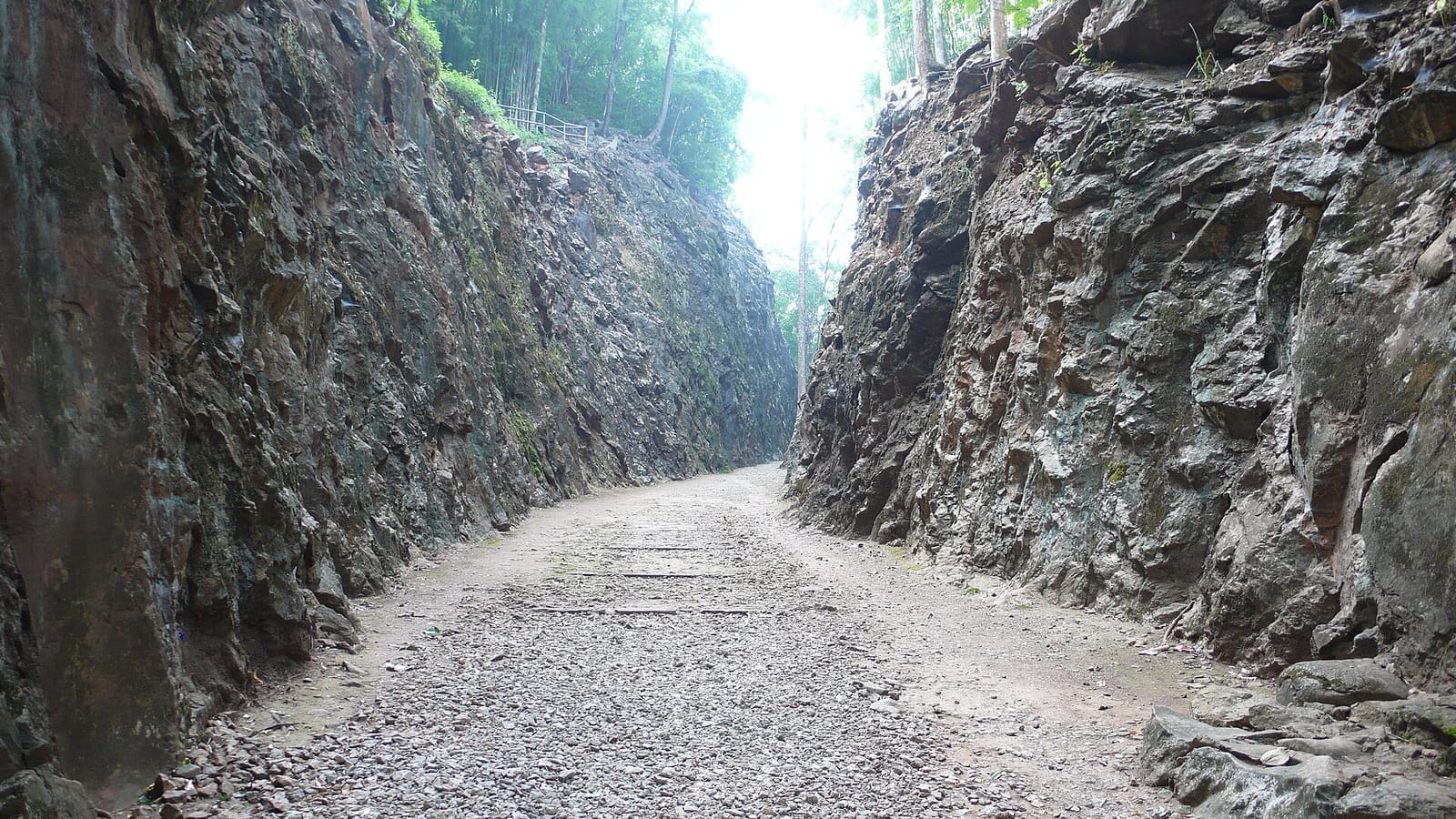
If you've heard of Kanchanaburi's "Death Railway," Hellfire Pass is the grimmest chapter of that story. During World War II, the Japanese army forced Allied prisoners of war and Asian labourers to cut a channel roughly 75 metres long and up to 25 metres deep through a rocky ridge — almost entirely with hand tools — so the rail line could pass through.
The name Hellfire Pass comes from the night shifts: starving prisoners kept digging by the light of torches and lamps, and the way their shadows flickered against the rock walls looked like a scene out of hell. The soldiers started calling it the "hellfire pass." Its official Japanese name was Konyu Cutting.
A short history — why this place matters
Work on the cutting began around 25 April 1943, with a first group of about 400 Australian POWs. The Japanese were pushing the schedule so hard that this period became known as the "Speedo" era (April–August 1943). Crews that once cut about 1 metre a day were forced to break through hard rock at 2–3 metres a day, working 15-hour shifts — sometimes as long as 18 hours.
At the Konyu section alone, which includes Hellfire Pass, at least 700 Allied prisoners of war died — from starvation, disease and beatings. That's why this is a memorial, not just a viewpoint.
Good to know before you go
The museum and trail are cared for by the Australian government (the Department of Veterans' Affairs), so the signs and audio guide come in both Thai and English and are put together in real detail. It's made for people who genuinely want to understand the story, not just walk through.
Want more out of Kanchanaburi? Book tours & activities
Booking online ahead on Klook or GetYourGuide is usually cheaper than the gate and skips the queue. Pick only the experiences you actually want — prices and availability are shown live on each site.
Hellfire Pass Museum — what you'll see
The museum building (officially the Hellfire Pass Interpretive Centre) sits on a rise looking down over the valley. Inside, it tells the story of the Thailand–Burma railway from start to finish, with real photographs, tools and objects, and recorded testimony from POWs who survived.
- Indoor exhibition — photographs, maps of the rail route, rock-cutting tools and the prisoners' own accounts.
- Audio guide — borrow it free at the counter, in Thai and English. Listen as you walk the trail and it adds a lot more depth at each stop.
- Valley viewpoint — the terrace behind the museum looks out over the ridges and the trail dropping down below.
- Memorial corner — plaques and wreaths left by visitors and the families of former prisoners.
Memorial Walking Trail
From the museum, a stairway leads down to the actual cutting, and you can walk straight into the rock channel the prisoners carved. The ground is gravel, with some of the original railway sleepers still in place in spots. It's a short walk to the point where the rock walls rise steeply on both sides — this is the heart of the place.
If you have the time and the legs for it, the trail continues along the old rail formation for about 2.5 kilometres, all the way to the Hin Tok area. Most of it is shaded natural path with interpretive signs along the way. The full out-and-back takes roughly 2–4 hours.
Can you handle the walk?
If you just want to see the cutting itself, it's a short flight of stairs down — figure on about 1–1.5 hours including the museum. But if you plan to walk the long route to Hin Tok, wear trainers or hiking shoes, carry water and check how you're feeling first, because the return leg is uphill.
Opening hours, entry fee and facilities
- Opening hours: daily, 9:00 AM – 4:00 PM.
- Entry fee: free, both the museum and the trail (there's a donation box to help maintain the site — give what you feel is right).
- Audio guide: free to borrow; you leave your ID card or passport as a deposit.
- Closed days: generally closed for Songkran (13–15 Apr), 5 Dec, 24–27 Dec and 31 Dec–1 Jan. In 2026 there's also an annual maintenance closure from 4–24 May, so check before you go.
- Facilities: restrooms, parking and a seating area inside the building.
Getting to Hellfire Pass
Hellfire Pass is in Tha Sao subdistrict, Sai Yok district, about 80 kilometres from Kanchanaburi town. It sits right off Highway 323 (the Kanchanaburi–Sai Yok–Thong Pha Phum road) around the 64–65 km marker, and it's clearly signposted.
Private car / rental
The easiest option. From town, take Saengchuto Road, turn onto Highway 323 toward Sai Yok, pass Sai Yok Noi Waterfall, then carry on another 20 km or so. Total drive is about 1.5 hours.
Chartered car / taxi
You can charter a car from town for the round trip — handy if you want to hit several stops in one day, like Tham Krasae and Sai Yok Waterfall. Agree on the price and the pickup time clearly up front.
Day tour
There are history-focused tours from Kanchanaburi or Bangkok that bundle the Bridge over the River Kwai, the Death Railway and Hellfire Pass together. Good if you don't have your own wheels.
Plan the route so it's worth it
Hellfire Pass is a fair way from town, so if you're driving out here, make a full day of it — a history-and-nature trip. You can fold in Tham Krasae, Sai Yok Waterfall or Sai Yok National Park along the same road.
Etiquette and things to know
- This is a memorial and, in spirit, a resting place — dress respectfully and keep noise down.
- Photos are fine, but skip the playful poses around the cutting and the memorial corner.
- Bring water and a hat. Midday walks get hot and there's nowhere to buy drinks along the trail.
- In the rainy season the path can be slippery — take extra care and listen for any on-site trail closures.
Plan a full day of historic Kanchanaburi
See the Kanchanaburi travel guide →