🔄 Updated 21 Jun 2026
The Phu Thai (sometimes written Phu Tai) are one of the Tai peoples who migrated across the Mekong and settled in Isan a little over a century ago. In Thailand they're concentrated around Kalasin, Nakhon Phanom, Mukdahan, and Sakon Nakhon. In Kalasin, Phu Thai communities cluster in the north and east of the province — the districts of Khao Wong, Kham Muang, Kuchinarai, and Na Khu, the hill country along the foot of the Phu Phan range. People here speak Phu Thai, wear Phu Thai dress, and still make merit by the customs of their group every year.
The Phu Thai Language — Sounds Like Isan, but Isn't
Phu Thai belongs to the Kra-Dai language family, the same branch as Lao and Isan Thai. An outsider listening casually might assume it's just Isan, but Phu Thai speakers pick it out instantly from the accent and a handful of distinctive words. The tones and vowels differ — Phu Thai tends to favor simple vowels over diphthongs, which makes the speech sound short and crisp.
- The word for "no" — like Isan they use "bo," but in some areas it comes out as "mi/mee," a tell-tale Phu Thai marker.
- A higher pitch — Phu Thai is spoken higher than ordinary Isan Lao; it sounds soft but has a rhythm all its own.
- Kinship terms — the group has its own words for parents and grandparents, different from central Isan.
Want to hear the real thing
Walk through the morning market in the town of Khao Wong or Kham Muang and you'll hear the elders chatting in pure Phu Thai. If you say hello and mention you've come to hear the language, people here are warm and happy to teach you a few easy words.
Want more out of Kalasin? Book tours & activities
Booking online ahead on Klook or GetYourGuide is usually cheaper than the gate and skips the queue. Pick only the experiences you actually want — prices and availability are shown live on each site.
The Dress — That Signature Black Costume with Red Trim
The image most people have of the Phu Thai is the black or deep-indigo outfit edged with a band of bright red. Women wear a hand-woven sarong and a dark long-sleeve blouse trimmed in red at the collar, the front opening, and the cuffs, with hair tied up in a high bun and adorned with silver. Men wear an indigo mo hom shirt or a black one with a phakhaoma sash. You'll see the full look at merit ceremonies and Phu Thai dances, when hundreds or even thousands of people dressed alike come out to dance together — a sight that stays with you.
- Black or indigo with red trim — the main hallmark that sets the Phu Thai apart from other Isan groups at a glance.
- Silverwork — necklaces, bangles, earrings, and hairpins of solid silver, worn with the costume on important occasions.
- A Praewa shawl over the shoulder — silk woven in the Phu Thai's own patterns, draped diagonally across the shoulder for ceremonies; a treasured family heirloom.
Ban Phon Praewa Silk — the Queen of Silks
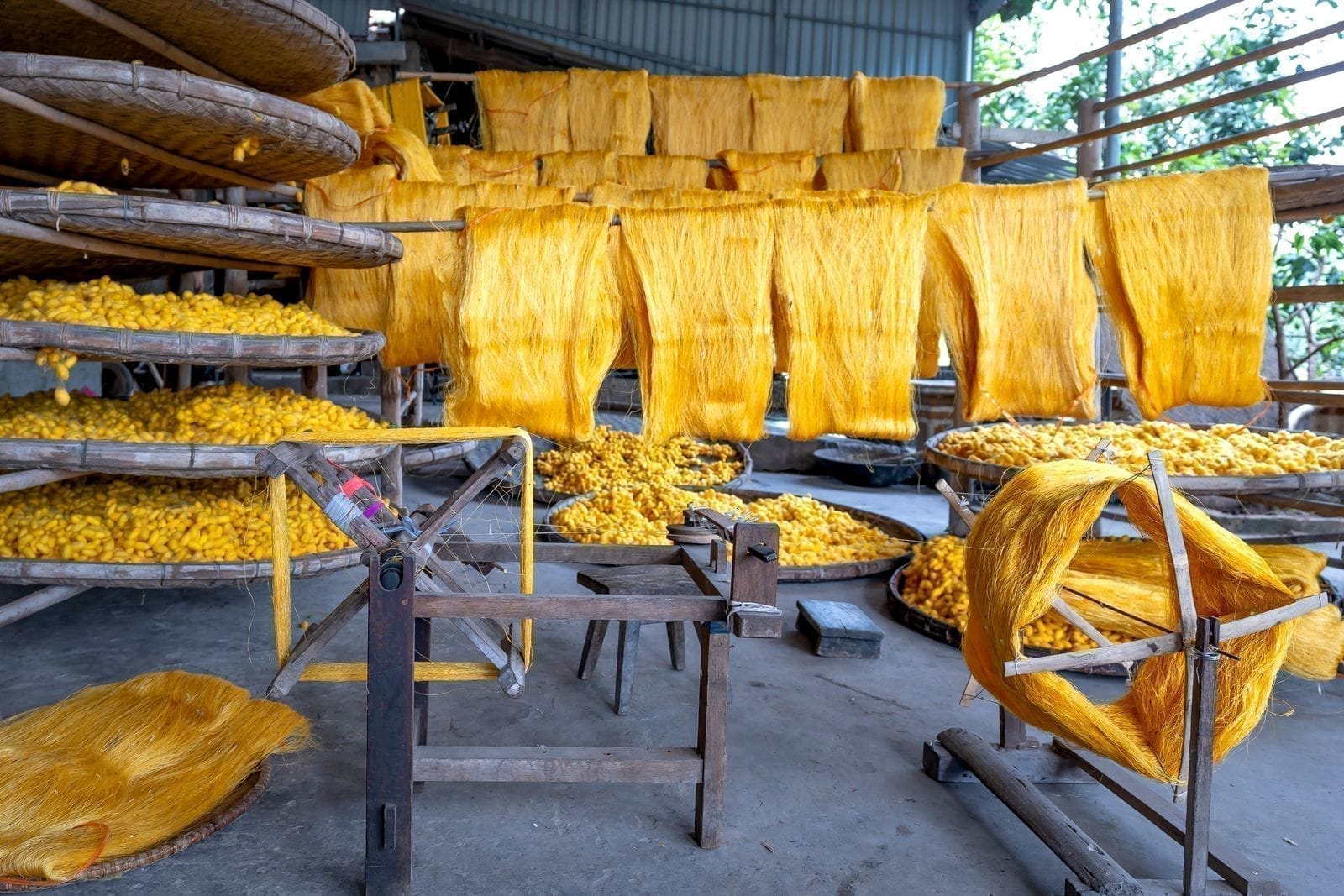
If there's one thing the Kalasin Phu Thai are best known for, it's Praewa silk. Its home is Ban Phon, Phon sub-district, Kham Muang district, a Phu Thai community that has woven Praewa for generations. The name "Praewa" comes from a length of silk cloth (phrae) roughly one wa long, woven with a mix of the jok and khit techniques. The patterns are intricate, the colors come from dyed silk, and each piece takes months to make — with the pattern of one piece almost never repeating another. That's how it earned the title queen of silks.
Praewa rose to fame because Her Majesty Queen Sirikit encouraged the people of Ban Phon to weave it for a living through the SUPPORT (Silpacheep) Foundation. What had been a ceremonial shawl became a craft people across the country seek out. Prices depend on the size, the fineness of the pattern, and the number of colors used. Small scarf-sized pieces start in the low thousands of THB, while large pieces with full, high-skill patterns climb to tens of thousands of THB — genuine collector's items with real value.
See the weaving at the village
Ban Phon has a Phu Thai Praewa Silk Cultural Center where you can watch the weaving steps and buy directly from the villagers. Call ahead on 043-856157 or 089-841-2440. Buying straight from the weaver gets you the real thing at a fairer price than buying second-hand.
Merit Festivals That Still Happen Every Year
The Phu Thai follow the Isan Heet Sip Song, Khong Sip Si calendar of customs, but they also have group-specific rites you'll rarely see elsewhere. If you're planning a culture-focused trip, try to time it with these.
International Phu Thai Fair (Khao Wong)
The big annual event that brings together Phu Thai from Thailand, Laos, and Vietnam. In 2026 it runs 23-27 January at the royal commemorative park by the Huai Sai Na Wiang reservoir, Khum Kao sub-district, Khao Wong district. The highlights are a mass Phu Thai dance with over a thousand performers and a procession of Phu Thai life.
Bun Khun Lan (Rice Blessing)
A post-harvest merit festival held around January. Villagers carry the rice up to the granary and perform a su khwan rite to thank the rice goddess Mae Phosop. In some areas they build beautiful castles of rice stalks — a glimpse of real Isan farming life.
Baisri Su Khwan
A wrist-tying rite to call the spirit, held at auspicious events and to welcome guests. Join a Phu Thai merit ceremony and you'll likely get your wrist tied with a blessing — a warm welcoming custom of the people here.
There's also the yao rite, a form of healing by a mo yao based on ancestral-spirit beliefs, and the Phu Thai dance, a group-specific style used at merit ceremonies and welcomes. The movements are graceful, set to the khaen and drums. See it live at a festival and you'll understand why people take such pride in being Phu Thai.
Beliefs and Way of Life
- Ancestral spirits alongside Buddhism — the Phu Thai keep guardian and household spirits, making offerings through the year's cycle while also going to the temple to make merit.
- The mo yao — the healer who performs rites by belief, using song and trance to comfort the sick; still found in genuine Phu Thai communities.
- The Phu Thai house — a wooden house raised high on stilts, the space underneath used for weaving and storage. A few old ones still stand in the old villages around Khao Wong and Kham Muang.
A 2-Day, 1-Night Phu Thai Culture Trip
To get under the skin of the Phu Thai, plan for two days running from Kalasin town out toward Kham Muang and Khao Wong. This route ties together the weaving villages, the scenery, and community life.
Ban Phon, Kham Muang — Home of Praewa Silk
Khao Wong — the Phu Thai Heart and Phu Phan Nature
Plan a full Kalasin trip — culture, nature, and food across the whole province.
See the Kalasin travel guide →