🔄 Updated 21 Jun 2026
When people think of Thailand's ancient cities, Sukhothai and Ayutthaya usually come to mind first, so Kamphaeng Phet ends up getting skipped a lot — even though it's part of the same World Heritage listing as Sukhothai, with a charm all its own. What stands out is that most of the ruins here are built from reddish-brown laterite, set in open woodland, which gives the whole place a sombre, weathered mood — quite different from the red brick of Ayutthaya. You can spend a full day walking around and barely run into a large tour group.
The city's main ruins sit inside Kamphaeng Phet Historical Park, on the east bank of the Ping River. The grounds split clearly into two zones: the walled-city zone (with Wat Phra Kaeo and Wat Phra That) and the Aranyik forest zone outside the walls (Wat Phra Non, Wat Chang Rop, Wat Phra Si Iriyabot). Across the river is the town of Nakhon Chum, home to a gleaming golden chedi that's the symbol of the area. We'll go through it zone by zone.
Historical Park — the walled-city zone
This zone is right next to town and you can walk between the sites from the car park. The main draws are Wat Phra Kaeo and Wat Phra That, lined up together in the heart of the old city, with the Shiva Shrine and a stretch of the original city wall nearby. It's a good place to start because it's compact and shadier than the Aranyik zone.
Wat Phra Kaeo
The largest royal temple in the old city. Legend says it once enshrined the Emerald Buddha and the Phra Buddha Sihing. Today what remains are stupa bases, a long row of laterite Buddha images and stucco lions — the main photo spot of the inner zone.
Wat Phra That
Right next to Wat Phra Kaeo, with a bell-shaped main chedi on a square base, ringed by smaller chedis and the foundations of an assembly hall. You can walk straight on from Wat Phra Kaeo and cover both in one go.
Shiva Shrine (San Phra Isuan)
The city's only Hindu shrine, now just a square laterite base. It originally held a bronze Shiva image inscribed with a date of 1510 CE (the original is kept in the museum; the one at the shrine is a replica).
Entry fee and hours
The park is open daily 08:30–16:30. Entry is 10 THB for Thais and 30 THB for foreigners, with separate tickets for the walled-city zone and the Aranyik zone — if you want to see both, budget for two rounds. It gets hot from mid-morning into the afternoon, so coming early or late makes for a much more comfortable walk.
Want more out of Kamphaeng Phet? Book tours & activities
Booking online ahead on Klook or GetYourGuide is usually cheaper than the gate and skips the queue. Pick only the experiences you actually want — prices and availability are shown live on each site.
Aranyik zone — the forest temples you shouldn't miss
The Aranyik zone lies outside the city wall to the north and covers far more ground. It was once where forest-dwelling monks (phra pa) spent the rains retreat, and you'll find traces of more than 40 temples scattered through open woodland. You'll need to drive or cycle on from the inner zone, since the temples are spread fairly far apart, but this is where the ruins are at their most beautiful and best-preserved.
Wat Chang Rop
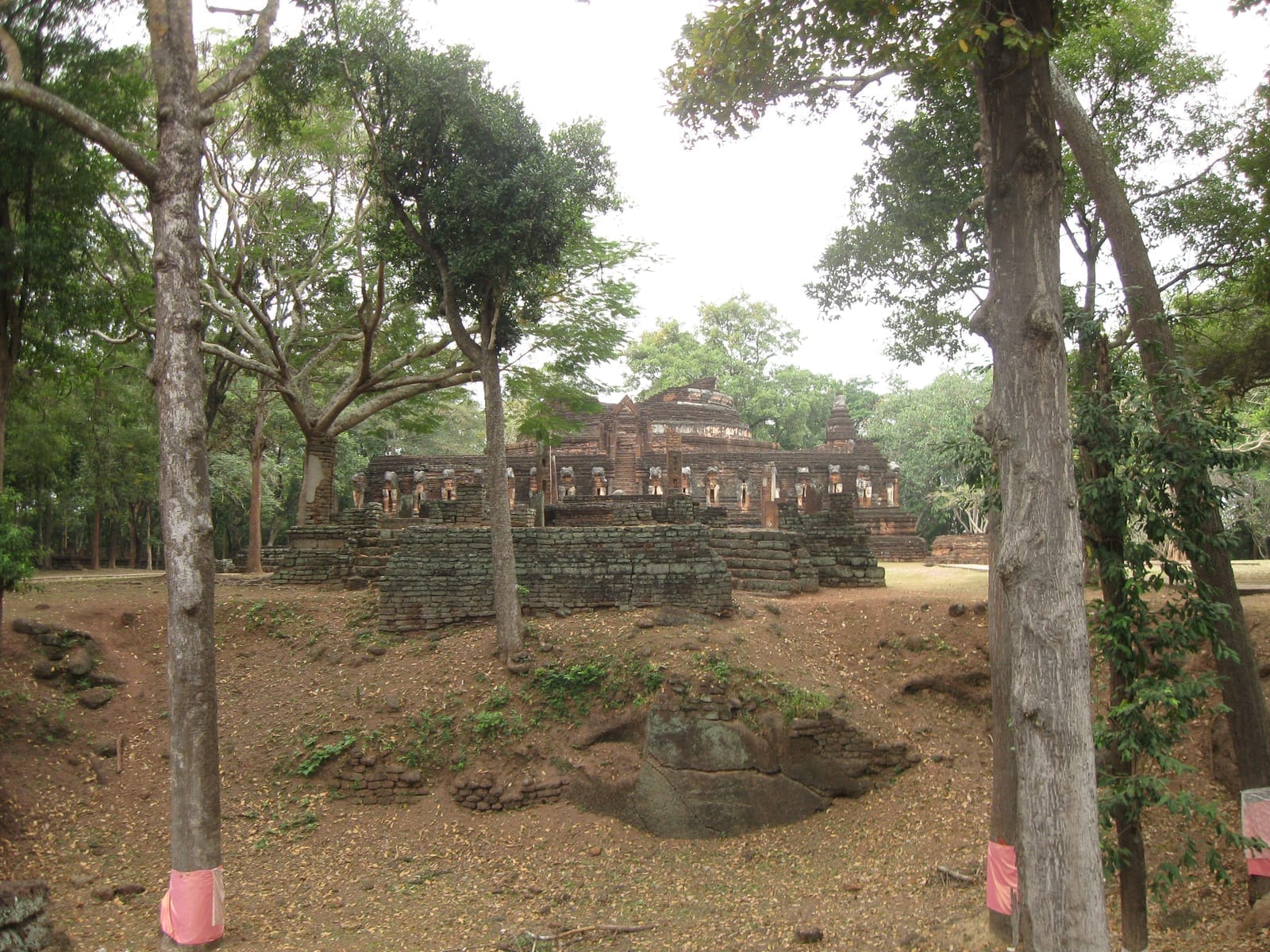
The city's highlight. A bell-shaped main chedi sits on a tall, broad square base ringed with 68 half-body stucco elephants, with stairways on all four sides so you can climb up to the upper platform. This is the defining image of Kamphaeng Phet and the most photographed spot in town.
Wat Phra Si Iriyabot
The name means 'the four postures of the Buddha' — it originally held images in all four: walking, sitting, standing and reclining, set around a square-mondop. Today a large standing Buddha about 9 m tall on the south side still survives intact, the only old standing image left in the park.
Wat Phra Non
A large temple at the northern edge of the Aranyik zone, built almost entirely from laterite. Massive laterite columns stand in rows, and a once-huge reclining Buddha now survives only as its base. The atmosphere is shady and quiet.
Wat Sing
A mid-sized temple in the Aranyik zone, notable for its assembly-hall foundations and laterite chedi, with a low boundary wall still visible around it. Easy to fold in after Wat Phra Non since they're on the same route.
Wat Awat Yai
One of the largest temples in the Aranyik zone, with a main chedi and an ancient laterite well. There's plenty of space to wander and few visitors — good for anyone who likes their quiet.
Tips for walking the Aranyik zone
The temples here are spread out with little shade, so if you don't have a car, renting a bicycle or motorbike beats walking. Bring water and a hat. The sun is gentlest before 10am or after 3pm, when photos come out best and you're not roasting on the walk.
Nakhon Chum side — the golden chedi across the river
Cross the Ping River to the west bank and you reach the town of Nakhon Chum, home to Wat Phra Borommathat Nakhon Chum — a working temple that feels distinctly different from the ruins in the park. Its chedi is a great golden monument, shaped much like Myanmar's Shwedagon, because it was restored over the original base by Burmese–Karen timber merchants in the reign of King Rama V.
- Origins — it began as three lotus-bud chedis (the rice-sheaf / lotus form) on a single base. Legend holds that King Lithai enshrined relics from Ceylon here in 1357 CE, over 600 years ago.
- The restoration — in 1871, Phraya Taka, a Karen timber merchant, restored it out of devotion, building a Burmese-style chedi over the original base — which is why it has the gilded form you see today.
- The temple festival — it's the origin of the 'Nop Phra Len Phleng' celebration on Makha Bucha day, an old tradition the people of Kamphaeng Phet still keep up.
- Visiting hours — it's an open temple with no entry fee; you can pay your respects and take photos any time of day. Good to pair with the market and cafés on the Nakhon Chum side.
Planning a temple route that won't wear you out
Half a day is enough to hit the main sites, but if you'd rather take it slow, set aside a full day and split it into a morning and an evening session to dodge the midday sun. Here's the order that flows the most smoothly.
Walled-city zone
Aranyik zone + Nakhon Chum
Straight talk
Kamphaeng Phet suits people who like exploring history in peace and quiet. If you're expecting the full set of facilities you get at Sukhothai, you may find it has less to offer, and English signage isn't everywhere — it's worth reading up a little beforehand so the visit means more. But in exchange you get genuine calm and very cheap entry, which makes it well worth it for anyone who loves old cities.
Plan a full trip around Kamphaeng Phet
See the Kamphaeng Phet guide →