🔄 Updated 21 Jun 2026
If you've only ever done Kanchanaburi as a quick Erawan Waterfall day trip, it's worth setting aside time for the caves and hot springs too. These spots are scattered across several districts deep in the forest — some are a two-hour drive from town, others need a boat ride across the river to reach. We've grouped them by zone so it's easier to plan a single day or an overnight.
Hindad Hot Spring — Soak in a Thong Pha Phum Jungle
Hindad Hot Spring (also called Kui Mang Hot Spring) sits in Hindad sub-district, Thong Pha Phum. It's a natural hot spring that Japanese soldiers discovered while overseeing the prisoners of war who built the Death Railway, fed by an underground source that flows all year round. They've built it into 3 concrete pools at different temperatures — from very hot, to medium, down to a small one for kids. The pools run around 45–55°C, surrounded by green forest and a cool stream. A lot of people like alternating between the hot pools and the cold stream right next to them.
- Opening hours — roughly 06.00–22.00 on weekdays · until around 22.30 on weekends.
- Entry fee — Thais pay a small fee (around 10–20 THB), foreigners around 40 THB. Prices change, so check on arrival.
- Distance — about 124 km from Kanchanaburi town, roughly a 2-hour drive.
- What to bring — swimwear and a towel. There are changing rooms and a few small shops on site.
The most comfortable time to soak
Early morning and after sunset, when the air is cool, are when soaking in the hot water feels best. Go in the middle of the day under strong sun and it's just heat on top of heat. In the rainy season the stream beside the pools runs fast and muddy — read the warning signs before you get in.
Want more out of Kanchanaburi? Book tours & activities
Booking online ahead on Klook or GetYourGuide is usually cheaper than the gate and skips the queue. Pick only the experiences you actually want — prices and availability are shown live on each site.
Limestone Caves Worth Seeing at Least Once
Kanchanaburi sits on limestone country, so its caves are packed with stalactites and stalagmites. Each one is a different level of effort to reach — some are a few hundred metres' walk from the car park, others need a boat ride in. These are the ones people talk about most and that earn the trip.
Lawa Cave (Sai Yok)
A large stalactite cave split into several chambers — the Throne Hall, the Curtain Room, the Music Room. It was discovered alongside prehistoric human skeletons. Getting there is part of the appeal, since you have to take a boat across the Khwae Noi River to reach it.
Krasae Cave (Sai Yok)
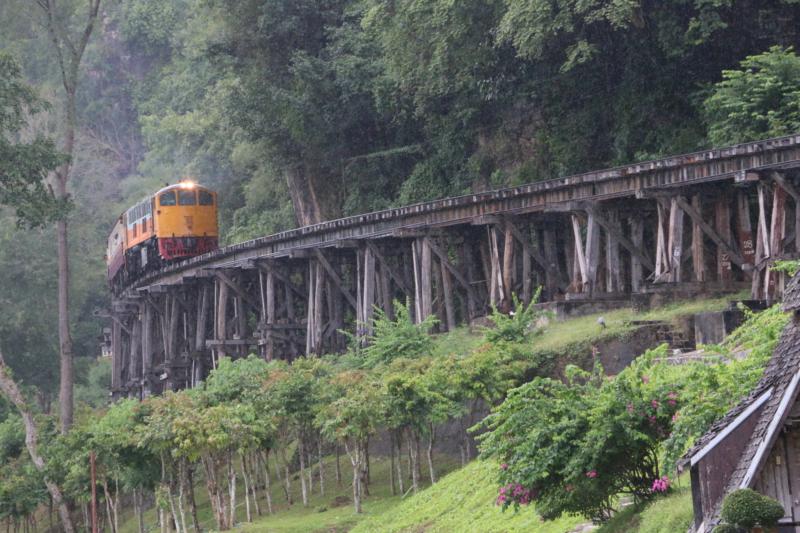
A small cave right beside the Death Railway, on the curve that hugs the cliff above the Khwae Noi River. Inside there's a Buddha image to pay respects to. This is the stretch where the railway was hardest to build and where the most POWs died. You can walk straight from Tham Krasae station along the tracks — the wooden trestle bridge skirting the cliff is one of Kanchanaburi's defining images.
Tham Than Lod Noi (Si Sawat)
Inside Chaloem Rattanakosin National Park, about a 200-metre walk from the car park. Inside there are stone columns, flowstone curtains, and a stream running through the whole way. You wade through shallow, cool water — good for anyone who likes a bit of adventure without it being too much.
Tham Than Lod Yai (Si Sawat)
In the same park as Than Lod Noi, this one stands out as a huge natural stone bridge, formed where a limestone hill collapsed and water carved out a cavity roughly 40–60 metres wide. Walk in and you feel tiny next to the size of the chamber.
Phra That Cave (Erawan Park)
Inside Erawan National Park, about 8 km from the waterfall itself. It gets its name from a stalagmite in the middle of the cave shaped like a chedi (phra that). Inside it's full of pretty stalactites and stalagmites — good to pair with an Erawan Waterfall day if you have your own vehicle.
About the boat to Lawa Cave
Lawa Cave means chartering a boat across the river, so going as a group makes the cost much more reasonable to split. Contact Pak Saeng pier ahead of time, or ask a resort around Sai Yok to help arrange it. Allow nearly two hours for the round-trip boat ride and don't set off too late in the afternoon.
Getting Ready to Explore Caves Safely
- Shoes with good grip — cave floors are slippery, with dripping water and wet rock. Sneakers or water shoes beat flat flip-flops.
- Torch or headlamp — some caves aren't lit all the way through, so a small light is reassuring to carry.
- Don't touch the formations — oil from your hands stops stalactites and stalagmites growing. Take photos, but don't touch.
- Check the season — in the rainy season, caves with streams may close or get difficult. Call the park before you set off.
- Phone signal — coverage is patchy in places around Thong Pha Phum and Si Sawat. Save offline maps.
How to Plan a Trip That's Worth the Drive
Sai Yok route (half-day to a day)
Take the train down to Krasae Cave, take in the cliffside views, then continue to Lawa Cave by boat across the river. Good for anyone who wants both history and caves in a single day.
Thong Pha Phum route (overnight)
Drive the long way out to Hindad Hot Spring and soak in the morning or evening. We'd suggest staying overnight around Thong Pha Phum, since it's a long way from town.
Si Sawat route (one day)
Enter Chaloem Rattanakosin park, walk Tham Than Lod Noi and Yai, and wade the stream inside the cave. You can pair it with Srinakarin Dam.
Here's the honest truth up front: these caves and hot springs are spread across different districts, far apart from each other. Don't expect to tick them all off in one day. Pick one zone per day and do it properly — you'll be less worn out and get more out of the atmosphere.
Plan a full Kanchanaburi trip across waterfalls, caves and history
See the Kanchanaburi travel guide →