📝 Written 1 Jul 2026 · ✅ Fact-checked 3 Jul 2026 · prices and schedules can change — check with the operator before booking
Before picking a trip, think through three things: how many days you have in Kanchanaburi, how much long car travel you can handle, and whether you want history, nature, or riverside chill. These four routes differ a lot in both distance and mood — some can be done in half a day, others take a full day, and Sangkhlaburi is far enough that it's barely worth it unless you stay overnight.
Overall, if you're coming for just one day and want to understand the story of this town, the history trail in the city center is the most convenient. If you want to cool off in nature, pick Erawan Falls. If you're traveling with family and want a riverside vibe along the Kwai, go with elephants plus rafting. And if you have two days or more and want to see a quieter, more culturally rich side of Kanchanaburi, head to Sangkhlaburi. The table below gives you the overview, then we break down each trip in detail.
| Trip | Known for | Travel time (from city center) | Best for | Price range |
|---|---|---|---|---|
| History trail (River Kwai Bridge + Death Railway + Hellfire Pass) | WWII history, riding the train along the cliffside | In town–Hellfire Pass ~1.5 hrs | History buffs with limited time, not focused on swimming | ฿900–1,800 (tour incl. transport) |
| Erawan Falls | 7-tier waterfall, emerald pools, swimmable | ~1.5 hr drive | Light hikers who want to swim and cool off | ฿900–1,500 (+ ฿300 foreign national park fee) |
| Elephant sanctuary + River Kwai rafting | Ethical elephant care (no riding) + raft stay/rafting | Around the city–Sai Yok ~40 min–1.5 hrs | Families, animal lovers, riverside-chill types | ฿1,800–3,500 (some overnight packages) |
| Sangkhlaburi (overnight) | Mon bridge, sunken temple, Mon way of life | ~3–4 hr drive (1 night recommended) | Travelers with 2+ days who love culture | ฿1,500–3,000 / trip (depending on lodging) |
Kanchanaburi History Trail Tour (River Kwai Bridge + Death Railway + Hellfire Pass)

If you only have one day in Kanchanaburi and want to understand why this town matters, the history trail is the first answer most people give. The main route follows the Thailand-Burma railway, built during World War II by the Japanese army using Allied prisoners of war and Asian laborers, tens of thousands of whom died in the process. Most full-day tours take you to walk across the River Kwai Bridge, then board a train from River Kwai Bridge station that runs along the original route through the Tham Krasae curve, where the tracks sit on a wooden frame clinging to a high cliff above the Kwai Noi river. Many programs also add Hellfire Pass, along with the Allied war cemetery and museum, letting you cover all the main historical sites in a single trip.
Based on real reviews across multiple platforms, people consistently praise the stretch of train riding along the cliffside as an unforgettable sight, and hearing the guide explain the history respectfully makes the trip feel more like a remembrance than a photo op. Hellfire Pass gets praise for its audio guide, which includes interview clips with former POWs at various points along the trail — walking while listening gives a deeper understanding of what happened there than reading plaques ever could. Compared with the other three routes, this trip's main advantage is that it's largely based in town, with short travel times, making it ideal for people with limited time.
The trade-off to accept: the bridge area gets crowded around midday, especially when a train pulls in. Kanchanaburi's weather is hot and sunny, and the train itself is a local service with hard seats and no air conditioning, running slowly and sometimes behind schedule. Hellfire Pass is also far out toward Sai Yok, and the walk back up is fairly steep. Some tours that pack in multiple stops in one day give relatively little time at Hellfire Pass — if you want to take it in properly, choose a program that clearly allocates enough time there, and behave respectfully since it's a memorial site, not just a fun photo spot.
- Covers all the main historical sites in one trip — the River Kwai Bridge, the Death Railway, and Hellfire Pass
- The Tham Krasae curve has the train running along a cliffside beside the river, a view many reviewers say they'll never forget
- Hellfire Pass has an audio guide with interviews from former POWs, giving deep historical context, and it's free to enter
- Main sites are in town, so travel is short — ideal for people with just one day
- The bridge area gets crowded around midday, with hot sunny weather and queues for photos
- The train is a local service with hard seats and no air conditioning, runs slowly, and is sometimes behind schedule
- Hellfire Pass is far out toward Sai Yok, the walk back is fairly steep, and some tours allocate too little time there
Erawan Falls 7-Tier Day Tour
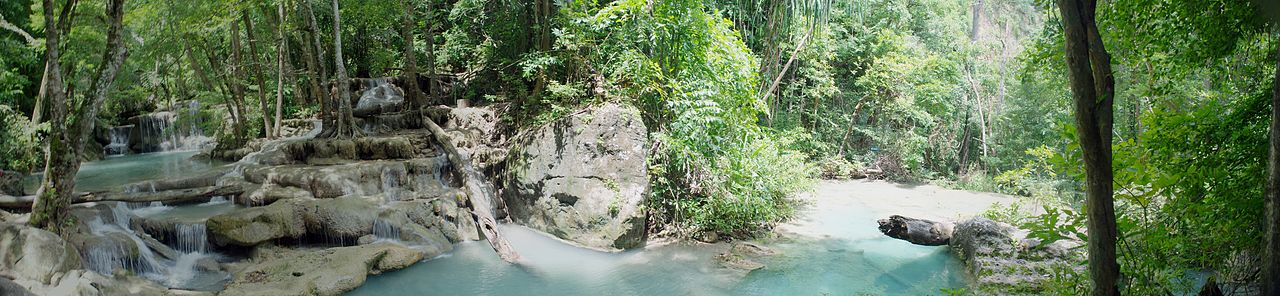
Erawan Falls is the inland nature highlight of Kanchanaburi that gets talked about the most. It sits within Erawan National Park in Si Sawat District, about an hour and a half from the city center. Most full-day tours include a van or shuttle from your hotel in town, with a guide on board, taking you up to walk the waterfall's 7 tiers across roughly 1,500 meters. Each tier has its own name and shape, and the most photographed spots are the middle tiers, where the water collects into wide, clear emerald pools formed by underwater limestone. Many tiers are swimmable, and tours usually include lunch and build in time to soak and cool off before heading back. Compared with the history trail, Erawan leans more toward fun and relaxation in nature.
Based on real reviews on Tripadvisor, Erawan Falls scores around 4.5 out of 5 from over 2,300 reviews. Most feedback praises the water as clearer and more beautiful than expected, with fewer people and quieter views the higher up you climb. Many say soaking in the cool water partway up the hike is the most memorable part. Guided tours get praise for taking care of logistics and sharing information along the way, so you don't have to worry about the route or timing yourself — ideal for people who don't want to drive themselves and want to cover the whole thing in one day.
What to know before booking, plainly: the national park entrance fee is charged separately from the tour price — foreigners pay around 300 baht, Thai nationals much less, and it's usually paid in cash on site. Also, plastic water bottles brought up must be deposited at the checkpoint and reclaimed on the way down, to prevent litter in the forest. The trail up to tiers 6–7 is fairly steep and slippery, with some sections requiring you to climb over rocks and grab roots, so wear shoes with good grip. Anyone with knee issues might want to stop around tier 4–5. Fish in the pools like to nibble at your feet, which startles a lot of people. Weekends get very crowded at the lower tiers, and the topmost tier is often closed off before the afternoon — staff start clearing people out from around 3:30 pm, so head out early if you want to reach tier 7.
- Water is a stunningly clear emerald green, more beautiful than expected, with several swimmable tiers to cool off in, as many reviews confirm
- The higher you climb, the fewer people and the quieter the views
- Guided tours include transport and lunch, so you don't need to drive or plan the timing yourself
- Leans fun and relaxing in nature — ideal for people who want to swim in a single day
- You'll need to pay the national park fee separately in cash on site (foreigners pay more than Thai nationals), plus a deposit for plastic water bottles
- The trail up to tiers 6–7 is steep and slippery, fish nibble at your feet, and weekends get very crowded at the lower tiers
- The topmost tier closes before the afternoon, so if you arrive late you may not make it to tier 7
Ethical Elephant Sanctuary + River Kwai Rafting / Raft Stay

This trip suits people who want both the charm of elephants and a River Kwai riverside atmosphere in one day. Kanchanaburi has several riverside sanctuaries built around the idea of "working for the elephants," with ElephantsWorld being one of the most talked-about examples. Founded in 2008 to take in elderly, sick, and rescued elephants from logging work or show camps, its principle is that people come to care for the elephants, not the other way around — so there's no riding and no shows. The program has you chop sugar cane and bananas to prepare food, hand-feed the elephants, make soft food balls for elderly elephants with poor teeth, and help scrub and bathe them in the River Kwai, with mahouts and staff present throughout. Many people extend the trip with rafting or staying overnight on a floating raft house in the Sai Yok area, where you can jump into the water right from your room and float along with the current in a life jacket.
Based on real reviews on Tripadvisor, this style of sanctuary averages around 4.8 out of 5, with many reviews ranking it among Kanchanaburi's top activities. Reviewers consistently praise the genuinely up-close time spent with the elephants — staff clearly care about the animals and explain each elephant's background well, lunch is generous, and the riverside setting is shaded and pleasant. The raft houses, such as River Kwai Jungle Rafts, score around 4.1 out of 5 from over 1,400 reviews, with guests noting the peaceful atmosphere, a sky full of stars at night thanks to no city lights, and activities like walking through a Mon village and watching a folk performance in the evening. This trip suits riverside-chill travelers and families with kids best out of the four routes.
What to know plainly: the elephant sanctuary is a full-day program outside town, so book several days ahead since spots fill quickly. There are stretches involving mud and bathing where clothes will definitely get wet and dirty, so bring a change of clothes. Some reviews note that the photo and feeding moments can feel a bit staged, and Tripadvisor itself doesn't allow bookings for hands-on elephant activities since they don't meet the platform's animal welfare standards. Many of the raft stays are intentionally rustic — some rooms have no electricity, or only during certain hours, cold water only, plenty of mosquitoes and insects, and some rafts host karaoke or parties with loud music late into the night. If you want quiet, be sure to specify a quiet raft zone when booking.
- The sanctuary doesn't allow riding or shows — you feed and bathe rescued elephants, with a rating around 4.8/5 on Tripadvisor
- Extend the trip with rafting or an overnight stay on a floating raft on the River Kwai, combining animals and nature in one day
- Shaded riverside setting, a sky full of stars at night on the raft, and genuine Mon culture with an evening folk performance
- The best fit for families with kids and riverside-chill travelers out of the four routes
- The full-day sanctuary program is outside town and should be booked well in advance; expect mud and bathing sessions that will definitely get your clothes wet and dirty
- Some reviews find the photo and feeding moments feel staged, and Tripadvisor doesn't allow bookings since it doesn't meet the platform's animal welfare criteria
- Many raft houses have only basic amenities — some rooms have no electricity, cold water only, plenty of mosquitoes, and some host loud parties late into the night
Sangkhlaburi Trip — Mon Bridge + Sunken Temple (overnight)

Sangkhlaburi is a whole other world within Kanchanaburi, tucked in the far west near the Myanmar border. It's about a 3–4 hour drive from Kanchanaburi city on a winding mountain road, making it nearly impossible to do as a worthwhile day trip. Most people stay at least one night. The highlight is the Mon Bridge (Uttamanusorn Bridge), the longest wooden bridge in Thailand, stretching across the reservoir above the Vajiralongkorn Dam and connecting the Thai community with a Mon village on the other side. In the early morning, monks go on almsround and Mon locals make offerings on the bridge — a scene many travelers set an alarm to catch. Another highlight is Wat Wang Wiwekaram, home to a large golden Buddhagaya-style pagoda, plus the remains of an old chapel submerged when the dam was built. In the dry season, when water levels drop, the chapel's spire rises above the surface, and you can take a boat out for a closer look.
Based on real reviews on Tripadvisor, the Mon Bridge and the Sangkhlaburi area score around 4.5 out of 5. Reviewers consistently praise the peaceful, quiet atmosphere, a contrast to the more crowded Kanchanaburi city center — Mon community life here still feels genuine and warm, the morning market has authentic Mon food to try, and sunrise over the reservoir with light morning mist is a scene many say is worth the long drive. This trip stands apart from the other three routes by offering more culture and calm, suiting people who want to escape the bustle and have enough time to spare.
The trade-off to accept, plainly, is the distance. The 3–4 hour drive on winding mountain roads can easily cause motion sickness, so bring medication, and if you don't have your own car you'll need to rely on the limited Kanchanaburi–Sangkhlaburi van service. The wooden Mon Bridge itself has been damaged and repaired several times, so walk carefully, especially when it's crowded. To clearly see the sunken temple's spire above the water, you need to visit in the dry season — during the rainy season, high water may make it hard to see or reach at all. Also, Sangkhlaburi is still a small town, so lodging and restaurants are simple; anyone expecting big-city convenience should adjust their expectations.
- The longest wooden Mon bridge in Thailand — at dawn, monks go on almsround and Mon locals make offerings, a scene many travelers set out specifically to see
- Wat Wang Wiwekaram has a golden Buddhagaya pagoda and a sunken temple you can view by boat, unlike anywhere else in Kanchanaburi
- A quiet, peaceful atmosphere with genuine Mon culture, unlike the more crowded city center, as many reviews note
- Sunrise over the reservoir with light morning mist, which many say makes the long drive worth it
- It's far — a 3–4 hour drive from the city on winding mountain roads, practically requiring an overnight stay; not suited to a single-day trip
- The winding road can easily cause motion sickness, and without your own car you'll need to rely on limited van departures
- The sunken temple is only clearly visible in the dry season, and amenities in this small town remain simple
Quick summary: which trip should you pick
If you have just one day and want to understand the town's story, pick the history trail. The River Kwai Bridge, Death Railway, and Hellfire Pass are all located in town and Sai Yok, with shorter travel times than the others, giving you both the scenic cliffside train ride and a moving war memorial.
If you want to cool off swimming in nature, go to Erawan Falls. The seven-tier emerald pools are genuinely swimmable — just head out early, avoid weekends, and budget for the park fee and the climb up the higher tiers.
If you're traveling with family or love animals and a riverside vibe, choose the elephant sanctuary plus rafting. You get ethical elephant care without riding, followed by a stay on a floating raft — the most relaxed trip and the best fit for kids. Just choose a sanctuary with a clear ethics policy and specify a quiet raft when booking.
If you have two days or more and want to see a quieter, more culturally rich side, go to Sangkhlaburi. The Mon Bridge, the sunken temple, and Mon culture are worth it if you don't mind the long drive and are willing to stay overnight — but it doesn't suit a single-day trip.
Book activities & tickets in advance
Popular day tours and activities in Kanchanaburi fill up fast — booking online ahead of time is more convenient.
Where to stay in Kanchanaburi?
Choose a well-located hotel, near the city center or a riverside raft house along the Kwai — compare prices across 3 sites before booking.
Search hotels on AgodaOnce you've picked the right trip, don't forget to book a well-located hotel as your base. See price-compared hotels here.
See well-located Kanchanaburi hotels →