🔄 Updated 21 Jun 2026
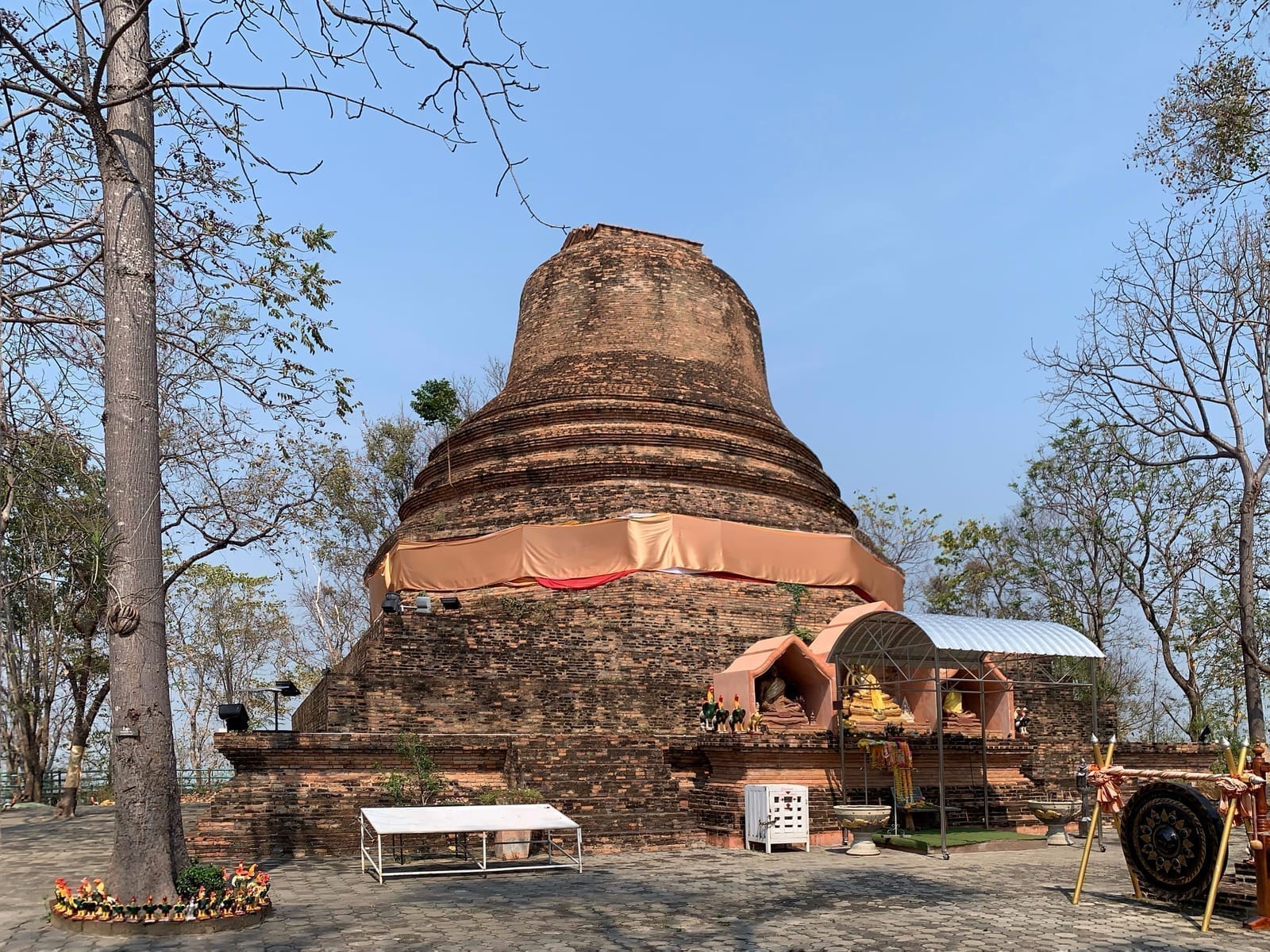
If you're in Phitsanulok and want to do both — make merit and get some view photos — in one place, without an hour-long drive up a mountain, Khao Samo Khaeng works well. The hill rises only a little over 200 metres off the plain, a small limestone outcrop in the middle of flat country, so you get an easy, open view of the town and the rice fields around it. The big draw is that there's plenty to see up top: an old temple, a centuries-old stupa, a Chinese shrine, and a sideways Buddha footprint that's said to be the only one of its kind. You can pay your respects at all of it in a single morning.
What Khao Samo Khaeng is like
Khao Samo Khaeng sits in Wang Thong sub-district, Wang Thong district — a single limestone ridge running north–south, standing alone in the river plain. Locals have a long attachment to the place, because it's both somewhere to make merit and somewhere to exercise. Mornings and evenings you'll see plenty of people walking, running, and cycling around the base of the hill. On Buddhist holy days or long weekends, more people than usual head up to pay their respects.
There used to be several old temples on the hill. The ones still in use and the main stops people make today are Wat Phra Phutthabat Khao Samo Khaeng (with a naga staircase up to the Buddha footprint), the broken-top stupa on the summit, the Sai Thi Huk Tueng Chinese shrine, and the white jade Guanyin. They're all in the same area, an easy walk or short drive apart.
Want more out of Phitsanulok? Book tours & activities
Booking online ahead on Klook or GetYourGuide is usually cheaper than the gate and skips the queue. Pick only the experiences you actually want — prices and availability are shown live on each site.
The spots worth stopping for on the hill
Naga staircase + sideways Buddha footprint
The highlight of Wat Phra Phutthabat Khao Samo Khaeng. The naga staircase runs 197 steps up the eastern foot of the hill to a sideways Buddha footprint set into the rock face — a vertical footprint said to be the only one of its kind, larger than a person. The climb is a little tiring, but there are rest points along the way.
Broken-top stupa (Khao Samo Khaeng summit)
A centuries-old stupa on the summit. Its top broke off over time, so people call it the broken-top stupa; it's believed to have been built in ancient times to hold the relics of an important senior monk. This is the most open city view on the hill — you can see the rice fields and town far off, and it's good for photos in the early morning or late afternoon.
Sai Thi Huk Tueng Chinese shrine
A Mahayana Chinese shrine built by Chinese immigrants, decorated throughout in Chinese style, with pretty red-and-gold corners for photos. It gets especially lively during the vegetarian festival, when free vegetarian meals are sometimes handed out.
White jade Guanyin
A Guanyin figure carved from white stone, in the same area as the cluster of Chinese shrines. People come to pray for health and compassion. There's a garden and a few benches around it, and it photographs well in soft light.
Abandoned temples and old stupas around the hill
Beyond the main stops, the area around the hill still has traces of old temples and ancient stupas scattered about. If you're into history, it's worth exploring on foot — it's quiet, plenty of shade, and good for an unhurried wander.
Tip
For a good city view, head up to the summit before 9 a.m. or in the late afternoon near sunset — the light is softer and it's not as hot. The naga staircase gets harsh midday sun, and the climb up is more tiring than it looks.
Viewpoints and photo spots
The appeal of Khao Samo Khaeng is that it's a low hill in the middle of the plain — climb up just a little and you get a wide view of the town. There are several spots people like to shoot.
- The summit near the broken-top stupa — the most open spot, with the rice fields and the town of Phitsanulok off in the distance; good for a wide view.
- Halfway up the naga staircase — turn back and look down to see the naga running all the way down, a favourite angle for anyone who likes architectural lines.
- The Chinese shrine courtyard — red-and-gold tones against the sky give a Chinese feel, good if you like bold colour.
- Around the foot of the hill — the shaded walking and cycling path that skirts the base, easy for nature shots.
How to get there, hours, costs
- Distance — about 17 km from the centre of Phitsanulok, heading toward Wang Thong district, roughly a 25–30 min drive.
- Getting there — easiest by your own car or a rented car/motorbike. There's a car park at the bottom, and at some spots on the hill you can drive up and park close by.
- Hours — you can generally go up to pay your respects during the day, roughly 8 a.m. until evening. Mornings are cooler and more comfortable.
- Entry — no entry fee; make merit as you wish (bring some cash for the alms bowl/donation box).
- Dress — it's a temple, so dress modestly and wear shoes that are easy to climb stairs in.
Worth knowing before you go
During the annual Buddha-footprint homage (around February, on Makha Bucha day) it gets especially crowded and there's a market. If you like a temple-fair atmosphere, come then; if you want quiet, you'll have an easier time avoiding that day.
Where to eat nearby after the temple
The Wang Thong side around Khao Samo Khaeng has several cafés and restaurants out in the fields that are genuinely open — easy to stop and rest at after the temple.
Kafae Klang Na Lung Som
A café out in the rice fields near the entrance to Wat Khlong Ruea, with wood-fired pizza and homestyle steak in an open, easygoing setting. Open roughly 10 a.m. to 8 p.m.
Wonthara Riverside Café
A café and resort by the water among the trees, shady and relaxed, with a play area for kids — good for a family stop.
Eateries along the Wang Thong road
On the way back into town there are several local noodle shops and made-to-order restaurants. If you want a proper meal, it's easy to find a spot.
An unhurried half-day at Khao Samo Khaeng
Pay your respects + take in the view
Coffee break
Want a full-day Phitsanulok plan, including Wat Yai and the best local food
See the Phitsanulok travel guide →