🔄 Updated 21 Jun 2026
This plan is written for people who want nature first, not a cafe photo trip. So we spend as much time as possible inside Khao Yai National Park and route the day around real wildlife behavior: most animals feed at dawn and dusk, and during the harsh midday sun they retreat into the shade. Building the day as blocks means you don't miss the golden windows. You'll mostly use your own car, because there's no public transport between spots inside the park and the stops are several kilometers apart. If you don't have a car, you can hire a songthaew or van up from Pak Chong.
Why Build It as a Block Day
The heart of a Khao Yai nature trip is timing, not the number of stops. Get the timing wrong and you could drive past every highlight without seeing a single animal. So we slice the day into 3 windows, each doing what actually suits that time of day.
- Morning block (06:00–11:00) — cool air, birds and gibbons calling, best for hiking and birdwatching, and the sun isn't harsh yet.
- Midday block (11:00–15:00) — animals are in the shade and the sun is strong, the best window for the waterfalls and a lunch break.
- Evening–night block (15:00–20:00) — deer and hoofed animals come out to graze on the grassland, followed by the night wildlife drive that's the highlight of this forest.
Understand the Fees and Timings First
Park entry for Thai adults is 40 THB, children 20 THB, plus a vehicle fee of 30 THB (motorbike 20 THB). The gate opens to vehicles around 06:00 and stops admitting in the evening, but if you've booked the night wildlife drive you can stay later. Try to enter before early afternoon so you have the full day to work with.
Book the activities in your Nakhon Ratchasima trip ahead
Booking online ahead on Klook or GetYourGuide is usually cheaper than the gate and skips the queue. Pick only the experiences you actually want — prices and availability are shown live on each site.
Morning Block — Pha Kluai Mai Trail, Birds & Gibbons
Start the day with a hike right as the forest wakes up. The most beginner-friendly route is the Pha Kluai Mai–Haew Suwat trail, about 3.4 kilometers. It follows the Lam Takhong stream from the Pha Kluai Mai campground and ends at Haew Suwat waterfall, taking around 2 hours. Most of it is gentle slope and dirt path with no steep climbs, so you can walk it on your own without a ranger. Early in the morning you've got a good chance of spotting several bird species and hearing gibbons whooping from the treetops — and if you're lucky, a hornbill flying past.
Hike + Small Pha Kluai Mai Waterfall
Leeches and the Rainy Season
In the rainy season (June–October) the trails are thick with leeches. Tuck your pant cuffs into your socks or wear leech socks, and carry balm or salt. Leeches aren't dangerous, but they'll startle you if you've never dealt with them. In the dry season there are almost none, but the waterfalls run lower.
Midday Block — Waterfalls and Lunch
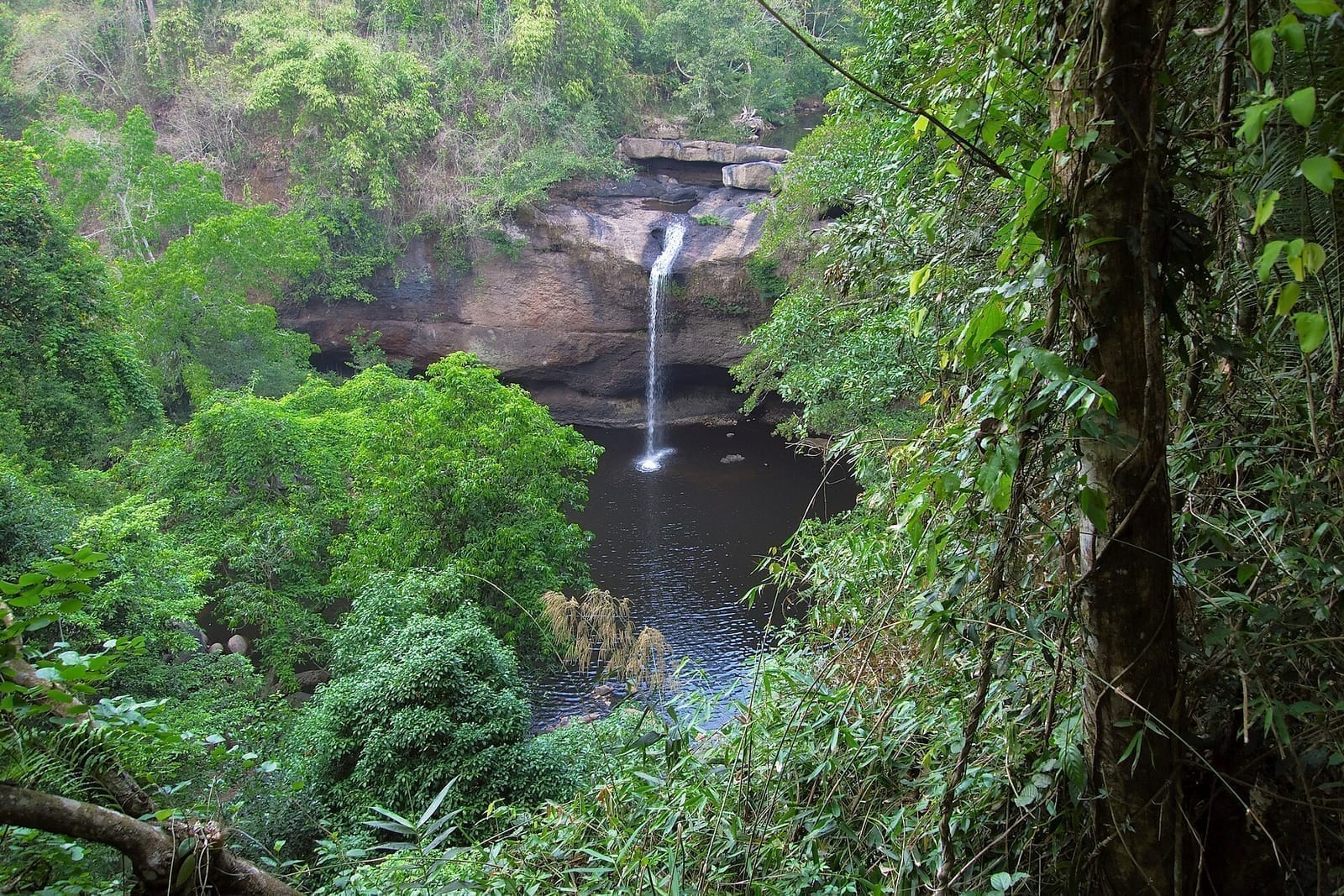
From late morning into the afternoon the sun is strong and the animals are in the shade — the best window for the waterfalls. Haew Suwat is a single-tier fall about 20 meters high, a short walk down from the parking lot. You can swim in the pool below when the flow is gentle, especially in the dry season when the water is clearer and safer. If you want to add a bigger waterfall, drive to Haew Narok, a 3-tier fall over 150 meters high — but this one is for viewing only, never go down.
Haew Suwat + Haew Narok + Lunch
What You Need to Know About Swimming
Haew Suwat floods quickly if there's rain upstream — the water can rise hard and turn muddy within minutes. Always watch the warning signs and listen to the rangers. Don't swim into the middle of the current or near the cliff edge. If the water turns muddy or starts flowing unusually fast, get out immediately. As for Haew Narok, never go in under any circumstances — there have been accidents from getting too close to the cliff.
Evening Block — Nong Pak Chi Grassland, Waiting for Animals
This is the part nature lovers wait for. The Nong Pak Chi grassland is a wide savanna in the middle of the forest, with a watchtower you can climb to sit and wait. In the soft evening light, wild deer and hoofed animals come out to graze, and sometimes you'll spot a wild elephant passing in the distance. The trick is to climb the tower and stay quiet — sit still, don't make noise, don't pace around, because the animals are very sensitive to sound and movement. Nong Pak Chi is set back from the main road and you have to walk in a fair way from the parking area, so leave extra time and bring a flashlight for the dark walk back.
- Golden window — around 16:30–18:00, when the light softens and animals start coming out; arrive early to climb the tower and wait quietly.
- Animals you might see — wild deer, barking deer, wild boar, many bird species, and on some days a wild elephant along the edge of the grassland.
- Key rules — no loud noise, no feeding the animals, no flash photography of wildlife, and carry your trash back out yourself.
- What to bring — a windbreaker, mosquito repellent, a flashlight, and the patience to wait. Animals don't show up on schedule.
What to Do If You Meet a Wild Elephant on the Road
In the evening and at night there's a chance of meeting a wild elephant on the park roads. If you do, switch off your engine or slow down, keep your distance, don't honk, don't shine flash or high beams in its eyes, don't get out of the car, and don't try to squeeze past. Wait until the elephant moves off on its own before continuing. If the elephant walks toward you, reverse slowly to open up more space.
Night Block — Night Wildlife Drive (the Highlight)
The activity that sets a Khao Yai nature trip apart is the night wildlife drive. Rangers run a high-railed pickup truck with a guide holding a powerful spotlight, taking you along a route the park sets, about 10 kilometers long and roughly 1 hour. The animals you'll usually see are deer, barking deer, wild boar and civets — and if you're lucky, an elephant or something rarer. The animals' eyes reflect the light as glowing points in the dark. Kids and adults find it equally thrilling.
- Price — around 600 THB per truck, seating up to 8 people, so the per-head cost drops if you come as a group.
- Booking — book at the visitor center before 18:00 on the day you want to go. Weekends fill up fast, so book early in the day.
- Timing — departures from around 19:00 onward, roughly 1 hour per run.
- What to bring — a warm jacket or windbreaker, because the truck is open and the forest is cold at night; keep your phone screen off, stay quiet and no flash.
Dinner + Night Wildlife Drive
To See More Animals
Your odds depend on the season and how quiet your group is. From the rainy season into early winter the grass is green and animals come out more. Groups that sit quietly and keep their phone screens off see more than groups chatting loudly. Don't expect an elephant every run — some nights you'll only see deer and a civet, and that's still the full night-forest experience.
Adjusting the Plan to the Time You Have
The full block-day plan suits people staying overnight or with a full day through the evening. If you have less time or different needs, adjust like this.
Only One Day, No Overnight
Cut the night wildlife block, keep the morning hike, midday waterfalls and evening Nong Pak Chi grassland, then leave the park before the gate closes.
All-In on Wildlife
Stay in the park or near the gate, book the night drive, and wake before dawn to hit the grassland for another round of animals before the hike.
Coming with Young Kids
Cut the long hike, focus on the short walk to Haew Suwat, the Nong Pak Chi grassland and the night drive that thrills kids, and skip the steep Haew Narok path.
Serious Hikers
Add a longer trail that requires a ranger, such as the Kong Kaew–Nong Pak Chi route, and book a park guide in advance.
Where to Stay for a Nature Trip
- Park lodge or campsite inside Khao Yai: wake up to mist and animals right away, closest to the wildlife drive, but you have to book ahead through the park reservation system, and weekends fill up very fast.
- Thanarat Road (Khao Yai): closest to the park gate, easy in and out, resorts at every level — good for people who want an early start into the forest but don't want to camp.
- Pak Chong town: budget-friendly stays near restaurants and markets, good for tight budgets, but the drive to the gate is a bit longer.
- Mu Si zone: lots of mountain-view resorts with a nice atmosphere, good for people who want a pretty stay alongside their forest trips.
Straight Talk
Nature guarantees nothing. Some days you hike all morning and only hear birds, or do a whole wildlife drive and see just two or three deer — that's just how a real forest works. What makes it worth it is the atmosphere, the air and the quiet, not the number of animals you can count. If you came to photograph animals up close like at a zoo, Khao Yai may not be your thing. But if you came to experience a real forest, this is the place.
Want a full Korat–Khao Yai trip plan — where to stay, eat and explore? See the city guide.
See the Nakhon Ratchasima guide →