🔄 Updated 21 Jun 2026
Waterfalls are one of the first reasons people drive up to Khao Yai. This forest is the headwaters of the Lam Takhong river and several other streams, so in the rainy season the water pours hard across the rock face, while in the dry season there's less of it but it's easier and safer to get in. The three most popular falls are Haew Suwat (easy walk, you can swim), Haew Narok (the tallest in the park, view-only) and Pha Kluai Mai (a small fall along a hiking trail and a good birdwatching spot). Plan your route well and you can hit all three in a single day without driving in circles.
Haew Suwat — the popular fall where you can swim
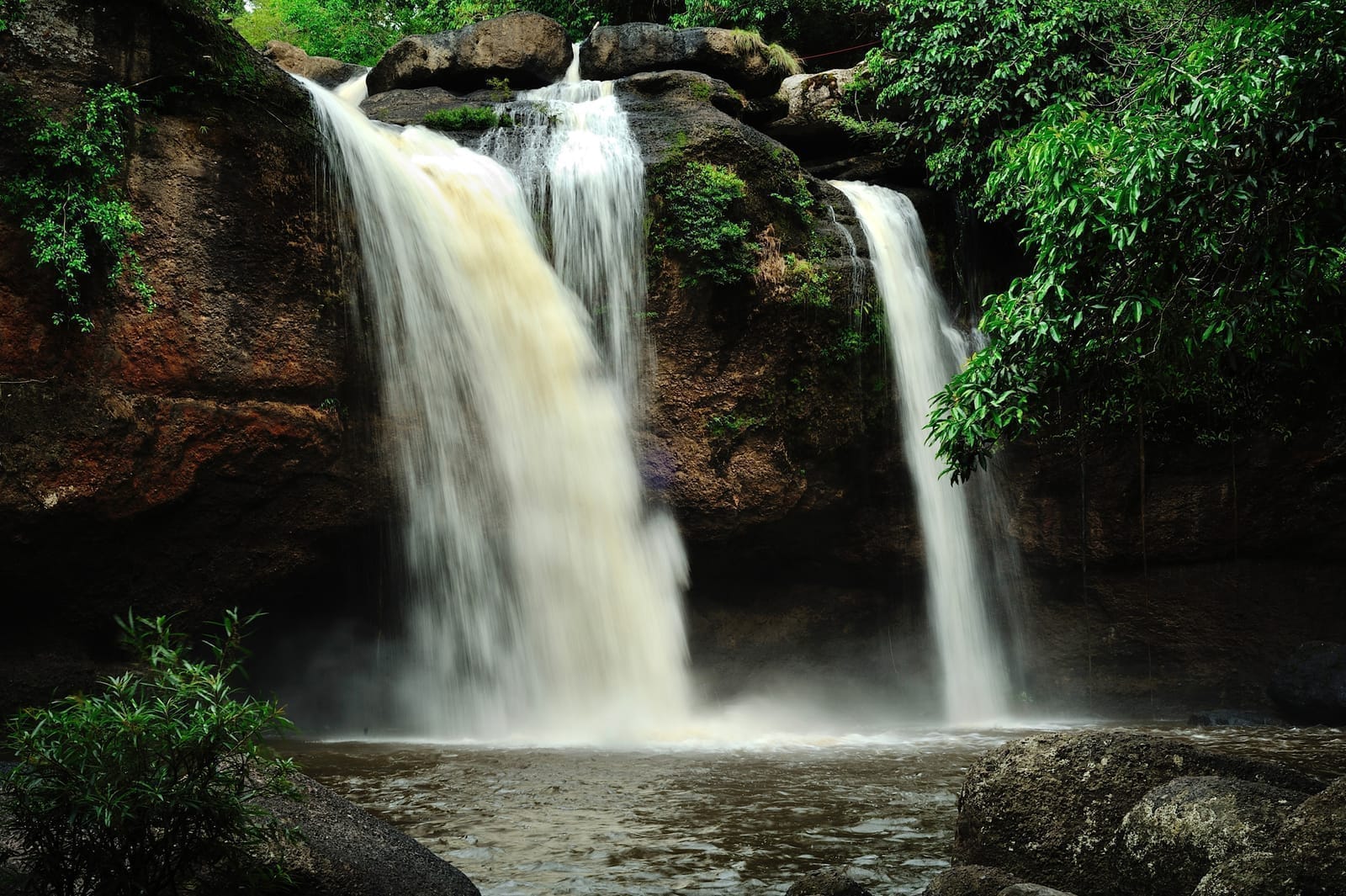
Haew Suwat is the best-known waterfall in Khao Yai. It's a single-drop fall plunging around 20 metres off the cliff into a wide pool below. The draw is that it's a short, easy walk from the car park on a comfortable path, so it suits families and anyone who doesn't want a long hike. If you've seen the Hollywood film The Beach, the waterfall in the cliff-jump scene was shot here. These days you can swim in the lower pool when the current is gentle, but never climb or jump from the cliff.
- Walking distance — from the car park it's a short staircase and path, just a few hundred metres to the falls. Kids and older walkers can manage it.
- Swimming — you can get into the lower pool when the current is gentle. The dry season (Nov–Apr) is best because the water is clear and not flooding.
- Photos — the spot facing the falls is the park's most popular photo angle. Go early for fewer people and nicer light.
- Facilities — there are toilets and shops near the car park.
What to know before you swim
Haew Suwat floods faster than it looks. In the rainy season the water can rise hard and turn muddy within minutes if it's raining upstream. Always check the water-level warning signs, listen to the rangers, and don't get into the middle of the flow or close to the cliff. If the water turns muddy or starts running unusually fast, get out immediately.
Want more out of Nakhon Ratchasima? Book tours & activities
Booking online ahead on Klook or GetYourGuide is usually cheaper than the gate and skips the queue. Pick only the experiences you actually want — prices and availability are shown live on each site.
Haew Narok — the tallest fall, view-only
Haew Narok is the tallest and most dramatic waterfall in Khao Yai, a three-tier fall dropping more than 150 metres in total. The top tier plunges into a deep ravine that's genuinely hair-raising to look down. From the car park you walk down a path for about 1 km to reach the viewpoint, on steps and fairly steep slopes — easy going down, but a workout on the way back. You absolutely cannot swim here: the cliffs are high, the rocks are slippery and the current is strong, and there have been accidents in the past. View it only from the railed-off point.
- Walking distance — about 1 km from the car park to the viewpoint, on steps and steep slopes. Save some energy for the climb back.
- Swimming — absolutely not. View from the railing only; the rocks there are very slippery.
- Best time — rainy season through early winter (Jul–Nov), when the water fills the cliff face and mist hangs in the air. The view is at its most spectacular then.
- Who it suits — people who love big natural views and can handle the walk. Not ideal if your knees are bad or you're with very young children.
Pha Kluai Mai — a small fall along the trail
Pha Kluai Mai is a small waterfall tucked along a hiking trail. The name comes from the wild orchids that once grew on the rocks beside it. Its charm isn't size but the shaded, evergreen-forest atmosphere, and the fact that it's one of the park's better birdwatching spots. Early in the morning you've got a good chance of spotting several bird species, and sometimes you'll hear gibbons calling. Most people reach Pha Kluai Mai by walking the nature trail that connects to Haew Suwat, rather than driving straight to the falls.
The Pha Kluai Mai–Haew Suwat trail, 3.4 km
This is Khao Yai's most popular trail for beginners. It runs about 3.4 km, starting from the Pha Kluai Mai campground, following the Lam Takhong stream and finishing at Haew Suwat waterfall. It takes around 2 hours to walk. Most of it is gentle paved and dirt path that isn't steep, passing through a mix of moist and dry evergreen forest. You get a small waterfall, a birdwatching spot, and a big waterfall to finish — all on one trail. You can walk it yourself without a ranger guide.
- Distance and time — about 3.4 km, around 2 hours one way, not counting stops for photos and swimming.
- Difficulty — easy to moderate, good for beginners. Most of it is flat, with a few stream crossings and rocky bits.
- Start and finish — starts at the Pha Kluai Mai campground and ends at Haew Suwat. They're different points, so plan your parking or pickup carefully.
- What to bring — drinking water, sneakers or hiking shoes with good grip, a rain jacket, and insect repellent.
- Best time to walk — set off in the morning when it's cool, the sun is soft, and you're more likely to see birds.
Leeches in the rainy season
In the rainy season (Jun–Oct) the trail is full of leeches. Wear leech socks or tuck your trouser cuffs into your socks, carry salt or balm, and don't stand still too long in damp spots. Leeches aren't dangerous, but they'll give you a fright if you've never met one. In the dry season there are almost none, but the waterfalls run lower.
Which waterfall should you choose?
If your time is limited or you're with kids and older folks, make Haew Suwat your main stop because it's an easy walk and you can swim. If you want a big natural view and can handle the walk, add Haew Narok. And if you're into hiking and birdwatching, the Pha Kluai Mai–Haew Suwat trail is your answer.
Haew Suwat
An easy few-hundred-metre walk where you can swim when the current is gentle. Good for families and anyone who wants a pretty waterfall photo without the effort.
Haew Narok
Khao Yai's tallest fall, three tiers over 150 metres. About a 1 km walk down, view-only and no swimming, but the view is worth the legwork.
Pha Kluai Mai
A small fall in the evergreen forest and a good birdwatching spot, reached by the hiking trail. Good for nature lovers who like the quiet.
When the waterfalls look their best
Khao Yai's waterfalls change character clearly with the seasons. Match your timing to what you want and you'll get more out of the trip.
- Rainy season (Jun–Oct) — water fills the cliff face and Haew Narok is at its most spectacular, but Haew Suwat runs fast and muddy with limited swimming. Lots of leeches, afternoon rain, slippery paths.
- Late rainy / early winter (Nov) — the most balanced time. Still plenty of water but starting to clear, cool air, crowds picking up but not at peak.
- Winter (Dec–Feb) — the best weather, with morning mist, but very crowded, especially on long weekends. Water starts to drop.
- Dry season (Mar–May) — clear, low water. Haew Suwat is at its best for swimming, but Haew Narok won't look as dramatic as in the rainy season.
All three waterfalls in one day
With a single day you can still cover all three falls, arranged by the actual route so you don't drive back and forth. Here's a plan: hike in the morning, swim midday, finish with the viewpoint in the afternoon.
Hike Pha Kluai Mai, swim at Haew Suwat, view Haew Narok
Stay overnight and add a hike and wildlife spotting
Getting to the waterfalls
All three waterfalls are inside Khao Yai National Park. The main entrance is the Pak Chong gate on the Nakhon Ratchasima side. From Bangkok it's about 2.5 to 3 hours by car via the motorway and then the Mittraphap road. The key thing is that there's no public transport between sights inside the park, and the waterfalls are several kilometres apart, so having your own car or a hired one is by far the easiest.
- Self-drive — the most convenient. From Bangkok take the motorway, then the Mittraphap road into Pak Chong, then Route 2090 (Thanarat) through the Pak Chong gate.
- Hire a car in Pak Chong — come by coach, van or train to Pak Chong, then charter a songthaew or van up to the park. Good if you don't have a car.
- Car with driver — available in Pak Chong, good for people flying in or arriving by public transport.
- Distances inside the park — Haew Suwat and Haew Narok are in different zones from the gate. Allow about 20–40 min of driving between sights.
The honest truth before you go
- Yes, you can swim at Haew Suwat — but not every day and not every season. In the rainy season the water runs fast and muddy, and rangers may close it. Don't push it.
- Haew Narok is strictly no swimming. There have been accidents from people getting too close to the cliff. View it from the railing only.
- On long weekends the famous falls get very crowded and the car parks fill fast. If you can, go on a weekday or arrive early for an easier time.
- The Pha Kluai Mai–Haew Suwat trail starts and finishes at different points. If you drive yourself, plan your drop-off and pickup carefully.
- Always pack out your own rubbish, and never feed the monkeys or wildlife around the waterfalls — it's dangerous and against park rules.
Plan a full Khao Yai–Korat trip — where to stay, eat and explore
See the Nakhon Ratchasima travel guide →