🔄 Updated 21 Jun 2026
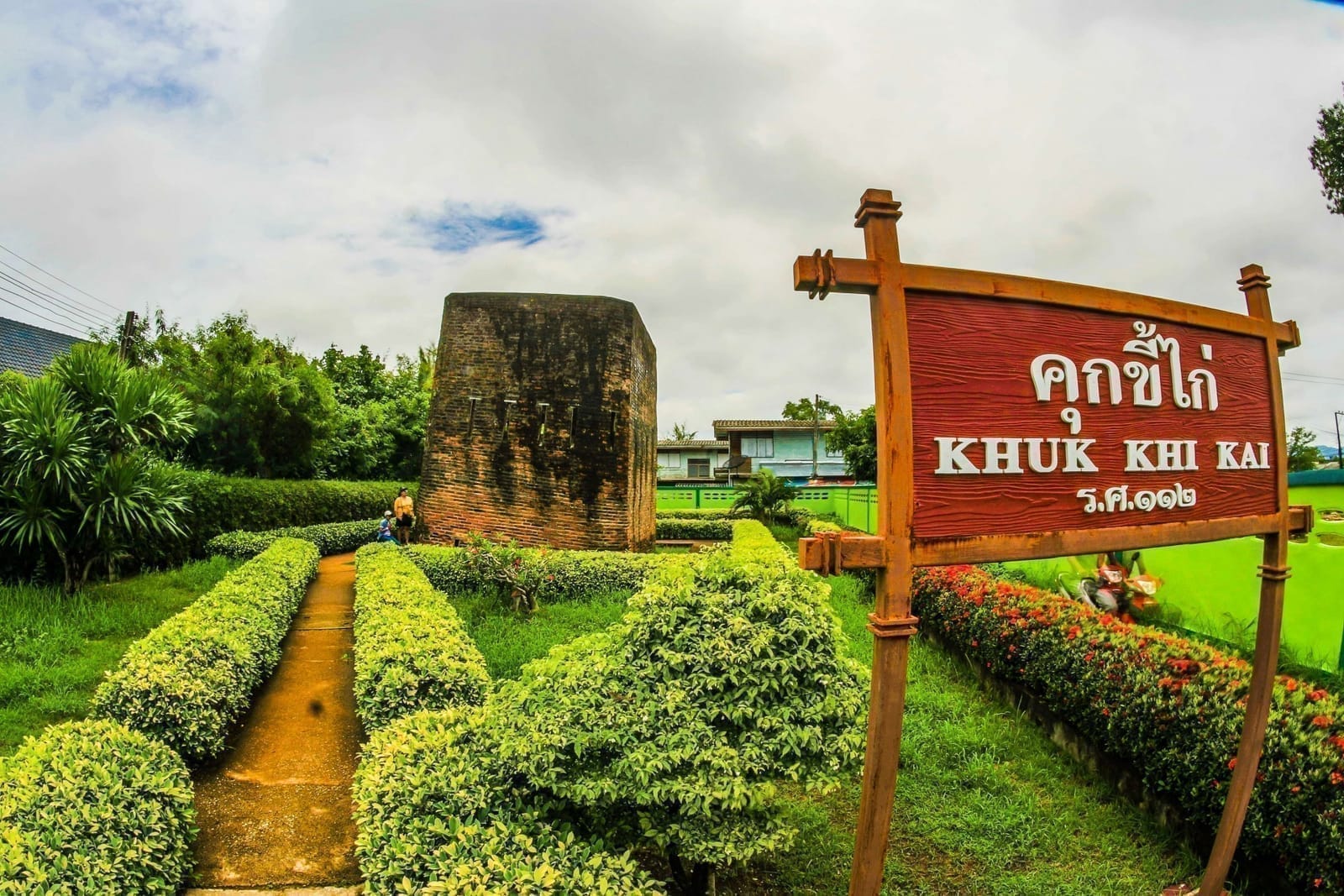
Drive south from Chanthaburi town toward the coast for about 30 kilometers and you reach the mouth of Laem Sing, where the Chanthaburi River flows out into the Gulf of Thailand. This spot has been the town's seaward gateway since the reign of King Rama III, and it's where the French chose to base their forces when they took over Chanthaburi. What's left to see today is Khuk Khi Kai, a square red-brick fort, and Tuek Daeng (the Red Building), which the French used as their command post. The two sit only about 200 meters apart — an easy walk between them.
What was R.S. 112, and why did the French occupy Chanthaburi?
R.S. 112 corresponds to B.E. 2436, or 1893. By then France had already colonized Cambodia and was pressing its claim over the territory on the left bank of the Mekong, which led to a clash at the mouth of the Chao Phraya River. Siam had to give in to France's demands, and France asked to hold Chanthaburi as a security until Siam fulfilled the terms of the agreement in full. French troops were stationed in Chanthaburi for 11 years, from 1893 to 1904, before withdrawing under a later treaty that traded the town back to Siam.
Worth keeping in mind
The years France held Chanthaburi were years the local people lived under a foreign army on their own soil. So Khuk Khi Kai and Tuek Daeng aren't just photogenic old buildings — they're physical evidence of one of the most tense chapters in the town's history.
Want more out of Chanthaburi? Book tours & activities
Booking online ahead on Klook or GetYourGuide is usually cheaper than the gate and skips the queue. Pick only the experiences you actually want — prices and availability are shown live on each site.
Khuk Khi Kai — a small fort with a name you won't forget
Khuk Khi Kai is a square red-brick fort, roughly 4.4 meters wide and 7 meters tall, with narrow slit openings running in two tiers for ventilation and to watch what's outside. The name — which translates as "chicken-dung prison" — comes from a brutal method of imprisonment: prisoners were locked on the lower floor while chickens were kept on the floor above. The divider between the two levels was an open grille, so chicken droppings fell onto the people below the whole time — a way of torturing prisoners who resisted the French. That's how the name Khuk Khi Kai stuck with the people of Chanthaburi to this day.
The Fine Arts Department restored Khuk Khi Kai in 1972 and registered it as an ancient monument. The fort still stands intact today, with information boards telling its story, and you can walk around the outside for photos. Inside is a small bare room — you only need a few minutes to see it — but standing in there and picturing what once happened gives you a different feeling than reading about it in a book.
- What it is — a square red-brick fort, two stories tall, with rows of slit openings in the walls
- Original purpose — both a gun fort guarding the river mouth and a place to hold political prisoners
- Condition today — restored and open to visitors as a historical learning site
- Time needed — about 15–20 minutes to walk around
Tuek Daeng — the French command post by the river
About 200 meters from Khuk Khi Kai, over toward the ferry pier, is Tuek Daeng, a single-story brick building painted red — hence the name — with arched verandas in colonial-era style. The French built it in 1893 on the site of the old Phikhat Patchamit fort, originally raised in the reign of King Rama III to defend against the Vietnamese, tearing down the old fort's bricks to construct the new building. It served as quarters for officers and the garrison guarding the mouth of Laem Sing throughout the occupation.
After the French withdrew, Tuek Daeng changed hands and was used for many things, including a library and a non-formal education center for Laem Sing district. It was restored in 1984 and now houses a small museum telling the story of R.S. 112 and life around the mouth of Laem Sing. The building sits right on the river beside the pier, where the sea breeze keeps it cool — a good spot for photos both in the morning and in softer late-day light.
Photo tip
The building's red-brick walls glow with warm tones when the sun comes in at an angle in the morning or late afternoon. Avoid midday, when the harsh light flattens the photos and the heat is too much. Come in the late afternoon and you can walk on to catch the sunset at Laem Sing beach right after.
How to get there, opening hours, and entry fee
From Chanthaburi town, take Sukhumvit Road toward Khlung district, then turn onto Highway 3149 heading to the mouth of Laem Sing. Carry on almost to the end of the road and Khuk Khi Kai will be on your right just before the Sing Amnuai ferry pier. Continue about 200 meters more and Tuek Daeng is on the left near the pier. It's around 30 kilometers from town in total — about a 35–40 minute drive.
- Distance — about 30 km from Chanthaburi town, a 35–40 minute drive
- Entry fee — free for both Khuk Khi Kai and Tuek Daeng
- Parking — there's a lot out front, but it's not large; expect a wait on weekends
- Getting around — driving or a motorbike is easiest; there's no public transport right to the door, so renting a vehicle in town is the way to go
On opening hours, let's be straight: this isn't a big museum with fixed times. Khuk Khi Kai is an open-air monument you can walk around during daylight. Tuek Daeng, on the other hand, is sometimes open and sometimes closed depending on the staff on duty. If you want to be sure of getting inside Tuek Daeng, come mid-morning to early afternoon on a weekday, or check with the TAT Chanthaburi office beforehand.
Where else to go around Laem Sing
The nice thing about Laem Sing is that one trip covers a lot — history, sea, and nature. Khuk Khi Kai and Tuek Daeng don't take long, so they pair well with the spots nearby to make the drive worth your while.
Laem Sing Beach & Ao Krathing
A long sandy beach by the sea, with a crouching lion-shaped rock jutting into the water that gives the cape its name. In the evening it's a favorite local sunset spot to sit and catch the breeze.
Khao Laem Sing Forest Park
A short hike up to views of the sea and the surrounding islands, with a nature trail. Good for anyone who likes a high vantage point.
Oasis Sea World
A dolphin conservation and breeding center at the mouth of Laem Sing, with a dolphin show. A solid pick for families with kids.
King Taksin's Shipyard (Samet Ngam)
A historical site believed to be a shipyard from King Taksin's era, on the way from town to Laem Sing — about 11 km from the town center.
A half-day plan for Laem Sing
History + the sea at Laem Sing
Want a full-day Chanthaburi plan covering the old town, the sea, and the food?
See the Chanthaburi travel guide →