🔄 Updated 21 Jun 2026
If you could only pick one place in Lopburi, a lot of people would choose King Narai Palace, because it packs the whole city's story into a single walled compound. This is the palace where King Narai the Great spent most of his reign, in an era when Ayutthaya opened up to trade and diplomacy with France, Persia, and the West. So the architecture mixes Thai forms with European influence in a way you won't see at any other palace in Thailand.
Later, during the reign of King Rama IV (King Mongkut), the abandoned palace was restored, with new throne halls and residences added, and given the name Narai Ratchaniwet after the king who first built it. That's why today part of the grounds is a historic ruin and another part is the Somdet Phra Narai National Museum, which is open to visitors.
The palace splits into 3 zones — follow this route and you won't get lost
The grounds are fairly large, divided into the outer, middle, and inner royal precincts. If you walk straight in from the entrance gate and keep heading inward, you'll hit the building clusters in roughly this order — no need to double back.
- Outer zone — the first stretch you reach, with the Phra Chao Hao building, the reception hall for foreign envoys, storehouses, a large water tank, and rows of old elephant and horse stables.
- Middle zone — home to Chanthara Phisan Hall and Dusit Sawan Thanya Maha Prasat Hall, the part used for governing and receiving state guests.
- Inner zone — the private royal quarters, with Suttha Sawan Hall and the residences added under Rama IV, plus the newer museum buildings.
Want more out of Lopburi? Book tours & activities
Booking online ahead on Klook or GetYourGuide is usually cheaper than the gate and skips the queue. Pick only the experiences you actually want — prices and availability are shown live on each site.
The throne halls and buildings worth your time
Dusit Sawan Thanya Maha Prasat Hall
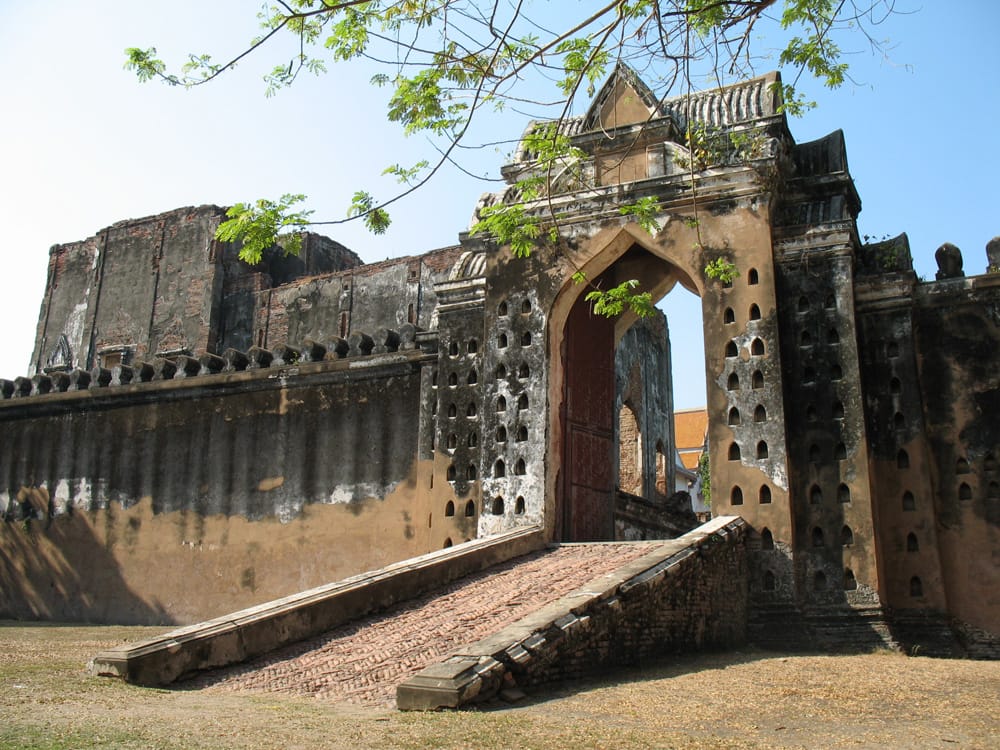
The audience hall where the king received foreign ambassadors. The building has a tall spired roof, and the inner walls were once lined with mirror glass imported from France. The easy thing to spot is the pointed-arch windows and doorways in the European style, which were rare in Thai architecture of the same era.
Chanthara Phisan Hall
Originally a meeting and government hall under King Narai, it became the site of Lopburi's first museum in 1924 before later growing into the national museum. An elegant Thai-style building.
Suttha Sawan Hall
The private royal residence in the inner zone, and the spot where King Narai passed away. Today only the foundations and remnants of the walls survive, with gardens and a pond around it — a quiet, calm corner that's a good place to sit and get out of the sun.
Phra Chao Hao Building
A brick-and-mortar building in the outer zone, thought to have once been a shrine housing a Buddha image called Phra Chao Hao, which is how it got its name. It's one of the older buildings where you can still clearly read the structure.
The Phra Prathiap buildings and elephant stables
The outer zone also has the remains of warehouses, the large water tank that was piped to supply water into the palace, and a long row of elephant and horse stables — a reminder that this palace really was a centre of governance and diplomacy.
A water system ahead of its time
One thing people tend to overlook is the palace's plumbing. Back then, earthenware pipes carried water from outside the city into a big tank in the middle of the palace — seriously advanced engineering for the Ayutthaya era. Take a look at the line of water tanks in the outer zone.
Somdet Phra Narai National Museum
Inside the palace, the Somdet Phra Narai National Museum is spread across several buildings, including Chanthara Phisan Hall and the structures added under Rama IV. It tells the story of Lopburi from prehistoric times through the Dvaravati and Lopburi (Khmer) periods up to the Ayutthaya era, with a focus on Thailand's relations with foreign powers. There are Buddha images, ceramics, tools and everyday objects, and finds excavated around the province. Labels are in both Thai and English, so it's easy to follow.
If you're into history, set aside about an hour for the museum section — that's about right. The buildings are air-conditioned and cool, which makes them a great escape from Lopburi's afternoon heat.
Tickets, opening hours and what to know before you go
- Opening hours — open Wednesday to Sunday, roughly 8:30 a.m. to 4:00 p.m. (the museum section). Closed Monday and Tuesday, and on some public holidays.
- Entry fee — about 30 THB for Thais and around 150 THB for foreign visitors. Children, students, and monks are usually exempt.
- Location — Sorasak Road, in the centre of Lopburi's old town, about a 10–15 minute walk from Lopburi train station.
- Time to allow — a relaxed walk around the whole palace, museum included, takes about 1.5–2 hours.
Check before you go
Opening hours and ticket prices change from time to time, especially around the King Narai Reign Fair in February, when it gets especially crowded. If you'd rather avoid the crowds, skip the weekends of that festival, and you can call the museum to check ahead on 0-3641-1458.
Making a half-day of it
King Narai Palace sits in the old-town district, so it's easy to walk on to other spots. Here's roughly how to pair it up.
Start the morning at the palace
Come around opening at 8:30 a.m. while the sun is still gentle, and walk the throne halls and museum before the crowds arrive.
On to Phra Prang Sam Yot
A few minutes' walk or ride away to see the Khmer prang and the town's resident troop of monkeys — another of Lopburi's highlights.
Baan Wichayen
The ruins of the home of Constantine Phaulkon, a foreign minister in King Narai's era — it carries the diplomacy story right on from the palace.
Plan a full Lopburi trip — old town, monkeys and local eats
See the Lopburi travel guide →