🔄 Updated 21 Jun 2026
If you've ever heard "if you want to learn to dive, go to Koh Tao," that's not just marketing. The island has dozens of dive schools packed into just a few square kilometres. The competition keeps course prices low in a way that's hard to find anywhere else, and combined with warm water, good visibility, and safe shallow training spots, Koh Tao has become the place where people start their underwater journey. And for those who already dive, there are legendary deep pinnacles waiting too.
Why Koh Tao is a diver's paradise
The main reason is that everything comes together just right. The sea stays warm at around 28–30°C nearly all year, so you don't need a thick wetsuit. Most dive sites are only a 15–40 minute boat ride from shore, and there's a range of depths to match your skill level. Best of all, there are so many dive schools that courses are affordable and run almost every day.
- Warm water almost year-round — around 28–30°C, so diving is comfortable without a thick suit
- Safe shallow training spots — Sairee Beach and shallow bays are ideal for Confined Water practice
- Friendly course prices — high competition makes Open Water cheaper than many places worldwide
- Dive sites for every level — from shallow reefs to 30-metre-deep pinnacles
- A chance to spot whale sharks — around the monsoon transitions, especially Apr–May and Sep–Oct
Want more out of Surat Thani? Book tours & activities
Booking online ahead on Klook or GetYourGuide is usually cheaper than the gate and skips the queue. Pick only the experiences you actually want — prices and availability are shown live on each site.
Dive courses — real prices and how many days
The course most people come to Koh Tao for is the PADI or SSI Open Water, the certification that lets you dive to 18 metres anywhere in the world. It takes about 3–4 days, starting with theory, then practice in shallow water, before heading out to the real sea. The standard price on the island is around 9,000–13,000 THB, usually including gear, certification fees, and at some schools even accommodation during the course.
- Discover Scuba Diving — a half-day try dive, no certification needed, around 1,000–2,500 THB, great for testing the waters first
- Open Water — your first certification, 3–4 days, around 9,000–13,000 THB (typical island price ~11,000–12,950 THB)
- Advanced Open Water — dive deeper, 2 days and 5 dives, around 8,000–11,900 THB
- Fun Dive — for the already-certified; the per-dive price drops when you buy a package
Long-running dive schools that come up often on the island include Big Blue Diving, Crystal Dive, Black Turtle Dive, Scuba Shack, and Coral Grand Divers — most clustered around Sairee Beach and Chalok Bay. Compare prices and group sizes before you decide; smaller groups usually mean closer attention even if the price is a little higher.
How to choose a school that's worth it
Don't just go for the cheapest. Ask clearly what the price includes (gear, certification fees, accommodation, insurance), how many students per instructor, and whether the instructor speaks a language you understand. During high season (Dec–Apr and Jul–Aug), prices rise and slots fill up — book ahead.
The top dive sites around Koh Tao
There are dozens of dive sites around the island, roughly split into shallow spots good for beginners and snorkellers, and deep offshore pinnacles for the experienced. Here are the ones people talk about most.
Chumphon Pinnacle
An underwater granite pinnacle that starts at around 14 metres and drops past 30. It's home to big fish — giant groupers, schools of barracuda — and there's a seasonal chance of whale sharks. It's the island's most famous deep dive, suited to Advanced divers because the current can be strong.
Southwest Pinnacle
A cluster of submerged granite peaks lined up together, rising from the seabed to near the surface at around 7 metres. The underwater terrain looks like a mountain range — you'll find marbled groupers, schools of barracuda, and on some days whale sharks. It's about 13 km offshore.
Sail Rock
A legendary pinnacle in open water between Koh Tao and Koh Phangan. The highlight is the chimney swim-through, where you drop in at 5 metres and come out at around 18. Expect dense schools of fish and a shot at whale sharks. It's usually a full-day boat trip.
Hin Wong Bay
A bay on the east side of the island with crystal-clear water, just 3–12 metres deep, plenty of coral types, and easy fish-spotting. It's reachable by a concrete road, making it a favourite for deep diving, snorkelling, and anyone after a quieter spot.
Tanote Bay
An east-side bay stretching along the coastline, 8–18 metres deep, with coral, sergeant fish, stingrays, and shrimp around the rocks. There's a big boulder in the middle of the bay you can climb and jump off, and the Tanote Peak viewpoint is close by.
Japanese Garden
A shallow spot beside Koh Nang Yuan with bright hard corals and lots of fish, shallow enough to see clearly while snorkelling. It's a favourite of both new divers and snorkellers.
Shark Bay
A shallow bay on the south of the island where you have a chance to see small, harmless blacktip reef sharks gliding through the shallows. It's a highlight of many snorkelling tours.
Koh Nang Yuan
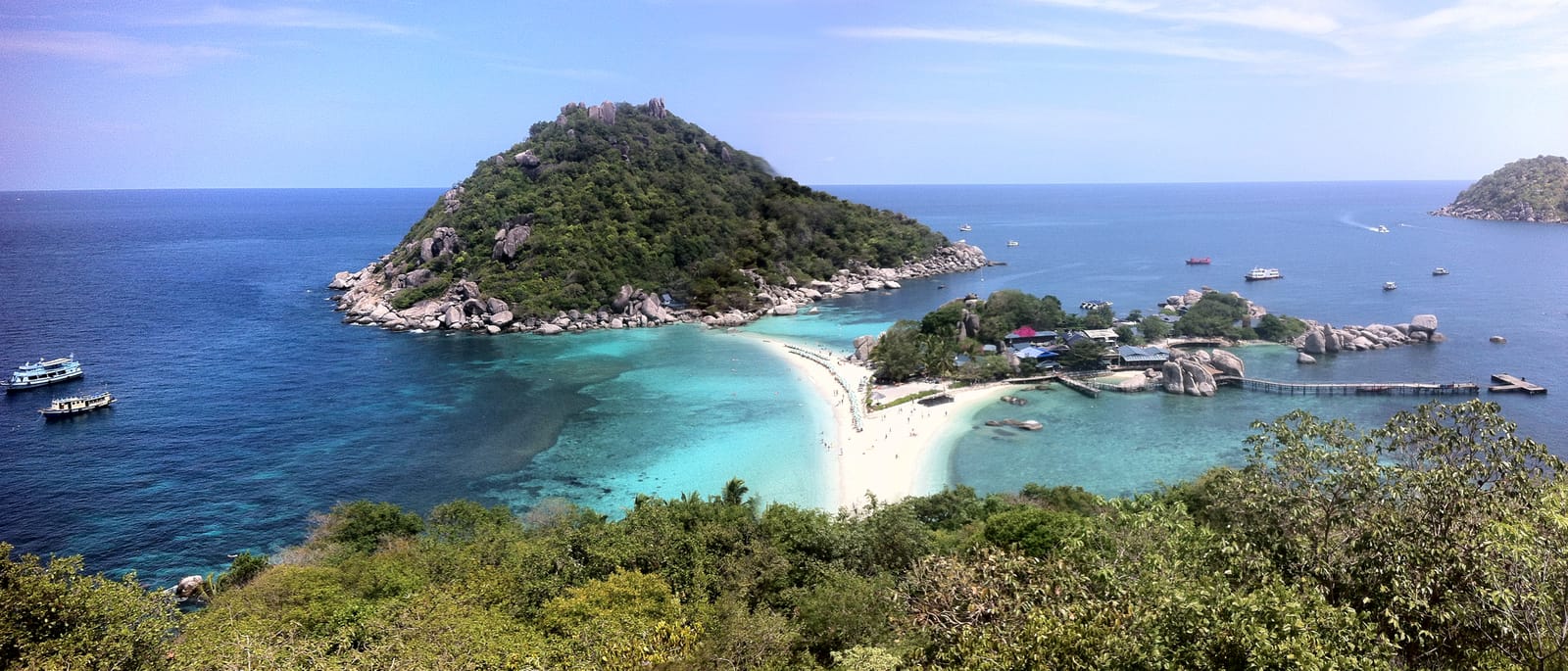
Three small islands joined by a white sandbar — a hugely popular viewpoint with clear water all around. The Twin Peak dive site is nearby. There's a 100 THB/person landing fee, and plastic bottles aren't allowed on the island.
When do whale sharks show up?
Whale sharks don't keep a fixed schedule, but the times people see them most are the monsoon transitions, around Apr–May and Sep–Oct. They usually turn up at deep pinnacles like Chumphon and Southwest Pinnacle. If you get to see one, count yourself very lucky — keep your distance and don't chase it.
Tanote Bay and Hin Wong Bay — two bays not to miss
If you're not diving deep, these two east-side bays are highlights you can enjoy even without a dive certification. Both are reachable by concrete road (though the climbs up the hills are very steep), the water is clear enough to see coral from the surface, and there are fewer people than over by Sairee Beach.
- Tanote Bay — there's a big rock in the middle of the bay to climb and jump off, a laid-back vibe, beachside restaurants, and you can walk up to the Tanote Peak viewpoint
- Hin Wong Bay — one of the quietest and clearest bays on the island, perfect for floating over the coral, with a small pier where you can sit and dangle your feet
- The approaches to both bays are very steep — if you're on a motorbike you need to be confident riding, or use a taxi/songthaew on the island instead
Be careful riding a motorbike on Koh Tao
Many roads are steep and unpaved with loose gravel, and motorbike accidents on Koh Tao are common. If you're not confident on steep terrain, hire a taxi or take a local songthaew instead. And always photograph the bike's condition before renting to avoid disputes over scratches.
Getting to Koh Tao
Koh Tao has no airport, so you have to come by boat from the mainland or a neighbouring island. The three main routes are from Chumphon (closest and most popular), from Surat Thani, and connecting from Koh Samui/Koh Phangan. The big speedboat operators on these routes are Lomprayah and Seatran/Songserm.
- From Chumphon (Thung Makham Noi pier) — Lomprayah speedboat runs about 2 trips/day (morning ~7:00 and afternoon ~13:30), taking around 1 hr 45 min, tickets around 750 THB/trip
- From Surat Thani (Tapi/Don Sak pier) — both speedboats and overnight ferries; the overnight ferry is the cheapest at around 600 THB, leaving in the evening and arriving at dawn
- From Koh Samui/Koh Phangan — connect by speedboat, around 1.5–2.5 hrs, great if you're island-hopping on one trip
- Bus + ferry package from Bangkok — joint bus-and-boat round trips are available, around 2,000–2,200 THB/person all in
Most people coming from Bangkok take a train or coach down to Chumphon, then connect to the Lomprayah speedboat, because that's the shortest boat ride and the water is calmer than the other routes. If you're already on Koh Samui or Koh Phangan, the speedboats connect conveniently. During the monsoon (Oct–Dec) the sea can get rough, so check the weather and ferry schedule before you travel.
What to do if you get seasick easily
The speedboat routes can rock quite a bit when the sea is rough. If you're prone to seasickness, take motion-sickness medication 30 minutes before boarding, pick a seat in the middle of the boat on the lower deck, and keep your eyes on the horizon — it helps a lot.
3-day, 2-night Koh Tao plan (for divers)
Arrive + settle in + Discover Scuba
Start your course / Fun Dive around the island
Finish the course + bay tour + head back
Getting ready before diving Koh Tao
- Check your health — if you have any condition (heart, lung, asthma), consult a doctor and tell the school before starting a course
- Don't dive then fly right away — leave at least 18–24 hours before boarding a plane, or a return boat that goes to high altitude
- Reef-safe sunscreen — helps reduce harm to the coral; some sites are starting to ask for it
- Cash — ATMs on the island charge high fees and sometimes run out of money, so bring spare cash
- Book accommodation + course ahead in high season — Dec–Apr and Jul–Aug are busy and slots fill up
Plan your full Surat Thani and island trip
See the Surat Thani travel guide →