🔄 Updated 21 Jun 2026
This trip is built for people driving their own car or a rental, because most of the temples sit outside the city centers where public transport struggles to reach, especially Phanom Rung and Mueang Tam, which are nearly 80 kilometers from downtown Buriram. The main route starts in Korat on day one (Phimai and Phanom Wan), then crosses over to spend the night in Buriram and tackles Phanom Rung and Mueang Tam the next day, so you never have to backtrack. If you only have 2 days, drop the last day. But with the full 3 days you can take it slow and actually breathe between temples.
The main temples on this trip
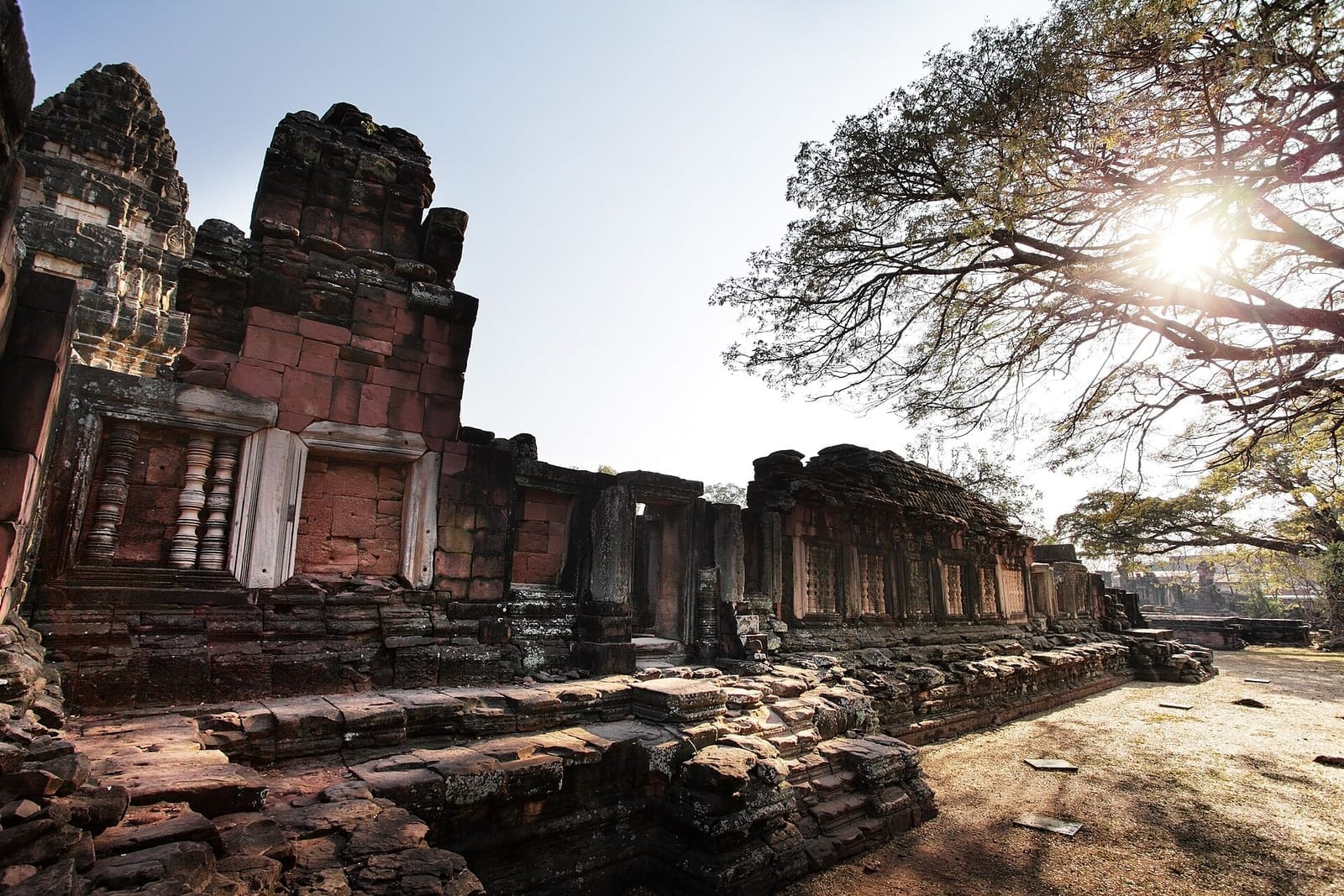
Before we start, let's get to know the four stars of the show. Each one has its own character, so they never blur together, from a temple right in the middle of town that's an easy walk to one up on a hill where you climb a long flight of stairs.
Phimai (Korat)
The largest sandstone temple in Thailand, sitting in the middle of Phimai town. Easy, flat walking with finely carved lintels and pediments. Open 07:00–18:00. Thai 20 THB, foreigners 100 THB.
Phanom Wan (Korat)
A quiet temple that the crowds haven't really found yet, about 15 km outside Korat city. Monks still hold ceremonies here, so it has a hushed, sacred feel. Open 07:30–17:30, with a small entry fee for Thais.
Phanom Rung (Buriram)
A temple on the rim of an extinct volcano. You climb a long stairway and walkway to reach it, and the views open up wide. Four times a year, sunlight aligns through all 15 doorways.
Mueang Tam (Buriram)
A flat-ground temple just 8 km from Phanom Rung, ringed by L-shaped ponds with five-headed naga balustrades that photograph beautifully. Quieter than Phanom Rung. A combo ticket covers both temples for 30 THB.
About the tickets
Phanom Rung and Mueang Tam share a combo ticket that gets you into both for 30 THB for Thais. Buy it at the ticket booth of whichever temple you hit first, it's better value than paying separately. Phimai and Phanom Wan are charged individually at each site. Carry cash, because some spots still don't take bank transfers.
Book the activities in your Nakhon Ratchasima trip ahead
Booking online ahead on Klook or GetYourGuide is usually cheaper than the gate and skips the queue. Pick only the experiences you actually want — prices and availability are shown live on each site.
Day 1 — Korat: Phimai and Phanom Wan
The first day stays within Korat province, clearing both temples on this side before you cross over. Phimai is about 60 kilometers northeast of Korat city, while Phanom Wan sits right along the way, so the plan is to stop at Phanom Wan first and carry on to Phimai.
The Korat-side temples
Straight talk
Phimai gets harsh at midday because it's wide open with no shade. Go late in the afternoon and it's hot and you'll be shooting into the light. We'd go before 11 a.m. or after 3 p.m. for nicer light and less suffering.
Day 2 — Cross to Buriram: Phanom Rung and Mueang Tam
Today is the highlight of the trip. You drive over from Korat or Phimai to Buriram, about 125 kilometers from Korat city, roughly two hours, but the real destination is Phanom Rung south of Buriram city. Running straight from Phimai to Phanom Rung shortens the distance. Phanom Rung means climbing the hill, so go early or late afternoon to dodge the midday sun.
The Buriram-side temples
Sunlight through all 15 doorways
Phanom Rung has special moments when the sun shines straight through all 15 doorways in a single line, four times a year: sunrise on April 3–5 and September 8–10, and sunset on March 5–7 and October 5–7. If you're set on seeing it, you need to be up at the top before the sky even lightens. It gets extremely crowded during these windows, and it all depends on the weather, so if the sky clouds over you may not see it. Keep your expectations in check.
Day 3 — Buriram city before heading home
The last day takes Buriram city easy before the drive home. If you haven't had your fill of temples, you can stop at smaller ones along the way back to Korat. But if you want a change from sandstone, Buriram city has spots to see that aren't temples.
Wrapping up Buriram city
Food along the way you shouldn't skip
- Phimai fried noodles (phat mi) — chewy noodles leaning sweet, eaten with banana blossom and bean sprouts. A Phimai specialty you'll find at several shops around the temple.
- Som tam with grilled chicken at the foot of Phanom Rung — shops along the access road, bold and properly Isan. After a tiring climb up the hill, it tastes twice as good.
- Buriram kunchiang and mu yo — popular souvenirs, easy to take home and they keep well. Find them in Buriram's city market.
- Jum jim and laab koi in Buriram — an Isan-style dinner with plenty of shops in town, perfect for capping off a full day of temple-walking.
Tips for enjoying the temples
- Go early or late afternoon — the temples are wide open with no shade. Midday is hot and hard to shoot, while morning and evening give nicer angled light.
- Bring water and a hat — especially for Phanom Rung with its long stairway climb. Pack water and comfortable walking shoes.
- Carry cash — entry fees and many shops around the temples still take cash only, so keep small bills handy.
- Allow travel time — the temples are tens of kilometers apart, so plan enough time and don't cram everything into one day until you're exhausted.
- Respect the sites — some temples are still sacred and host ceremonies. Dress modestly and don't climb on the monuments.
If you're not driving yourself
Phanom Rung and Mueang Tam really are hard to reach by public transport. Without a car, the easiest route is to take the train or a coach into Buriram, then hire a local van or taxi to run you out to Phanom Rung and Mueang Tam, or book a day-trip tour from the city. It's a better use of time than piecing together rides yourself.
Want a place to stay in Korat before starting this cross-province trip?
See the Top 10 Korat hotels →