🔄 Updated 21 Jun 2026
If you've ever seen a photo of someone hanging off a tall cliff above emerald water in Krabi, it was almost certainly at Railay or Tonsai. These two beaches sit on the Phra Nang peninsula and can only be reached by boat — no road access — which is exactly why they've stayed quiet and kept their long-standing climber-community feel. The cliffs are all limestone, full of pockets, edges and tufas to grab onto, which makes climbing here genuinely fun and leaves you with hundreds of routes from total-beginner up to pro level.
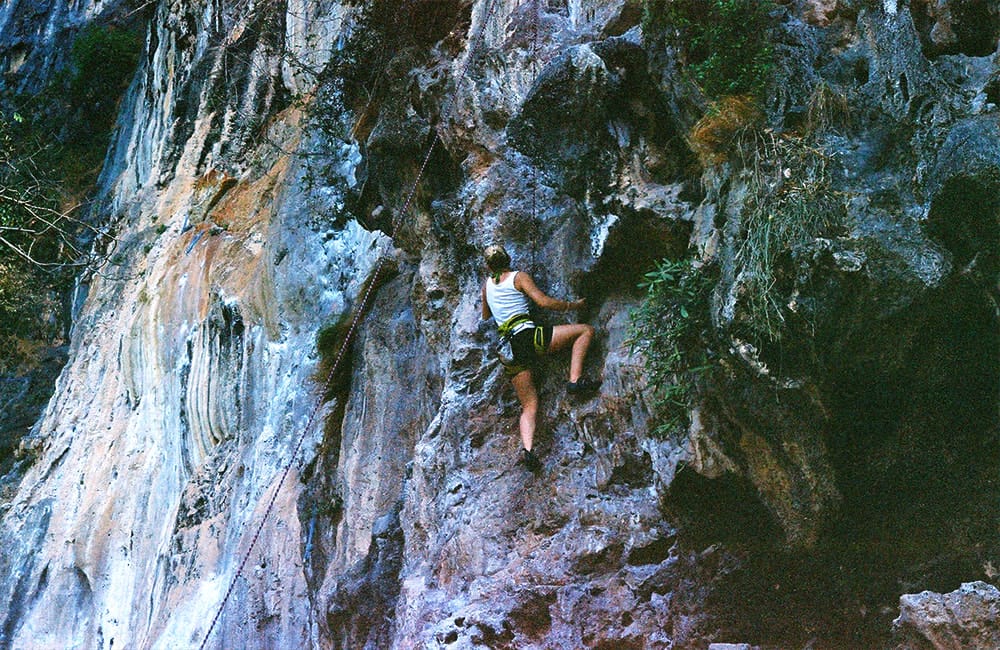
The first thing a beginner should understand is that climbing here is mostly top-rope and sport climbing. That means the cliff already has steel bolts fixed at regular intervals, the instructor clips the rope for you, and you simply climb up while someone holds the rope (belays) from below. If your hand slips, you just hang on the rope — you don't fall to the ground. It's a sport that looks far scarier than it actually is, and people with a mild fear of heights can still give it a go.
What beginner courses are there
The climbing schools around Railay and Ao Nang split their courses clearly by time and group size. If you've never climbed at all, start with a half-day course. The instructor teaches you everything from putting on the harness and tying knots to calling commands to your belayer, then you get to climb a few easy real routes on the cliff. If you're hooked, you can move up to a full day or a multi-day course where you learn to belay yourself and lead climb.
- Half-day course (beginner) — around 3–4 hours, covers the basics plus a few easy routes; ideal for a first try
- Full-day course — basics in the morning, several climbs in the afternoon, and you also learn to belay
- 2–3 day course — builds up to lead climbing and the next set of techniques; good for people who want to climb on their own
- Private guide — one instructor for a small group, close attention, routes adjusted to your level
Half day or full day?
If you just want to find out whether you like it, a half day is plenty. But if you've come specifically to climb and want the trip to be worth it, a full day gives you a lot more time on the rock — and your hands tend to get used to the limestone right around the afternoon.
Want more out of Krabi? Book tours & activities
Booking online ahead on Klook or GetYourGuide is usually cheaper than the gate and skips the queue. Pick only the experiences you actually want — prices and availability are shown live on each site.
Rough prices (updated 2026)
The prices below are the rough ranges you'll see commonly across several schools — they shift up and down with the season and how many people are in the group. Most courses include all the gear (harness, climbing shoes, helmet, rope) plus drinking water, and usually insurance too. Ask clearly what's included before you book.
- Half-day course (group) — around 1,000–1,200 THB per person
- Full-day course (group) — around 1,800–2,000 THB per person, lunch included with some operators
- Private guide, half day — around 3,500 THB (1 person) / ~6,000 THB (2 people)
- Private guide, full day — around 5,000 THB (1 person) / ~9,000 THB (2 people)
- 3-day course — around 7,000–8,000 THB per person
Straight talk
The one thing we want to flag is Deep Water Soloing (climbing sea cliffs with no rope and dropping into the water), which used to be a big draw in Krabi. The national park has now banned it within the Railay area. If you find an operator still advertising it inside the restricted zone, be wary. The DWS tours that still run take you out to climb islands outside the park boundary instead.
Climbing schools that are open
Railay and Ao Nang have several long-running climbing schools. Most instructors are certified and speak both English and Thai. Pick one with a beachfront office you can walk into and chat — check the condition of the gear and ask about the instructor-to-student ratio (for beginners it should be no more than 4–6 people per instructor).
King Climbers / The Rock Shop
A Railay old-timer running since 1997, with a full range of courses from beginner half-days to multi-day lead climbing. Office on the Railay East side.
Real Rocks Climbing
Runs both group and private climbs at Railay and Tonsai. Internationally certified instructors, taking everyone from beginners to advanced.
Hot Rock Climbing School
A beachfront school on Railay West, looking after both beginners on short routes and people with a base who want a bigger challenge.
Basecamp Tonsai
A climbing base on the Tonsai side that serious climbers favour. A real climber-community vibe, good for people staying to climb for a long stretch.
Crags for beginners
Beginner-grade routes (below 5.10a, or just into grade 5 and up) are almost all on the Railay side — not Tonsai, which leans toward hard overhanging lines. Your instructor will take you to whatever crag suits the day, but the names you'll hear most often for beginners are these.
123 Wall
The most popular beginner crag — good rock, lots of easy lines, shaded most of the day from Oct–Apr. The downside is it gets very crowded between 9am and 4pm.
Muay Thai Wall
Near Phra Nang beach, shaded all day and an easy walk in, with routes at several grades to work your way up. Good for a scorching day.
Diamond Cave Wall
Near the Diamond Cave entrance, with routes at a range of grades and a short walk from Railay East. A starting point many courses use.
Dodge the crowds
123 Wall is where the schools take a lot of beginners. If you want to climb in peace without queueing, avoid 9am to 4pm, or tell your instructor from the start that you'd rather go somewhere quieter.
The best season to climb
The most comfortable time to climb is the dry season, Nov–Mar, especially Dec–Feb when the air is dry and humidity is low. Mornings and evenings are pleasantly cool (around 20–25°C), midday is hot but bearable (28–32°C), and the sea is calm so boats run in and out of Railay all day. It's the season when climbers from all over the world show up in the biggest numbers.
- Nov–Mar — best of all: dry air, rock that isn't slick, calm sea (peak crowds Dec–Feb)
- Apr — fiercely hot at 35–38°C with full sun on the cliffs; you tire fast, so pick a shaded wall
- May–Oct (rainy season) — rain comes in spells but you can still climb, because many cliffs overhang enough to stay dry even in the rain; choose your timing and crag
- During heavy rain — boats struggle to run and the rock gets wet and slippery; keep a backup plan ready
You can still climb in the rainy season
Don't write off Railay if you're coming in the rainy season — many overhanging limestone walls stay dry even when it's pouring. Local instructors know which spots are still climbable; you may just get less time on the rock, so book somewhere flexible with your dates.
Getting there and where to stay
Railay and Tonsai are reachable by boat only. The easiest way is a longtail boat from Ao Nang beach, about 15 minutes to Railay West, at around 100 THB each way (roughly 200 THB round trip), with about 50 THB added after 6pm. Boats leave once they're full (usually 8 people) — buy your ticket at the boat-service point in the middle of Ao Nang beach.
- Railay West — a pretty beach with accommodation across the range from mid to luxury; good if you want sightseeing alongside the climbing
- Railay East — the mangrove side, cheaper to stay, and you can walk over to West in 5–10 minutes
- Tonsai — about a 20-minute walk from Railay West (or a short boat hop), cheap to stay, with a true climber-community feel
- Stay in Ao Nang and day-trip — also fine if you'd rather not haul your bags across the water
If you're set on climbing several days in a row, staying right at Railay or Tonsai is more convenient — you wake up and walk to the cliff, no gambling on a boat every morning. But if you're only trying it for a day, staying in Ao Nang and having the school meet you at the pier works just fine.
Getting ready and FAQs beginners ask
- What to wear — a t-shirt and light, stretchy long trousers; shorts are fine but your knees may scrape the rock
- Footwear — you can show up in flip-flops; the school lends you climbing shoes
- Sweaty hands — chalk bags are provided to keep your grip; no need to bring your own
- Afraid of heights — give it a try; instructors start you on low routes and ease you up, with no pressure
- No need to be fit — beginners climb more with their legs than their hands; anyone in normal health can do it
- Bring — plenty of water, sunscreen, a hat, and some snacks to refuel
After you finish climbing
A short walk from Railay West are Phra Nang Cave and the Railay Viewpoint–Lagoon, which you can scramble up to without ropes (though the path is slippery and steep, so wear shoes with grip). It's a fitting view to close out a day that's worth the effort.
Plan a full Krabi trip — both the sea and the cliffs
See the Krabi travel guide →