🔄 Updated 21 Jun 2026
Lamphun is one of the oldest towns in northern Thailand, and the story of Queen Chamthewi still lives in people's daily lives here — not just in textbooks. Ku Chang–Ku Ma is part of that living history: two old brick stupas standing close together in the Wat Kai Kaeo neighborhood, Nai Mueang sub-district. Locals believe Ku Chang holds the remains of the royal war elephant, while Ku Ma behind it is the tomb of a war horse. Together they have become objects of devotion for the town to this day.
What's interesting is that Ku Chang–Ku Ma isn't famous for grand architecture — it's famous for a sense of the sacred passed down from one generation to the next. Most people who come aren't foreign tourists but northerners and believers from across the country who come to ask for blessings on their work and stability. Come on a weekday morning and it's quiet and peaceful, with locals dropping by to pay respects throughout.
The legend of Pu Kam Nga Khiao, the royal elephant
At the heart of Ku Chang is the royal elephant named Pu Kam Nga Khiao — the name literally means a dark-hued elephant with green tusks. The legend says it had great power: in battle, it only had to turn to face the enemy to leave them weakened. So it was seen as the royal elephant that helped keep the Hariphunchai kingdom safe.
There are several versions of the story. In one, Pu Kam Nga Khiao was the mount of King Mahantayot and King Anantayot, the twin sons of Queen Chamthewi. When the elephant died, people built a stupa to hold its remains, said to be positioned with its head and tusks pointing upward to ward off misfortune — which became the Ku Chang you see today. Ku Ma behind it is believed to be the tomb of a royal horse from the same era.
Good to know
Folk legends come in several versions, and some details don't line up exactly between sources. This is a story tied to the town's identity, not fully verifiable historical fact. Take it in as part of the place's charm and leave it at that.
Want more out of Lamphun? Book tours & activities
Booking online ahead on Klook or GetYourGuide is usually cheaper than the gate and skips the queue. Pick only the experiences you actually want — prices and availability are shown live on each site.
What the monument actually looks like
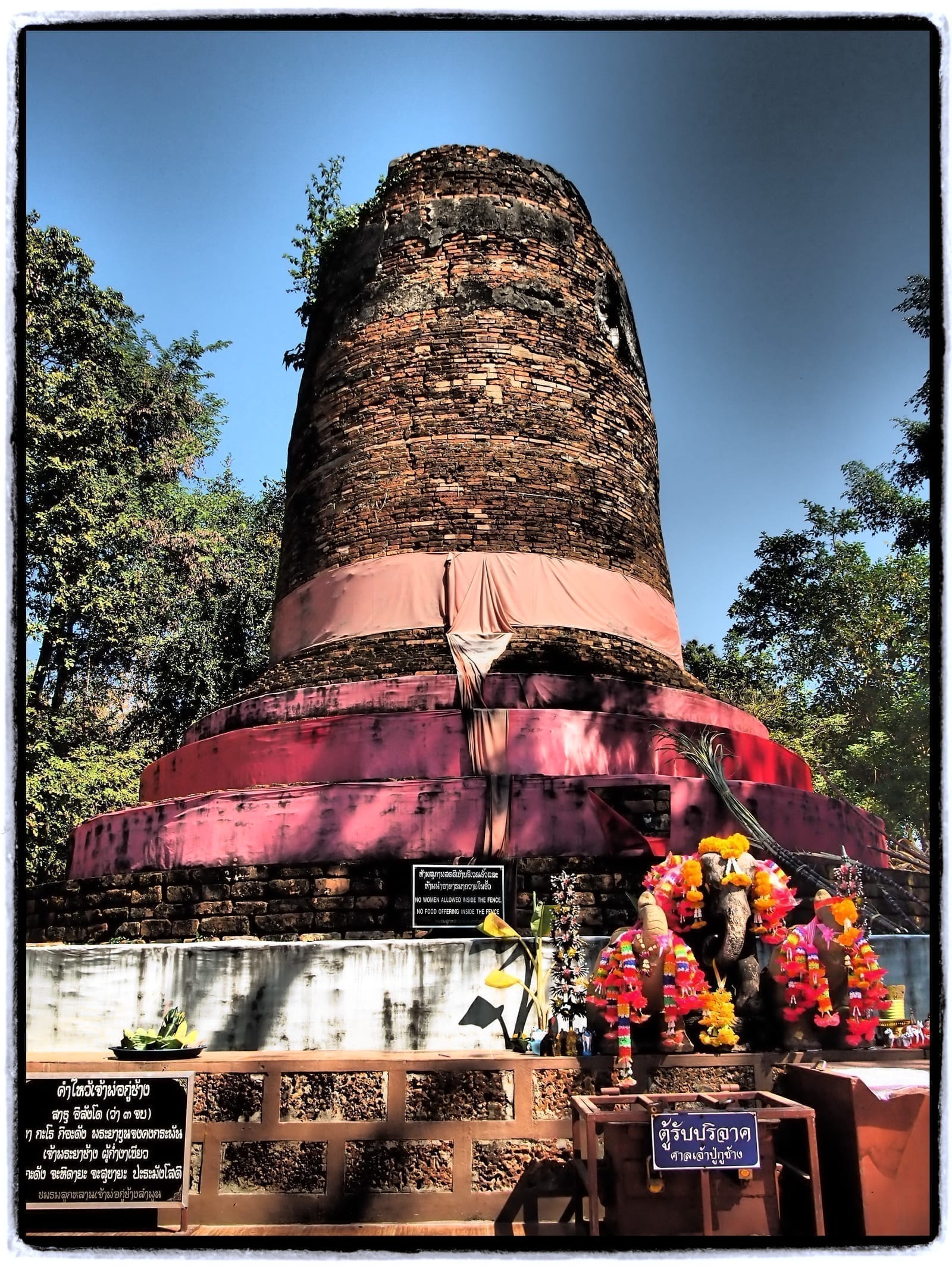
Ku Chang is a cylindrical brick stupa with a rounded top, the larger of the two and the main focus for worshippers. A shrine to Chao Pho Ku Chang stands in front, with a replica statue of Pu Kam Nga Khiao inside for people to pay respects to. The stupa is registered and maintained by the Fine Arts Department. The style carries a Mon flavor, which fits the roots of Hariphunchai — a town with strong Mon heritage.
Ku Ma sits behind Ku Chang and is smaller — a bell-shaped stupa with a fairly squat profile and a throne-like base similar to typical chedis. The two stupas are in the same compound, an easy walk apart. The surroundings are shady and pleasant, with large trees giving cover from the sun.
- Ku Chang — the larger stupa and main point of worship, with the Chao Pho shrine and the statue of Pu Kam Nga Khiao
- Ku Ma — the smaller stupa behind it, believed to be the tomb of a war horse
- Chao Pho Ku Chang shrine — where offerings are placed; flowers, incense, and offerings can be found on site by donation
How to make a wish, and what you can do here
Lamphun locals mainly revere Ku Chang for work and stability. Anyone with something weighing on them, hoping for things to go smoothly, or facing a big decision tends to drop by to make a vow and ask for a blessing. The basic offerings are flowers, incense, and fruit, which you can buy near the shrine. Light the incense, say your name, and ask for what you have in mind.
The belief people talk about most is passing under the elephant's belly. There's a spot to crawl beneath the statue of the royal elephant, and it's said that anyone who passes under Pu Kam Nga Khiao will be blessed with good fortune, a prospering life, and steady progress in their career. It's a simple ritual, and many people come specifically to do it.
One well-known story of a vow fulfilled involves a large clothing exporter who once came to vow for smooth exports. When business succeeded, they returned to make good on the vow with a donation in the millions of baht. Stories like this reinforce the faith of those who come — but remember that the result of a wish also depends on your own intention and the work you put in.
When to go
On the 9th waxing-moon day of the 9th lunar month each year there's an offering ceremony and a blessing rite for Chao Pho Ku Chang — it's especially busy and lively. If you want a quiet atmosphere to make your wish in peace, a weekday morning is better, when the sun is still soft and the crowds are thin.
Getting there and what to know before you go
Ku Chang–Ku Ma is within the town of Lamphun, about 2 km north of Wat Phra That Hariphunchai and the old town. It's just a few minutes by car or motorbike. Coming from Chiang Mai, drive along the old Chiang Mai–Lamphun road lined with beautiful rubber trees on both sides — it takes around 40–50 minutes.
- Location — near the Wat Kai Kaeo community, Nai Mueang sub-district, Mueang Lamphun district
- Opening hours — an open-air monument within the community; visit during normal daylight hours, ideally morning to evening
- Admission — free; only a donation box and offerings by faith
- Dress code — this is a sacred site, so neat, modest dress is best
- Parking — there's parking space in front of the monument
A visit here doesn't take long — about 20–40 minutes covers it. It pairs well with other sights around Lamphun on a one-day trip, since everything is close together.
More to see nearby in Lamphun
Wat Phra That Hariphunchai
Lamphun's thousand-year-old sacred relic, a golden chedi in the heart of the old town and a key stop. It's only a few minutes from Ku Chang.
In townWat Chamthewi (Ku Kut)
An ancient temple believed to hold the relics of Queen Chamthewi, with the unusual stepped Ku Kut chedi — tied to the same story as Ku Chang.
In townQueen Chamthewi Monument
A monument to the first ruler of Hariphunchai, where Lamphun locals come to pay respects — a fitting way to round out the story.
Plan a full day around Lamphun — Ku Chang, the great relic temple, and northern Thai food
See the 1-day Lamphun itinerary →