🔄 Updated 21 Jun 2026
What makes Lampang work for photographers is that it hasn't been polished smooth. The old corners are still genuine, the carriages still work for a living instead of being parked for show, and the century-old gingerbread shophouses still line the Wang River. The highlight most people haven't reached yet is the white stupa on the hilltop at Wat Chalermprakiat, which sits well outside town and needs a full day. So this plan spends Day 1 on the old quarter and the carriages, Day 2 tackling the white hilltop stupa as a full-day trip, and Day 3 catching quiet morning light and a beautiful temple in town before you head home.
Before you set off — light and timing
Most of Lampang's photo spots are outdoors, so the light matters more than the camera. The shophouses and the White Bridge shoot best in the early morning and in the soft light just before sunset. The hilltop stupa, on the other hand, needs a morning-to-late-morning visit, because by late afternoon mist or cloud often shrouds the peak. If you also want the Kad Kong Ta night market, plan your trip across a Saturday or Sunday, since the walking street only opens on those two nights.
- Morning golden hour (6:30–8:00) — the White Bridge and the shophouses are still empty, the light is soft, and you get clean shots.
- Late morning to midday — the best window to head up to the white hilltop stupa, when the sky is clear and the peak shows.
- Evening light (16:30–18:00) — warm light hits the wooden buildings of Kad Kong Ta, the prettiest time to shoot the old shophouses.
- Saturday–Sunday nights — the Kad Kong Ta walking street is open, roughly 17:00–22:00, for warm-lit market shots and crowds.
Book the activities in your Lampang trip ahead
Booking online ahead on Klook or GetYourGuide is usually cheaper than the gate and skips the queue. Pick only the experiences you actually want — prices and availability are shown live on each site.
Day one — carriages, old town, and the White Bridge
Day one covers the in-town highlights. Start with a morning carriage ride while the streets are still clear, then get out and shoot the old shophouses and the White Bridge. Spend the afternoon in a wooden-house cafe out of the sun, and come back for the evening light to shoot the shophouses again. If it falls on a Saturday or Sunday, finish the night on the Kad Kong Ta walking street at a relaxed pace.
Old town along the Wang River
A tip on the carriages
In the early morning the streets are still empty, so you get the carriage rolling along clean roads with no cars cluttering the frame. If you want a shot of yourself riding the carriage past the old buildings, ask the driver to slow down through the prettier stretches — most are happy to pause for a photo.
In-town photo spots you shouldn't skip
If your time in town is tight, these are the spots that pay off the most, ranked by how well they shoot and by how uniquely Lampang they are — things you won't find anywhere else.
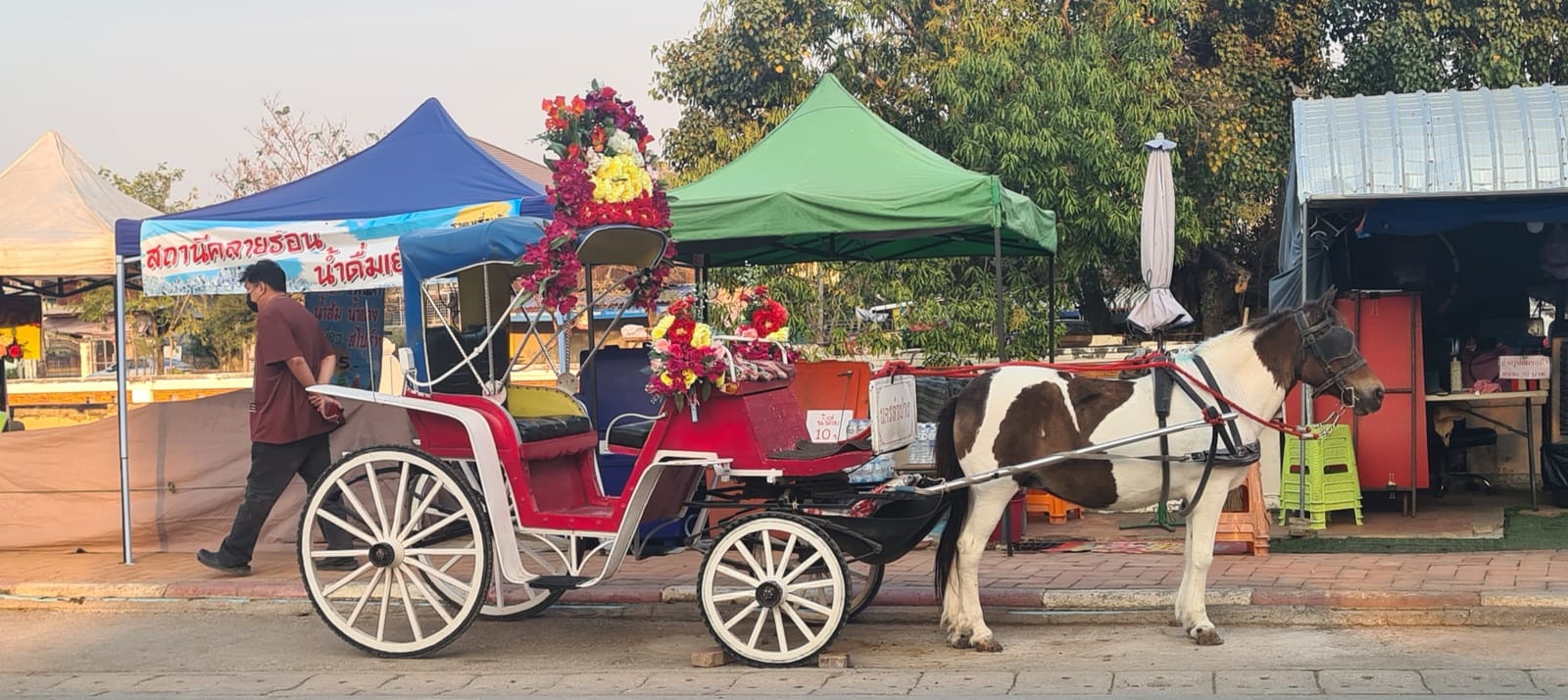
Lampang's iconic horse-drawn carriages
Lampang is the only city in Thailand where horse-drawn carriages still run for real. A carriage rolling past the old shophouses or parked in front of the White Bridge is the signature shot that instantly says Lampang. You can shoot it riding one yourself, or catch one as it passes.
Ratchadaphisek Bridge (White Bridge)
A century-old white bridge with arched railings and white-rooster figures on the bridgeheads. Shoot standing mid-bridge to line up the arches in depth, or go down to the riverbank to capture the full span. Morning and evening have the best light.
Kad Kong Ta old market street
Teak houses and century-old gingerbread buildings line the Wang River, with street art on the walls for cooler shots. The carved old window frames and wooden balconies are the highlight. On Saturday and Sunday nights, the market lights add to the atmosphere.
Gingerbread-house cafes
Carved Burmese–French wooden houses brought back to life as cafes, like Mong Ngwe Zin (built around 1908), filled inside with old photographs and artwork. A great indoor angle for both portraits and architectural details.
Baan Sao Nak
A teak house over a century old, with 116 pillars, blending Lanna and Burmese craftsmanship. Built by a wealthy timber merchant and now open as a museum. The rows of wooden pillars underneath make a beautifully framed shot. Entry is just a few tens of baht.
Wat Phra Kaeo Don Tao Suchadaram
An old temple central to the city, with a stupa and assembly halls blending Lanna and Burmese art. The woodwork and stained-glass detail make for grand shots, and it's a short walk from the old quarter.
Day two — up to the white hilltop stupa
The highlight for photographers is the white stupa on the hilltop at Wat Chalermprakiat Phra Chomklao Rachanusorn (also called Wat Phra Phutthabat Pu Pha Daeng), in Chae Hom district. It's about 50 km out of town, roughly an hour and a half by car, so you need to set aside the whole day and leave early to catch good light before cloud shrouds the peak.
White hilltop stupa, Chae Hom district
Preparing for the climb
The white stupa means a steep stairway of about 300 steps — if your knees aren't up to it, weigh it up first. Wear comfortable shoes, bring water and a hat, because the sun on the hilltop is strong. Most importantly, go in the morning to late morning, since by late afternoon mist or cloud often drifts in and shrouds the peak, leaving you unable to get the floating-stupa shot.
Day three — quiet morning light and a beautiful temple before you go
Spend the last day catching the morning light before the crowds, for clean shots with no one walking through the frame, then move on to Wat Phra That Lampang Luang — the Lanna temple that gives the grandest shots in the city — before picking up souvenirs and heading home.
Morning light and Wat Phra That Lampang Luang
How to shoot it so it looks good on social
Play with leading lines
The arched railings of the White Bridge, the rows of wooden pillars at Baan Sao Nak, and the long stretch of Kad Kong Ta street all make leading lines that give a shot depth. Try placing a subject or a carriage at the end of the line.
Use people for scale
With the hilltop stupa and the tall old buildings, putting a small figure in the frame shows the size and height more clearly. The image tells more of a story than shooting the architecture alone.
Follow the light, not the clock
Shoot the in-town spots morning and evening, and the hilltop stupa in the late morning with a clear sky. Schedule around the light and the shots get better on their own, without leaning on heavy filters.
The best time to go
Lampang shoots well year-round, but the late-rainy-to-early-cool season (November–February) gives you clear skies and cool weather, the most comfortable time to walk outdoors and climb the hill. Avoid March–April, when haze from burning can leave the sky hazy and the mountain views won't come out.
Want a full plan for the whole of Lampang?
See the Lampang travel guide →