🔄 Updated 21 Jun 2026
Lampang is easier to visit than you'd think — a small town where the centre is walkable, rooms are cheap, and it sits roughly halfway between Bangkok and Chiang Mai. Plenty of people stop here on the way north, but Lampang holds its own for two or three days. This article sums up what's worth knowing before you go, so you can shape the trip around what you actually want to see.
When is the best time to visit Lampang?
The most comfortable time to visit Lampang is the cool season, roughly November to February — crisp air, clear skies, and enough relief from the heat to wander temples and Kad Kong Ta all day. The coldest month is January, when nighttime temperatures can dip to 9–10°C on some days. If you're coming then, pack a warm layer, especially if you're heading up to higher ground like Chae Son or the hills around town.
- Nov–Feb (cool season) — the best window: cool air, great for walking around outdoors · this is high season, and rooms fill fast over New Year
- Mar–May (hot season) — very hot; avoid walking in the midday sun, but rooms are cheap and crowds are thin · March–April can bring some haze
- Jun–Oct (rainy season) — lush and green, the waterfalls look their best and it's good for Chae Son, but build in time for rain · cheapest rooms of the year
A tip on timing
If you want to catch Kad Kong Ta, which only runs on weekends, plan your trip to straddle a Saturday or Sunday for at least one night so you don't miss the town's main highlight.
Kad Kong Ta runs on weekends only
Kad Kong Ta is the old-town walking street along the Wang River, on Talat Kao Road in Suan Dok subdistrict, and it's a highlight you shouldn't skip — but it's open only on Saturdays and Sundays, from evening into the night, roughly 5–10 pm (sometimes starting as early as 4 pm). Come on a weekday and you'll find only quiet old buildings with no stalls.
- What's on sale — local food, northern sweets, handmade goods, crafts, souvenirs, and street snacks to graze on as you walk the length of the street
- The atmosphere — old wood-and-stucco shophouses line both sides, many of them century-old buildings, lit up beautifully at night and great for photos
- How to get there — it's in the town centre, walkable from any old-town hotel, or flag down a horse carriage to arrive Lampang-style
Best time to go to Kad Kong Ta
Arrive in the early evening, around 7 pm — stalls are all open, the lights are on, and it's not yet so packed that walking is a chore. Show up late, near closing, and some vendors are already packing up.
How to get to Lampang
Lampang is easy to reach from both Bangkok and Chiang Mai, with options by train, bus, and plane. Pick whatever suits your budget and the time you have.
- Train — every northern-line train passes through Lampang, and the station is a handsome old wooden building worth a photo · from Chiang Mai it's very cheap, with third-class tickets starting in the low tens of THB and the ride taking about two hours
- Bus/minivan — several departures a day from Bangkok (Nakhonchai Air, Sombat Tour), taking around 8–9 hours · from Chiang Mai it's about an hour and a half to two hours, with fares starting around 100 THB
- Plane — there are direct Bangkok–Lampang flights of just over an hour, good if you're short on time · the airport sits right next to town, just a few minutes from the centre
Getting around town
There's plenty you can cover on foot in central Lampang, but for out-of-town temples like Wat Phra That Lampang Luang you'll want wheels. The main options:
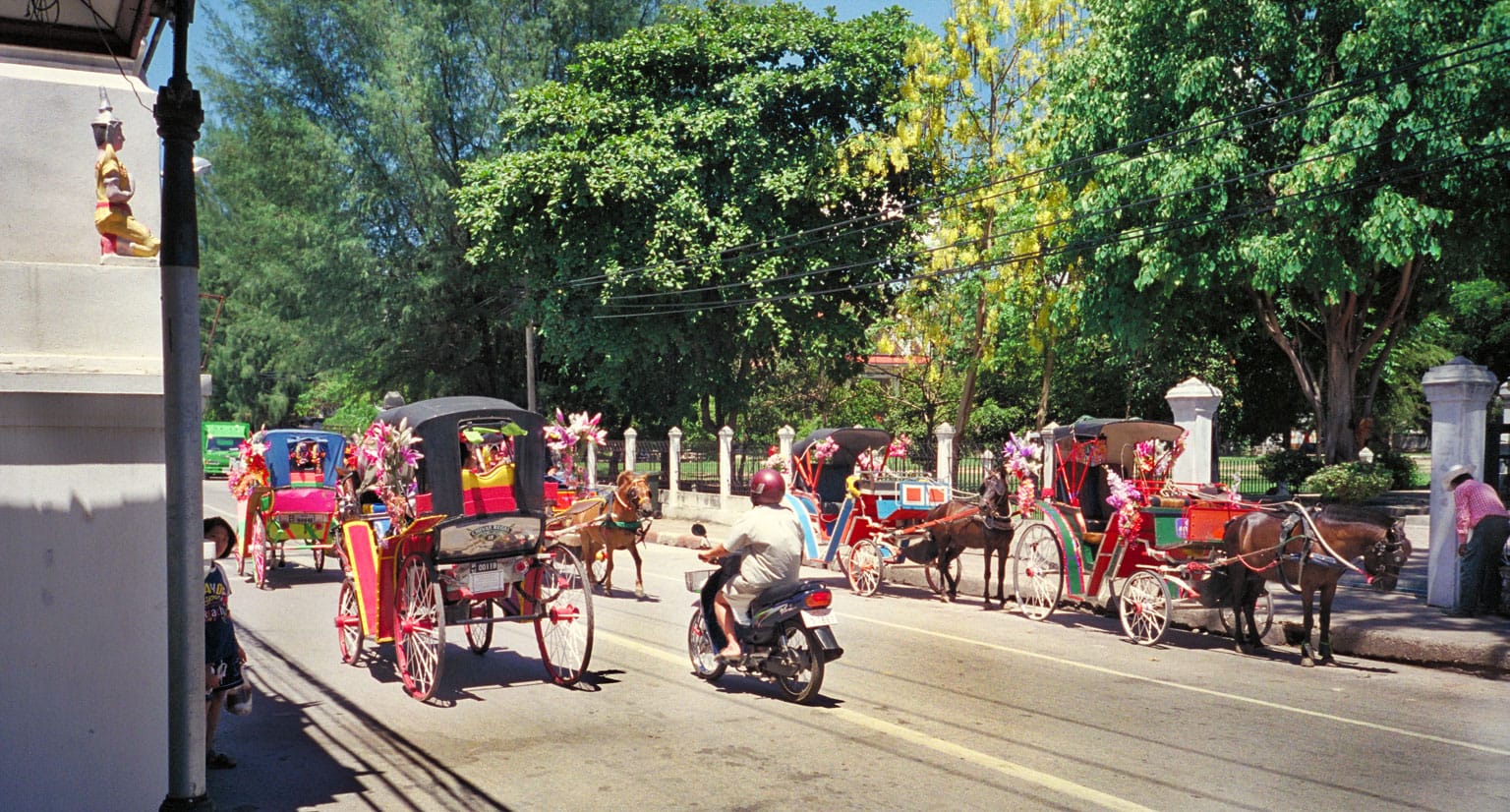
Horse carriage
Lampang's signature that still runs for real — good for a short loop around the old town. Always agree on the price with the driver before you climb in.
Rented motorbike
The most nimble way to cover the town and the outlying temples. Rental shops are in town and it's only a few hundred THB a day.
Car rental / ride apps
Best for longer trips like Chae Son or the elephant conservation centre, or when there's a group of you who'd rather travel in comfort.
Daily budget for Lampang
Lampang is an easy town to do on a budget — food is cheap, rooms are inexpensive, and most attractions are free or just a few tens of THB to enter. Here's a rough estimate per person per day (not counting the cost of getting to Lampang).
- Budget ~700–1,000 THB/day — guesthouse or hostel beds, eating at local spots and Kad Kong Ta, visiting the free-entry temples, walking or renting a motorbike
- Comfortable ~1,500–2,500 THB/day — a mid-range hotel, some cafés and good restaurants, a horse-carriage ride around town, with a little set aside for souvenirs
- Relaxed ~3,000 THB and up/day — a boutique hotel or a resort with a good view, eating at well-known spots, and hiring a car for trips outside town
Saving money
Many of Lampang's important temples are free to enter, and you can eat your fill at Kad Kong Ta for a few hundred THB. If your trip leans on temples and walking the old town, your daily budget will run noticeably lower than in the bigger tourist cities.
Lampang souvenirs worth taking home
Lampang has souvenirs that are genuinely its own, not the same things you'd find elsewhere. The two it's best known for are watermelon rice crackers (khao taen nam taeng mo) and the rooster-pattern ceramic bowls.
Watermelon rice crackers (khao taen nam taeng mo)
Lampang's number-one souvenir — steamed sticky rice mixed with watermelon juice, sun-dried, then deep-fried crisp and drizzled with cane syrup or various toppings. Famous makers like Khao Taen Thani and Khao Taen Khun Manee offer dozens of flavours, and they keep for a month or more.
Rooster bowls / ceramics
The town's emblem and a registered GI product, with the classic rooster design on a white ground. Pick some up at Dhanabadee Ceramic, Lampang's original maker, or at the ceramic workshops around Ko Kha.
Sai ua, mu yo and naem
The classic northern-food souvenirs — herby grilled sausage, pork roll and fermented pork — found at the long-running souvenir shops in the Sob Tui area. Easy to pack home and a good gift for anyone who likes bold, punchy flavours.
Woven textiles & local crafts
Hand-woven cloth, home décor and local crafts — you'll find these at Kad Kong Ta on weekends, with plenty of handmade pieces to choose from. Good for smaller souvenirs.
Coffee and highland goods
Lampang has hills where coffee is grown, and several cafés sell their own roasted beans. They make a good souvenir for the coffee crowd — light and easy to carry.
What to pack
- A warm layer — especially for Nov–Feb or if you're heading up high; nights really do get cold
- Comfortable walking shoes — temple visits and Kad Kong Ta involve a fair bit of walking
- Cash — many market vendors and most horse-carriage drivers take cash only, so keep some on you
- A shawl / knee-covering trousers — for temple visits, where modest dress is expected
- Sunscreen — if you're going in the hot season or spending the whole day outdoors
All set? See the full Lampang trip plan and where to stay.
See the Lampang travel guide →