🔄 Updated 21 Jun 2026
A lot of people come to Lamphun just to pay respects at Wat Phra That Hariphunchai and then head home — even though the town itself is small and compact, with old temples scattered all around it, each only minutes apart on foot or by car. Every temple tells a different story: the origin of a famous amulet, a rare Burmese-style chedi, and a Lanna ordination hall with stucco work so detailed you'll stop to stare. This guide picks three temples that each stand out for a different reason, plus a temple route that ties them together at an easy pace.
Wat Mahawan — Birthplace of the Phra Rod Amulet
Wat Mahawan, or Mahawan Wanaram, dates back to Queen Chamadevi's time, around the 7th century CE. It's believed she had important temples built to guard the four directions of the Hariphunchai kingdom, with Wat Mahawan serving as the temple of the western direction. It sits close to the old city moat, just a few minutes' walk from Wat Phra That Hariphunchai.
What made this temple known across the country is the Phra Rod, one of the five oldest amulets in the revered Benjaphakhi set, over 1,300 years old. By legend it was made alongside the temple's great chedi. Amulet collectors regard the Phra Rod as strong protection from harm. The temple also holds important Buddha images and has a peaceful, shaded atmosphere under big old trees — a good place to walk slowly and pay respects in quiet.
- Known for — birthplace of the Phra Rod, one of the five Benjaphakhi amulets, and the western-direction temple from Chamadevi's era
- Location — west side of the old town, very close to Wat Phra That Hariphunchai and walkable from it
- Good for — history lovers, amulet enthusiasts, and anyone who wants to start a temple route from the town centre
Tip
If you're coming specifically to learn about the Phra Rod, ask the temple staff in advance whether there's a display or explanatory signage, since the genuine amulets are extremely valuable. Most of the time you'll see photos and hear the stories rather than the actual pieces.
Want more out of Lamphun? Book tours & activities
Booking online ahead on Klook or GetYourGuide is usually cheaper than the gate and skips the queue. Pick only the experiences you actually want — prices and availability are shown live on each site.
Wat Phra Yuen — Bagan-Style Chedi Across the Kuang River
Cross the Kuang River to the east side, into Wiang Yong sub-district, and you'll find Wat Phra Yuen, an old temple that flourished during the Hariphunchai era. Its name comes from an important standing Buddha image inside. According to records, around 1369 CE, King Ku Na of Chiang Mai–Lamphun invited the monk Sumana Thera from Sukhothai to stay here and had additional standing Buddhas built until there were four, tying this temple to the spread of Buddhism in Lanna during that period.
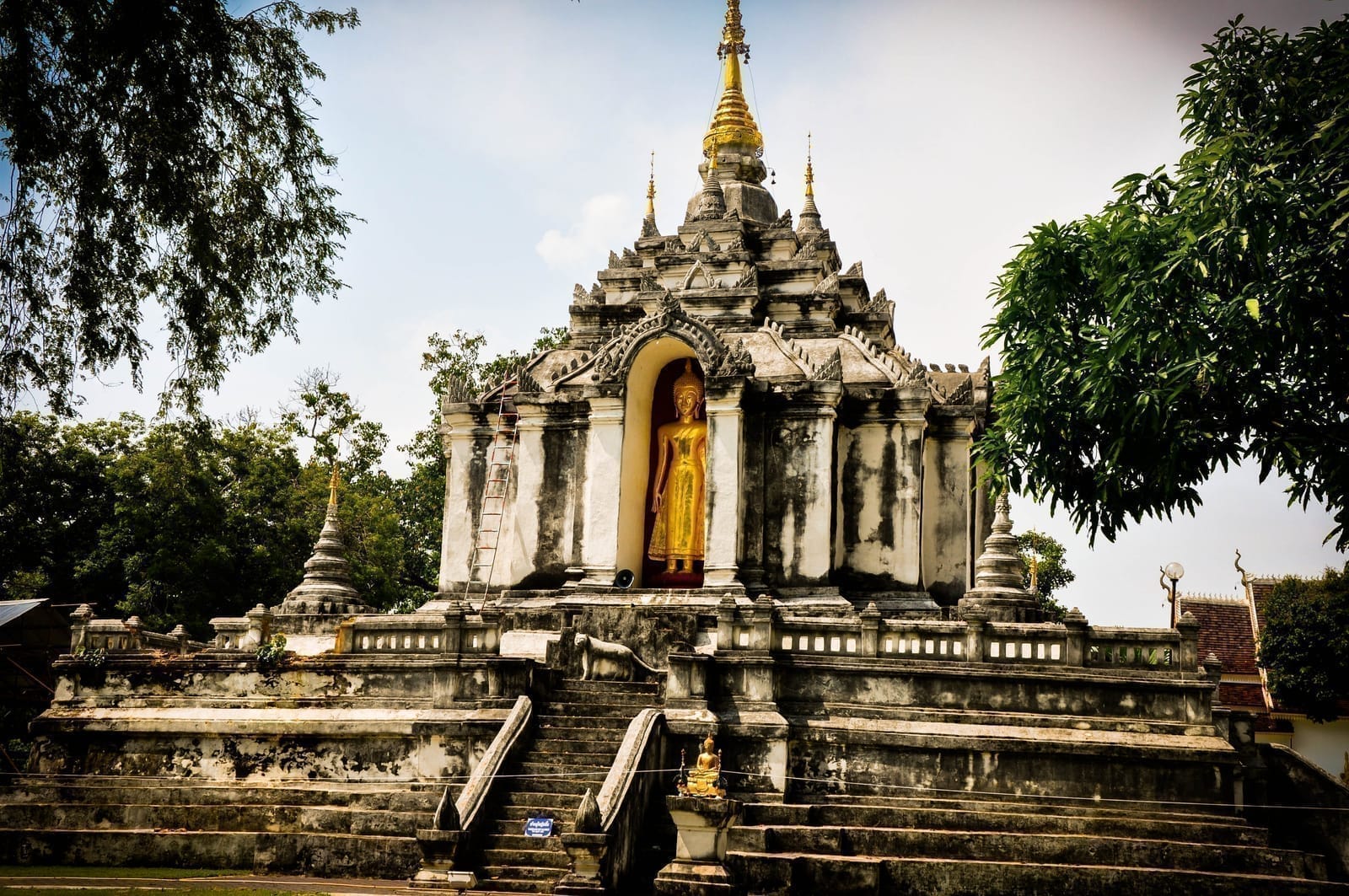
The highlight here is the Bagan-style chedi, which is rare to see in Thailand. Its form resembles the Sabbannu chedi in Bagan, built up in receding tiers, with stairs leading to an upper circumambulation terrace ringed by a low wall, plus small subsidiary chedis at each of the four corners. The square reliquary section has niches enshrining a standing Buddha on all four sides. Between 2005 and 2006, the Fine Arts Department restored the chedi and unearthed the head of a Hariphunchai-era Buddha image dating to roughly the 12th–13th centuries CE.
- Known for — a square, tiered Bagan-style chedi with standing Buddhas facing all four directions, rarely seen in Thailand
- Location — east side of the Kuang River, Wiang Yong sub-district, just outside the town centre
- Good for — fans of chedi architecture, wide-angle photography, and travellers who want to avoid the crowds, since not many people make it here yet
Best time to go
The chedi courtyard is open and gets fairly strong sun at midday, so come in the morning or late afternoon — the low-angle light shapes the chedi nicely and gives softer photos. Dress modestly, since this is an active historic site.
Wat San Pa Yang Luang — Lanna Stucco Artistry
Wat San Pa Yang Luang is an old temple over a thousand years old, in the Nai Mueang sub-district. It was originally a Brahmin religious site before becoming a Buddhist temple around 531 CE, and some texts consider it one of the earliest Buddhist temples in the Lanna region. What people talk about most is the ordination hall, whose decoration is so detailed it has been ranked among Thailand's most beautiful temple halls.
The Phra Chao Khiao Khong hall was built in 1993, using golden ironwood and red wood from Laos, Myanmar, and Thailand. It was designed and decorated by Khruba Inn (Phra Khru Panya Thammawat), blending old Lanna craft with contemporary work — stucco patterns, gilded designs, and colours that play beautifully with the light inside the hall. It's a temple where you can spend a long time studying the details without getting bored.
Phra Chao Khiao Khong Hall
The temple's main highlight — detailed stucco and gilded patterns, with the interior light playing across the work. Great for photos from every angle.
Temple grounds & Lanna art
Clean, shaded surroundings that are good for resting and paying respects unhurried, with Lanna artwork throughout the area.
Photo tip
The work inside the hall is detailed and packed with elements, so come in the morning or evening when the sun is gentler — the light is softer and there are fewer people. Inside the hall you should remove your shoes and keep your voice down, in keeping with temple etiquette.
A Half-Day Temple Route
Lamphun's town centre is small and most temples are close together, so with half a day you can visit all three without rushing. We've ordered the route to start from the town centre and work outward, finishing with the temple that takes the longest to look around.
Three temples, half a day (morning)
If you'd rather walk most of the way, pair Wat Mahawan with Wat Phra That Hariphunchai, which are on the same side. Wat Phra Yuen is on the other side of the river, so you'll want a vehicle. None of the three charges admission, but each has a donation box for those who'd like to contribute as they see fit.
- Dress code — modest, shoulders and knees covered, since all three temples are still used for religious ceremonies
- Getting around — in town, a motorbike or rental car is easiest; the distances between temples are short, but crossing the river is far more convenient with a vehicle
- Best time — morning or late afternoon, when the sun is gentler, the crowds are thinner, and the photos come out better
Plan a full day in Lamphun — temples, cafés, and local food
See the Lamphun travel guide →