🔄 Updated 21 Jun 2026
If you think of Lamphun as just a town you pass through on the way to Chiang Mai, stop and spend a day walking it and you'll change your mind. This is Nakhon Hariphunchai, the old kingdom Queen Chamthewi came to rule around the 7th century CE, even before Chiang Mai was founded. What makes walking Lamphun's old town fun is that everything sits close together: it's only a few minutes on foot from Wat Phra That to the outer city walls. And because the crowds aren't anything like the bigger cities, you get a calm atmosphere where you can actually take the history in.
The Conch-Shell Town Plan: Walls, Moat & the Kuang River
Start with the big picture. Lamphun's old town is laid out as a rounded rectangle shaped a bit like a conch shell, running parallel to the Kuang River on the east. The city walls are built of brick and mortar, with a moat running alongside them on almost all four sides, except the east, where the Kuang River served as a natural barrier instead. Walk along the moat in the late afternoon and you'll see the old brick lines and shady big trees. It's where locals come out to exercise.
- The walls and moat — still clearly visible in several stretches, especially on the west and south sides, where you can walk a long way alongside them.
- The Kuang River — flanks the town on the east, with a bridge crossing over to the Wat Phra Yuen side; a lovely spot to photograph the town in the evening.
- The conch-shell plan — easy to spot on a map; the streets inside curve along the line of the walls rather than running in a straight grid.
Want more out of Lamphun? Book tours & activities
Booking online ahead on Klook or GetYourGuide is usually cheaper than the gate and skips the queue. Pick only the experiences you actually want — prices and availability are shown live on each site.
The Six Ancient City Gates — Track Them All Down
Hariphunchai had six city gates set around the walls. Today some survive only as a name and a location, but a few still have remnants of brick wall to see. Tracking them all down turns into its own little historical treasure hunt.
- Pratu Tha Nang — the gate with the clearest surviving brick wall, on the east side by the Kuang River; a great spot to photograph that old-town feel.
- Pratu Li — the southern gate, whose name refers to an escape route in times of war; today it survives as a neighborhood name and a road junction.
- Pratu Mahawan — the western gate.
- Pratu Chang Si — the northern gate.
- Pratu Tha Kham / Pratu Tha Sing (Pratu Khua) — the two remaining gates on the east side along the Kuang River.
Insider tip
If you want to bag all the gates without wearing yourself out, rent a bicycle or motorbike in town and ride along the moat right around the town in one loop. The circuit isn't far, an easy ride in under half an hour.
Wat Phra That Hariphunchai, the Heart of the Town
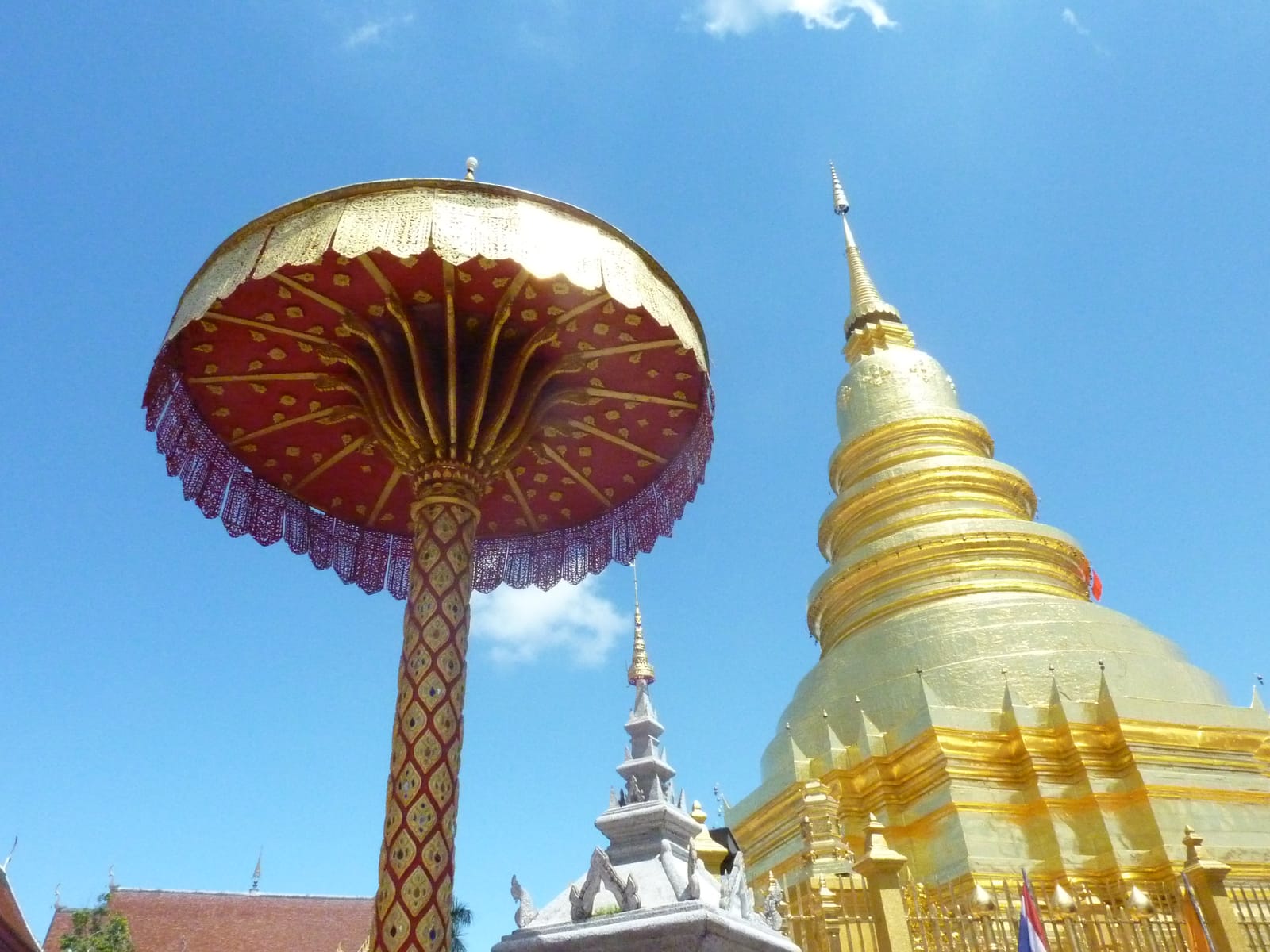
Wat Phra That Hariphunchai Woramahawihan is the center of the old town and the temple for people born in the Year of the Rooster. The gleaming golden, bell-shaped chedi stands tall and is visible from far off, built to enshrine relics of the Buddha back in the reign of King Adittayarat, the Hariphunchai king who succeeded Queen Chamthewi's line. Inside the grounds you'll also find old gateway arches, paired lion statues, and an old bell tower to wander past. Entry is free every day, and you can walk in from morning to evening.
- Best time — before 9am, when the sun isn't harsh yet and the golden chedi looks gorgeous against the sky, or late afternoon before sunset.
- Dress code — this is a sacred temple, so dress modestly with shoulders and knees covered.
- Around the temple — step out the front gate and you'll find local sweets, souvenir shops, and several cafes to drop into.
Wat Chamthewi (Wat Ku Kut), Thousand-Year-Old Craftsmanship
Walk or drive outside the city walls to the west along Chamthewi Road and you'll reach Wat Chamthewi, known to locals as Wat Ku Kut. The highlight is the Suwan Chang Kot chedi, a stepped square stupa with standing Buddha images set around each tier, true Hariphunchai art that's hard to find anywhere else. It's believed to hold the ashes of Queen Chamthewi. The stillness of this temple really makes you feel its thousand years of age.
Know before you go
The name "Ku Kut" comes from the chedi's spire being broken off (kut means lopped or stunted). Look for why the top isn't pointed like an ordinary chedi and you'll understand where the name comes from.
Ku Chang, Ku Ma & the Queen Chamthewi Monument
Not far from the town on the north side are the ancient monuments of Ku Chang and Ku Ma. Legend says Ku Chang holds the remains of Queen Chamthewi's royal war elephant, while Ku Ma is believed to enshrine the remains of the royal horse of Prince Mahantayot, her son. Locals revere Ku Chang as sacred and regularly come to pay respects and make wishes. Another stop you shouldn't miss is the Queen Chamthewi Monument, honoring the first monarch who brought Buddhism, art, and culture to this region; it stands in Nong Dok public park on the south side of town.
Ku Chang & Ku Ma
Two cylindrical ancient monuments outside the town on the north side, where Lamphun locals come to pay respects and make wishes for strength and success.
Queen Chamthewi Monument
A wide plaza in the middle of Nong Dok park, a good starting point for understanding the town's history before you set off to see the temples.
Hariphunchai National Museum
If you want to understand what you're seeing in the temples more deeply, stop by the Hariphunchai National Museum, right across from Wat Phra That. It holds Hariphunchai-style Buddha images, ancient inscriptions, and pottery excavated in the area. Admission is cheap and an hour of wandering is enough to leave satisfied. It's the kind of stop that lets you see far more once you carry on walking the old town.
- Location — 122 Inthayongyot Road, Nai Mueang subdistrict, directly across from Wat Phra That Hariphunchai.
- Opening hours — Wednesday to Sunday, 9:00am–4:00pm (closed Monday, Tuesday, and public holidays).
- Admission — tens of baht for Thai visitors, a few hundred for foreigners, very reasonable.
A One-Day Lamphun Old Town Walking Plan
If you've only got one day, you can comfortably cover all the highlights. Every spot is within walking distance or just a few minutes' drive. Here's the smoothest route.
The Heart of Town & the Museum
Old Temples & the City Walls
A Cafe Break & Sunset
Cafes to Rest Your Feet Around the Old Town
Walking the old town all day means you'll need somewhere to pause, and happily Lamphun has plenty of new-generation cafes that have opened around Wat Phra That, with good vibes and within walking distance.
Temple House Lamphun
A cafe right next to Wat Phra That; the ground floor is a relaxed seating area with souvenirs, while upstairs is an art and photography gallery. Great for resting and soaking up the old-town atmosphere.
Yann
A second-floor cafe just past the traffic-light junction beside Wat Phra That, only a short hop away. Plenty of specialty drinks and sweets, with a view down over the old-town street.
Black to Basic
An open, airy spot near Wat Phra That decorated in loft style, perfect for escaping the afternoon heat and recharging before you carry on.
Blacksmith
A coffee shop shaded by trees, about 1 kilometer from Wat Phra That, with a chilled-out feel that's great for settling in for a long afternoon.
Straight talk
Many Lamphun cafes are small local-run spots, and some close on weekdays or have a regular day off each week. Check the shop's page before you go, especially if you've got your heart set on one place in particular.
How to Get to Lamphun & the Easiest Way to Walk the Old Town
- From Chiang Mai — drive or take a songthaew/minivan, about 30–40 minutes; it's only 26 kilometers, easily done as a day trip.
- By train — there's a Lamphun station on the northern line, only about 20–30 minutes from Chiang Mai, with a classic atmosphere.
- Around the old town — you can walk to nearly everything, or rent a bicycle/motorbike in town if you want to reach Ku Chang and Wat Chamthewi outside the walls.
Plan a full Lamphun trip — temples, cafes, and food all in one
See the Lamphun travel guide →