🔄 Updated 21 Jun 2026
When people think of Samut Songkhram, most picture Amphawa floating market, the Maeklong Railway (umbrella) Market, or the fireflies. But there's another image that's just as true to this area: the sea-salt fields along the Gulf of Thailand coast. The salt here is well known enough to be registered as a GI product (geographical indication) under the name "Mae Klong sea salt," and the farming is still done the old way — sun, wind, and time, waiting for seawater to crystallise, with nothing to speed it up.
The nice part is that it's easy to reach and free to visit. The salt pans line both sides of the coastal road around Bang Kaeo–Khlong Khon sub-districts and carry on toward Bang Taboon in Phetchaburi. You can just pull over and walk out to take photos — though there's a bit of etiquette worth knowing first, which we cover below.
What are the Samut Songkhram salt fields, and why go
A salt field is a set of shallow pans where salt farmers let seawater in layer by layer, then use the sun and wind to evaporate it down to salt crystals. The beauty is in the clear water surface mirroring the sky, set against the cone-shaped white piles the farmers rake together, and the wooden windmills used to pump water. The whole scene reads like open-air art that shifts colour through the day.
- Free entry, free photos — the pans sit right by the road, so you can park on the shoulder and shoot. No admission fee.
- Wide, sweeping views — great for minimalist shots, water reflections, and panoramas at sunset.
- A real working way of life — come during harvest and you'll see farmers raking salt and hauling it in baskets, a scene you can only catch in a handful of places in Thailand.
- Close to Bangkok — about 70–80 km away, a little over an hour's drive. An easy day trip.
Want more out of Samut Songkhram? Book tours & activities
Booking online ahead on Klook or GetYourGuide is usually cheaper than the gate and skips the queue. Pick only the experiences you actually want — prices and availability are shown live on each site.
The right timing — salt season & golden hours
The salt fields aren't beautiful year-round, because the work follows the season. The key is strong sun and little rain. Go at the wrong time and you may find empty water-logged pans with no salt piles to shoot.
- Salt season: roughly November–April — farmers start once the rains end (after Buddhist Lent). The first batch of the year usually comes around January, with output climbing through the dry, high-sun months.
- Peak for the salt piles: January–April — this is when the piles are biggest and whitest, the best time for photos.
- Rainy season (May–Oct) — the fields rest or sit flooded, so you won't get the white salt piles you see in review photos.
As for time of day, there are two windows for good light: early morning (soft sun, still water mirroring the sky) and the evening before sunset, around 5:00–6:30 pm, when the sky turns orange and purple against the salt piles. That's when the most photographers gather and wait.
Check before you head out
Read the forecast. A clear day with thin clouds gives a better sunset than a completely cloudless or overcast one. And if it rained the day before, the salt piles may have been collected or partly dissolved.
Sunset photo spots & the best angles
The main route people take for salt-field photos is the coastal road that branches off Rama II Road down toward Khlong Khon–Bang Taboon–Ban Laem. It's a secondary road that runs alongside the salt fields for a long stretch, with plenty of places to pull over. Here are the spots that locals and photographers recommend.
Bang Kaeo salt fields
Roadside salt pans around Bang Kaeo sub-district, which the province promotes as a place to learn about the salt-farming way of life. Plenty of salt piles, windmills, and water-reflection angles to shoot.
The Khlong Khon–Bang Taboon road
A coastal road flanked by salt fields on both sides. Drive along and pull over wherever an angle catches your eye — a favourite among photographers who like to shoot on the move.
Chaloem Phra Kiat Bridge (Bang Taboon Bay)
Just over the line into Ban Laem, Phetchaburi, this is a well-known spot to watch the sunset over the bay — a good way to cap off a salt-field trip before heading back.
- Water-reflection angle — crouch low so the camera sits near the water and you catch the full sky and salt piles mirrored — clean and glass-like.
- Silhouette against the piles — at sunset, stand on a dyke with the light behind you for a dark silhouette cutting against the orange sky.
- Windmill angle — the wooden water-pumping windmills are the signature of these salt fields; put one in the frame and it tells the story well.
- Dyke-line angle — use the long, straight dykes as leading lines for a clean minimalist shot.
How the salt is made — it doesn't come easy
The charm of the salt fields isn't only in the pretty pictures — it's in the story behind them. Sea-salt farming is work that means reading the sky, the wind, and the water, and it still runs mostly on manual labour. Roughly, the steps go like this.
- Let seawater into the pans — farmers pump seawater in to settle through a series of layered pans, gradually raising the brine's concentration.
- Sun and wind — the sun and wind evaporate the water bit by bit until the brine is salty enough to crystallise. This stage takes several days.
- Harvest the flower of salt — the thin film of crystals that forms and floats on the surface before sinking is called "flower of salt" (dok kluea). It's considered a premium grade — fine and white — used in cooking, traditional medicine, and skin-exfoliating spa treatments.
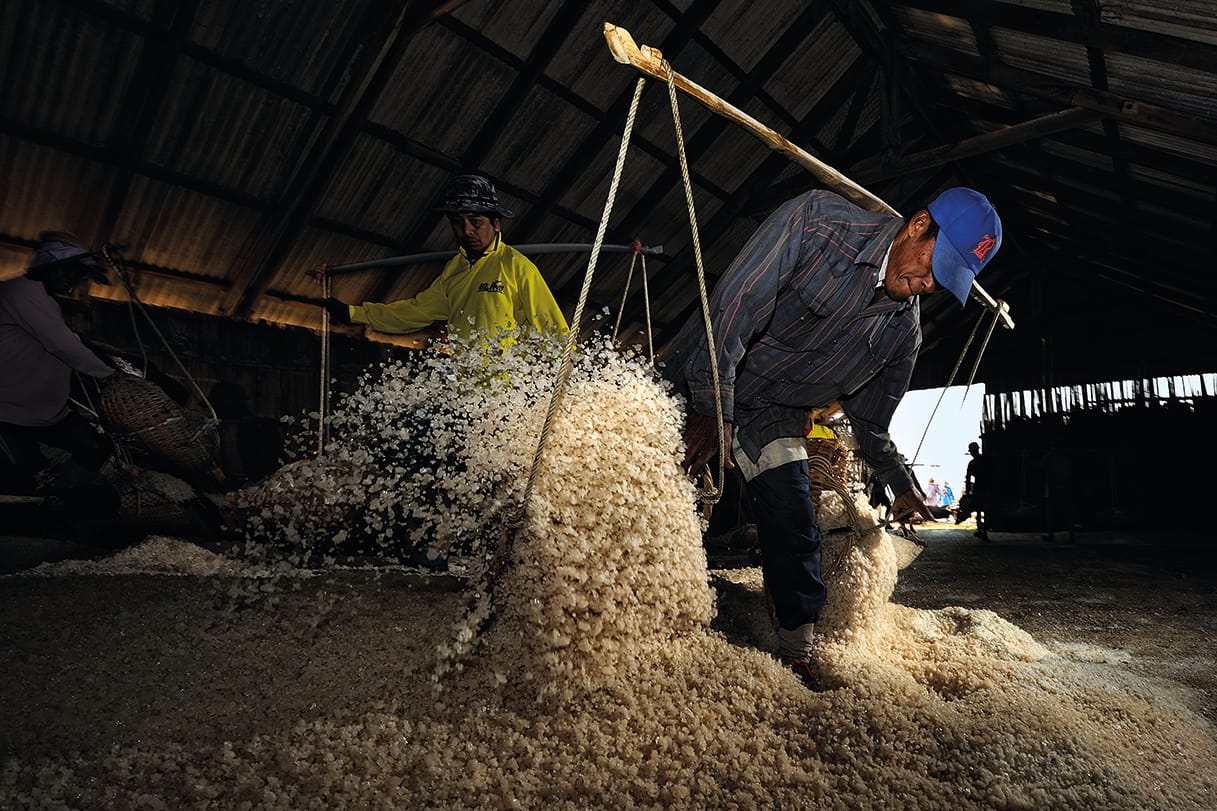
- Rake and haul — salt that settles to the bottom is raked into piles, then carried in baskets to the salt barns. It's a labour-intensive scene that gets rarer every year.
A souvenir to take home
If you spot farmers selling salt by the road, pick some up. Natural flower of salt runs about ฿30–35 per kilo bag, while regular sea salt is cheaper. It's a light, genuinely useful souvenir, and buying it supports the salt farmers directly.
Stop at a salt-field cafe — Salt Lake de Maeklong
If you'd rather sit with the salt fields in air-con and a coffee, stop at Salt Lake de Maeklong in Bang Kaeo sub-district, on the inbound side of Rama II Road (around the 58 km mark). It bills itself as Thailand's first salt-field cafe, telling the story of salt and Mae Klong mackerel through its menu and setting. The upper floor is a cool glass room overlooking the fields, while the open ground floor lets you walk out to photograph the windmills and salt pans.
- Hours — roughly 10:00 am–6:00 pm (often closed Wednesdays; check their page before you go).
- Per person — about ฿100–250, with savoury dishes, desserts, and drinks.
- What people order — the salt-field coffee (with a sea-salt note) is the signature many come to try.
To be straight with you, this cafe is stronger on concept and views than on the coffee itself. If you're here mainly for photos and to get out of the heat, you'll like it; if you're a serious coffee person, it may leave you a bit flat.
Pairing the salt fields with other stops in a day
The salt fields don't take long to actually shoot, so they pair well with other Samut Songkhram stops to fill a day. Here's a sample plan that lines up nicely with the light and the timing.
Markets – salt farming – sunset
For those who want to stay in Amphawa
How to get to the Samut Songkhram salt fields
- Private car (easiest) — from Bangkok take Rama II Road toward Samut Songkhram, about 70–80 km, then turn onto the coastal Khlong Khon–Bang Taboon road. Just drop a pin on "Bang Kaeo salt fields" or "Salt Lake de Maeklong."
- Van / coach — ride to Mae Klong town first, then take a local hire car or rent a motorbike out to the salt fields, since public transport rarely reaches the pans directly.
- Rent a car/motorbike in Mae Klong — handy if you didn't drive yourself. The coastal road is easy and scenic, but watch out for sun and strong afternoon wind.
Etiquette when visiting the salt fields
The salt fields are people's livelihood. Don't walk out and step into the water pans or onto the salt piles — it ruins the salt and damages the dykes. Shooting from the dykes or the roadside is plenty pretty already. And if you want a worker in your shot, a smiling ask for permission goes a long way.
Plan a full Samut Songkhram trip across the whole province
See the Samut Songkhram travel guide →