🔄 Updated 21 Jun 2026
The Khmer ruins trail in Maha Sarakham isn't as grand as Phimai or Phanom Rung, and that's exactly its charm: few crowds, quiet, and you can walk right up close without barriers blocking the view. The main sites here are arogyasala, the "hospitals" built under King Jayavarman VII around the 13th century CE, scattered through old communities, plus the former Dvaravati city at Na Dun. We've arranged them into a loop you can drive in a single day, or take at an easy pace over two.
What was Champa Sri, and why so many Khmer ruins here?
Present-day Na Dun district was once the site of a large ancient city called Champa Sri, which flourished roughly between the 8th and 11th centuries CE, contemporary with the Dvaravati culture of the Chi River basin. Later, as Khmer influence spread into the region around the 13th century CE, Khmer-style religious buildings were added on top, especially the group of arogyasala that King Jayavarman VII had built across his kingdom. That's why Maha Sarakham holds both Dvaravati traces and Khmer prasat in the same area.
The best thing to help it all make sense is the Champa Sri National Museum within the Phra That Na Dun grounds, which holds artifacts excavated locally, from terracotta votive tablets and pottery to Dvaravati-era evidence. We'd suggest stopping here before or after walking the ku, since it brings the whole picture into much sharper focus.
Read the signs before you walk
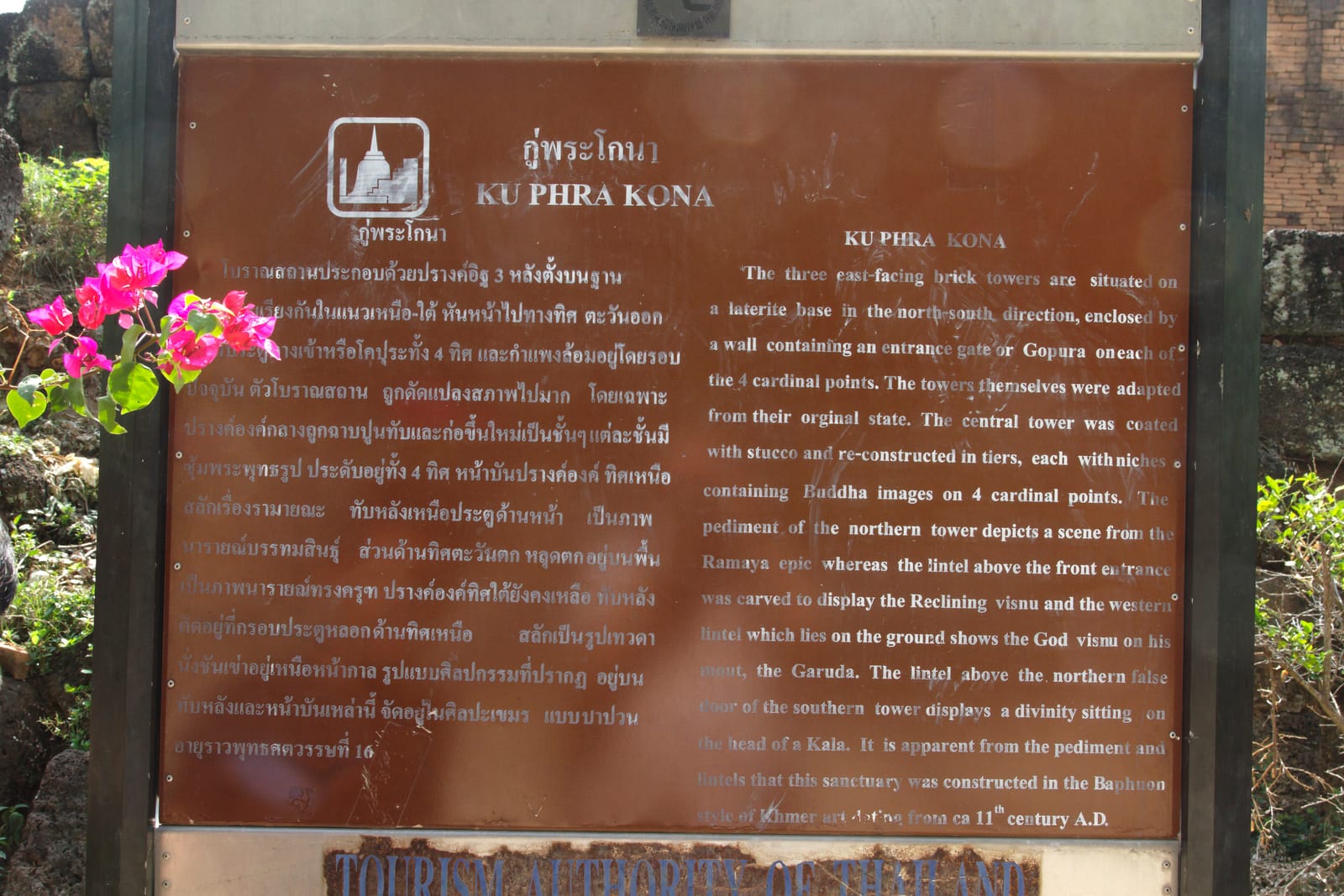
Each ku has a Fine Arts Department information board posted in front of the monument. Spend two minutes reading it before you walk in and it turns a pile of laterite into a story you can actually picture.
Want more out of Maha Sarakham? Book tours & activities
Booking online ahead on Klook or GetYourGuide is usually cheaper than the gate and skips the queue. Pick only the experiences you actually want — prices and availability are shown live on each site.
Stop 1 — Ku Santarat, the most complete arogyasala
Ku Santarat, which locals also call Ku Non Mueang, sits in Na Dun district and is the highlight of the trail because it's an arogyasala whose layout is still fully readable. It's built of laterite on a single-tier base, with the main tower facing east and a boundary wall framing a rectangular enclosure. It dates to the reign of King Jayavarman VII, around the 13th century CE.
- Main prang — built of laterite facing east; it once enshrined Bhaisajyaguru, the Medicine Buddha
- Library (bannalai) — a small building inside the boundary wall at the southeast corner, used to store scriptures
- Baray (pond) — a laterite pond to the northeast, roughly 10 x 12 metres, used in rituals and as a water source for the community
- Gate tower (gopura) — the eastern entrance, whose structure is still clearly visible
Every year the province holds a worship ceremony at Ku Santarat, marking it as a monument that locals still feel tied to and help look after, not just an abandoned ruin. Morning and late afternoon bring lovely raking light, better for photos and a cooler walk than midday.
Hours and admission
Ku Santarat is an open-air monument, free to visit with no admission fee, but it's best to go from midday to late afternoon since there's no lighting after dark.
Stop 2 — Ku Noi, paired with Ku Santarat
Not far from Ku Santarat is Ku Noi, also part of the ancient Champa Sri cluster. It's smaller and less of it survives, but it rounds out the picture, showing that this area once held several religious sites close together. If you have time it's just a few minutes on from Ku Santarat; navigating to "Ku Noi Na Dun" on a map is the easiest way to find it.
Stop 3 — Phra That Na Dun, the Buddhist landmark of Isan
The end of the trail is Phra That Na Dun, a large white chedi standing tall in the middle of grounds spanning more than 900 rai. Its story begins in 1979, when the Fine Arts Department and locals unearthed Buddha relics held in a bronze miniature stupa, buried in a mound in the middle of the rice fields. The evidence points to this being the heart of Dvaravati-era Champa Sri, so a chedi was built to enclose it. Designed by the Fine Arts Department in a style adapted from Dvaravati stupas, it stands roughly 50.5 metres tall on a square base about 35.7 metres on each side, completed in 1987.
- The chedi — walk the circumambulation path and pay respects; it's a deeply revered landmark for the people of Maha Sarakham
- Champa Sri National Museum — to the south of the chedi, displaying artifacts excavated in the area
- Gardens and open grounds — shady open space, good for an evening stroll
Champa Sri National Museum
Open Monday–Saturday, 8:00 a.m.–4:00 p.m., closed Sundays. The chedi itself is open for worship every day with no admission fee. If you want to visit the museum too, avoid Sundays.
Around February–March each year there's usually the Phra Borommathat Na Dun worship festival, a major merit-making event for the province. Come during that window and it's especially lively, though far more crowded than usual.
Bonus stop — Ku Ban Khwao, near the city
If you're leaving Maha Sarakham town and want to catch one ku before the long run down to Na Dun, Ku Ban Khwao — also known as Ku Mahathat (Prang Ku Ban Khwao) — sits in Khwao subdistrict, Mueang district, about 13 km from town along Chaeng Sanit Road. It's an arogyasala from the same group as Ku Santarat, built in the reign of King Jayavarman VII around the 13th century CE, made of laterite, with a compact square tapering tower. You can stop, take photos and have a look in a short time, making it a good opener before heading out of town.
The smoothest order to visit
For a single day, we'd suggest Ku Ban Khwao (near the city) first, then make the long run south to Na Dun and take Ku Santarat, Ku Noi and Phra That Na Dun as one group, so you never have to backtrack.
One-day plan: driving the Khmer ruins loop
Leaving town
The Na Dun ku cluster
Phra That Na Dun
The easy version: 2 days, 1 night
If you'd rather not rush the driving and want to mix in some nature and city cafés too, splitting it over two days is far more relaxed.
In town + Ku Ban Khwao
A full day in Na Dun
Before you go
Transport
This route works best with your own car or a rental. The ku are spread across different districts and public transport barely reaches them.
Clothing
You'll be walking out in the open on laterite courtyards. Bring a hat, an umbrella and comfortable walking shoes; the Isan sun is strong around midday.
Water
Some ku have no shops nearby, so keep water in the car and stock up in the district town before heading to the sites.
Etiquette at the monuments
Stick to the marked paths, don't climb on or sit on the ku, and don't pick up or move any laterite pieces. These are hundreds of years old and can't be put back.
Plan a full-day history trip in Maha Sarakham
See the Maha Sarakham travel guide →