🔄 Updated 21 Jun 2026
Long before the province we know as Maha Sarakham existed, this stretch of the middle Chi River basin was already home to settlements dating back to the Dvaravati era — one of the earliest waves of Buddhist culture to reach the Isan plateau, roughly the 7th to 11th centuries CE, or well over a thousand years ago. What survives today isn't the grand stone temples you find on the Khmer side, but smaller pieces of evidence that say a lot about belief: stone sema markers planted in the fields, clay votive tablets buried inside stupas, and pure Dvaravati-style sandstone Buddhas. We'll lay it all out as a single story — from the ancient city, to the great discovery, to where you can go and see the real thing right now.
Champasri — a Dvaravati city beneath the Na Dun fields
The heart of the story sits in Na Dun district, south of the provincial town. This was once the site of the ancient city of 'Champasri,' an oval town ringed by a moat and earthen rampart in the classic Isan Dvaravati layout. Archaeologists date it to roughly the 8th to 11th centuries CE. Within the old city and around it, you find the remains of religious structures, stone sema markers, and earthen mounds that were once stupa bases scattered across many spots. The city stayed forgotten for so long that locals just called these mounds 'non' or 'don pu ta' without knowing what lay beneath — until the major discovery in 1979 put the name Champasri back into the history books.
What sets Maha Sarakham apart from other Isan towns is having traces of two cultures stacked in the same ground. The lower layer is Buddhist Dvaravati; the upper layer, from a later period, carries Khmer influence laid over the top — like Ku Santarat and Ku Ban Khwao, the laterite prasats from the reign of Jayavarman VII. Getting to walk past both Dvaravati sema and Khmer ku in one trip is like reading two chapters of Isan history back to back.
Dvaravati in a nutshell
Dvaravati is the name scholars use for the cluster of Buddhist settlements in the central plains and Isan, roughly the 6th to 11th centuries CE — before the Khmer period and before Sukhothai. The telltale signs are sandstone Buddha images, clay votive tablets, stone Wheels of the Law, and, in Isan specifically, stone sema markers, which are barely found anywhere else in the country.
Want more out of Maha Sarakham? Book tours & activities
Booking online ahead on Klook or GetYourGuide is usually cheaper than the gate and skips the queue. Pick only the experiences you actually want — prices and availability are shown live on each site.
The 1979 discovery — a Buddha relic and tens of thousands of tablets
It started with a mound of ruins in a villager's rice field in Na Dun. In 1979 the Fine Arts Department worked alongside locals to excavate, and they found a bronze stupa holding a relic of the Buddha — said to look like a cloudy-white grain of rice — along with a huge trove of other artifacts. The find made national news and got the whole province paying attention to the heritage under its own soil. This discovery was the starting point for building Phra That Na Dun over the excavation site and setting up a museum to keep what remained.
- Clay votive tablets — around 1,000 found intact, plus roughly 18,000 broken fragments, with dozens of different Dvaravati-style designs
- Bronze stupa — a metal casket holding the relic of the Buddha, the centerpiece of the whole dig
- Clay molds — the master molds used to press the tablets, proof these were made locally rather than imported
- Gold-leaf fragments and fittings — offerings buried inside the stupa, reflecting the faith of the people of that era
What's interesting is that the Na Dun clay tablets didn't just stay in archaeology textbooks — they became amulets that amulet collectors prize highly, treated as genuine Dvaravati Buddhist art over a thousand years old. The ones the Fine Arts Department kept are on display in the museum, while those handed out or circulating in collector circles have their own long trail of stories. So this is both an archaeological legacy and an object of local faith at the same time.
Stone sema — the artifact that defines Isan
If you had to pick one object to stand for Isan Dvaravati, a lot of people would say the 'stone sema,' because it's found densely across Isan but almost never elsewhere in the country. A sema is a slab or pillar of stone planted to mark out a sacred boundary. The word 'sima' means boundary, and 'phattha' means to bind or fix — together meaning an area set aside for religious rites. But in Isan, Dvaravati-era sema carried a broader meaning. Many are tied to beliefs about ancestral spirits and to marking out a community's sacred ground, not just the monks' ordination boundaries we tend to think of today.
- Form — anything from rough natural stone slabs, to flat lotus-petal-shaped slabs, to pillar-like columns; some stand taller than a person
- Carving — many are carved with narrative scenes, such as a moment from a Jataka tale or the life of the Buddha; some bear a miniature stupa or an auspicious water vessel
- Placement — usually planted in clusters ringing a religious mound; some sites hold a whole forest of dozens of sema in one spot
- Age — dated to roughly the 7th to 11th centuries CE, contemporary with the city of Champasri
Across Maha Sarakham, stone sema turn up in several districts — around Na Dun, Kantharawichai, and the area around the old city. Some still stand where they were originally placed, at temples and on mounds; others have been moved into museums for safekeeping. If you want to see sema up close, walking through the Champasri museum and stopping at the old temples around Kantharawichai will show you the most.
Get more out of looking at sema
Try noticing which sema are plain smooth stone and which carry carved designs, because the ones carved with narrative scenes are considered rare and hold a lot of artistic value. If you find them out in the open, don't climb on them or lean against them — many are genuine pieces over a thousand years old still standing in their original spots.
Kantharawichai's standing sandstone Buddhas — Dvaravati that people still bow to
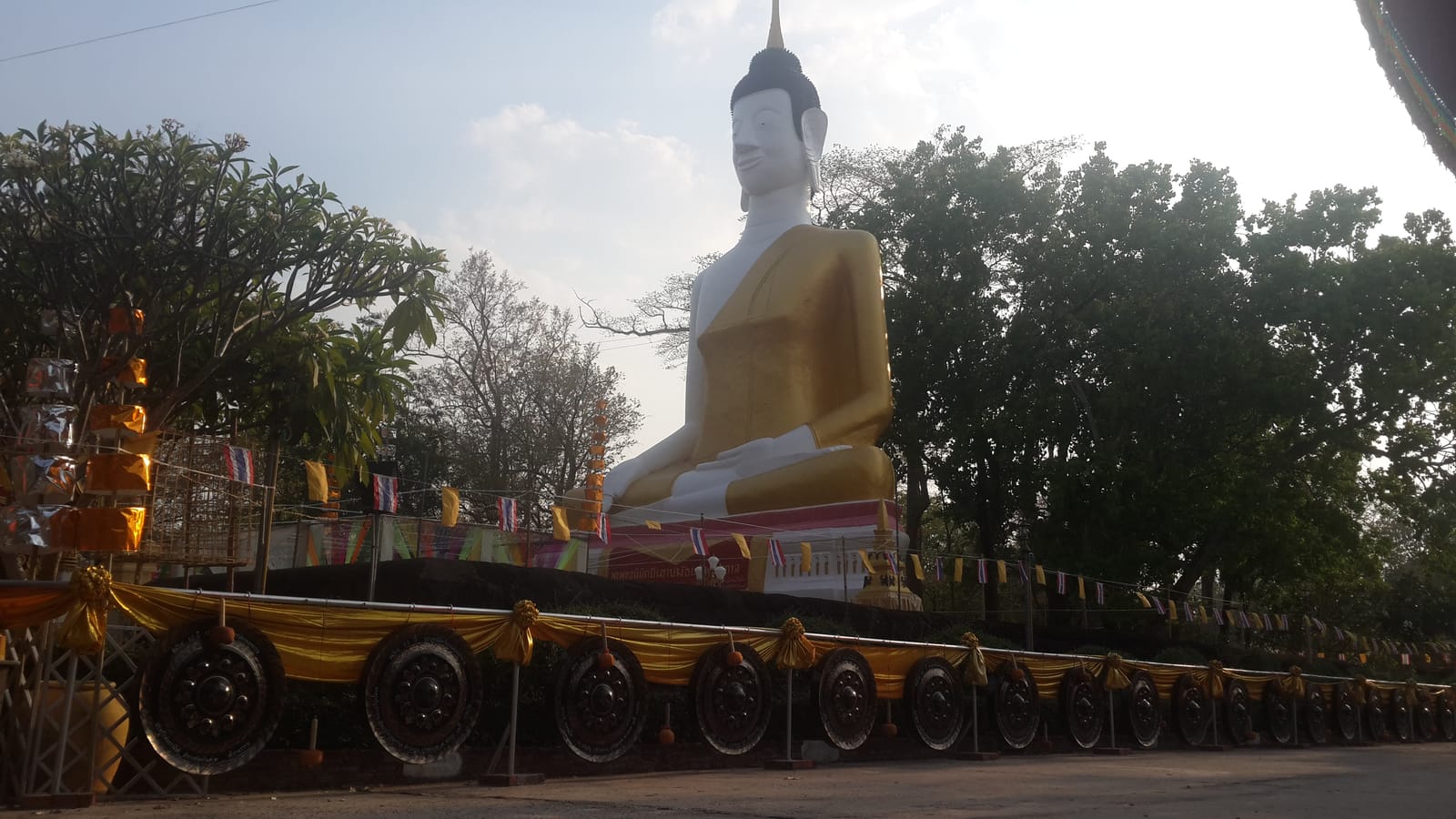
Another living trace of Dvaravati is Kantharawichai district, which was also an ancient moated, rampart-ringed town. Here you'll find two standing sandstone Buddhas in Dvaravati style, the town's twin guardian images. The better-known one is 'Luang Pho Phra Yuen,' or Phra Phuttha Mongkhon, at Wat Phuttha Mongkhon (Wat Phra Yuen) in Khanthararat subdistrict. Carved from sandstone, it stands about 4 meters tall, with a cylindrical face and a hip-swayed tribhanga posture — clearly Dvaravati workmanship. Stone sema stand planted near the image, marking this ground as sacred since ancient times. This pair of Buddhas has been registered as a national antiquity of importance since 1935.
What makes Kantharawichai compelling is that thousand-year-old objects are still genuinely revered in everyday life — not just sealed behind museum glass. Villagers still come to bow, there's an annual merit festival, and local legend says the standing Buddha was made during a drought to plead for rain in season. Standing in front of the image feels like touching a Dvaravati that's still breathing, not just dead ruins.
Champasri Museum — where you see the real artifacts
If you want to understand this whole story in one place, the Champasri museum is where to start. It sits in Phra That subdistrict, just south of Phra That Na Dun, built in 2000 as two connected Thai-style buildings. Inside, the story unfolds in stages — from the arrival of Buddhism, to the discovery of the Buddha relic, to the major artifacts dug up at Na Dun, to the area's role as a Buddhist center of Isan — shown through models, info panels, and accompanying video. The standouts are the dozens of genuine clay votive tablets and the detailed account of the excavation.
- Location — Phra That subdistrict, Na Dun district, near Phra That Na Dun, about 65 km from the town of Maha Sarakham
- Opening hours — roughly Monday–Saturday, 08:00–16:00 (closed Sunday); check ahead before long holidays
- Admission — free; large groups should contact ahead
- Combine with — walk up to Phra That Na Dun, then carry on to Ku Santarat in the same district with ease
Beyond the Champasri museum, anyone interested in Isan culture more broadly will find museums and exhibition spaces at Mahasarakham University in town that gather Isan arts and culture together — a good follow-on from the archaeology trail in the same day.
Plan a 2-day Dvaravati trail
The Dvaravati trail is spread across different corners of the province. The Na Dun side is to the south, while Kantharawichai is close to town. Splitting it into two days means you won't have to rush and you'll have time to actually stand and look at each piece. Here's a route that flows smoothly.
Na Dun side — the stupa, the museum, the Khmer ku
Kantharawichai side — sandstone standing Buddhas, sema, ku near town
Phra That Na Dun
The Buddhist Park of Isan: a white stupa built over the spot where the Buddha relic was unearthed, decorated with Dvaravati motifs and tablet designs. It's the anchor point for this town's whole historical trail.
Na Dun district · free entryKu Santarat
A laterite Khmer prasat from the reign of Jayavarman VII, built as a hospital chapel, near Phra That Na Dun. You can clearly see the gap between the Dvaravati and Khmer eras in a single trip.
Getting around and what to wear
The Maha Sarakham Dvaravati trail is easiest with your own car, because Na Dun and Kantharawichai sit in different directions and public transport within the province is sparse. If you don't have a car, many people fly into Khon Kaen and rent one for the roughly 1-hour drive over. At the stupa grounds and temples, dress modestly, bring an umbrella or hat since many spots are open and sun-baked, and leave extra time in the museum to read the info panels in full.
Plan a full Maha Sarakham trip — history, food, and places to stay
See the Maha Sarakham travel guide →