🔄 Updated 21 Jun 2026
If you're visiting Maha Sarakham and want to understand where this region really comes from, Phra That Na Dun is the place to start. It isn't a newly built stupa that just sits there for show — it was raised to enshrine Buddha relics that were genuinely unearthed here, on ground that was once an ancient Dvaravati-era town. Walk around the stupa, then carry on to the museum and the nearby Khmer sanctuary, and you'll come away with a fuller picture of Isan's history than a temple visit alone would give you.
What is Phra That Na Dun, and why call it the Buddhamonthon of Isan?
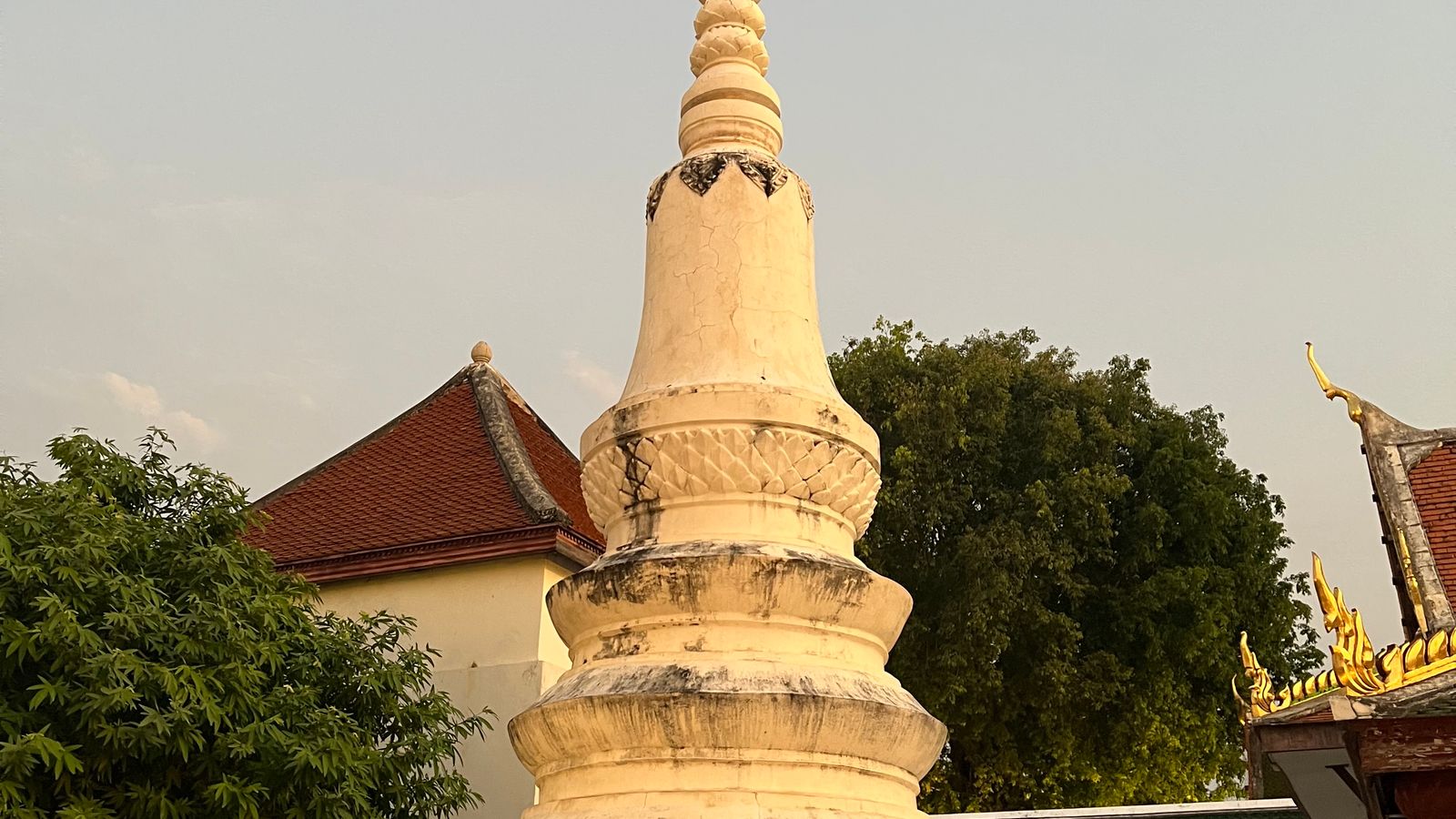
Phra That Na Dun stands in Tambon Phra That, Na Dun district, across a grounds of roughly 902 rai. The stupa itself is a white bell-shaped chedi, newly built in a form modelled on the clay votive tablets found in the area, and it enshrines the Buddha relics discovered in 1979. The surrounding land is laid out as a wide precinct with open plazas, an arboretum, a herb garden, and Buddha images in various poses — which is why people call it the Buddhamonthon of Isan: it was conceived as a centre of Buddhism and culture for the northeast.
The atmosphere here is different from a temple in town. The space is wide and breezy, and the white stupa stands out sharply against the sky. Early morning and late afternoon, when the light is soft, are the most comfortable times to walk and the best for photos. Locals come to make merit and circle the stupa, while travellers usually stop to see the stupa and the museum in one go.
Want more out of Maha Sarakham? Book tours & activities
Booking online ahead on Klook or GetYourGuide is usually cheaper than the gate and skips the queue. Pick only the experiences you actually want — prices and availability are shown live on each site.
The 1979 discovery of the Buddha relics
It started in 1979, when the Fine Arts Department, working with villagers in Tambon Na Dun, unearthed a stupa containing Buddha relics from a mound that turned out to be an ancient ruin in a villager's rice field. The relics looked like tiny crystal grains, set inside three nested reliquaries — gold innermost, silver in the middle, and bronze on the outside. Alongside them, a large number of clay votive tablets were found scattered across the same area, evidence that this had once been a sizeable Buddhist community.
After the discovery, Phra That Na Dun was built to enshrine the relics with proper honour, and the surrounding land was developed into the Buddhamonthon of Isan. That's why Phra That Na Dun carries value both as a place of faith and as a piece of history at the same time.
Nakhon Champa Si and the traces of Dvaravati
The whole Na Dun area is the site of the ancient city of Nakhon Champa Si (sometimes spelled Nakhon Champasri), a town that flourished in the Dvaravati period, around the 7th to 11th centuries CE. The city was laid out as a rounded rectangle ringed by a moat and earthen rampart, so the clay votive tablets and Buddha relics found here weren't stray finds in one spot — they were part of a real, lived-in ancient Buddhist town from over a thousand years ago.
Later, around the 11th century, Khmer culture spread into the area and left its mark in sandstone and laterite sanctuaries that still survive, such as Ku Santarat. That makes Na Dun a place where Dvaravati and Khmer civilisations overlap on the same ground — and anyone who enjoys history will have a great time connecting these dots.
What to see around Phra That Na Dun
The Phra That Na Dun stupa
The white bell-shaped main stupa, enshrining the Buddha relics. You can circle it to make merit, and the wide open plaza photographs beautifully in the morning and late afternoon.
Nakhon Champa Si Museum
On the south side of the stupa, displaying antiquities and clay votive tablets and telling the story of the ancient Dvaravati city of Nakhon Champa Si — it helps you grasp where the finds came from.
Arboretum & herb garden
Green space within the wide precinct, good for a stroll and a shady break, with planted species and walking and meditation Buddha images to pay respects to.
What to wear
This is a sacred site, so dress modestly — cover your shoulders and keep hems below the knee. Most of the plaza is open and exposed to the sun, so bring a hat or umbrella and drinking water. Before 10am or after 4pm are the most comfortable times to walk.
Khmer sanctuaries near Na Dun to add to your trip
- Ku Santarat — a Khmer sanctuary built of laterite and sandstone, thought to date from around the 11th century, when Khmer culture reached Nakhon Champa Si. It's in Na Dun district, a short drive on from the stupa.
- Ku Ban Khwao — another of Maha Sarakham's Khmer sanctuaries, on the same archaeological route. A good add-on for anyone who likes following the traces of Khmer civilisation.
- Local museums in the area — there are spots that tell more of the ancient-city story and show additional finds, helping you see Na Dun as an archaeological site, not just a place to pay respects.
If you're here for the history, pair Phra That Na Dun, the Nakhon Champa Si Museum, and Ku Santarat in the same day — they're all close together around Na Dun, the drive between them is easy, and the story runs in sequence from Dvaravati through to the Khmer.
How to get to Phra That Na Dun
Phra That Na Dun is about 65 kilometres south of Maha Sarakham town. We'll be straight with you: there's no public transport that reaches the stupa itself, so a private car or rental is by far the easiest option. From the city it takes a little over an hour, depending on the route.
- Private car / rental — the most comfortable way. Drive south from Maha Sarakham town for about 65 km; there's plenty of parking on site, and it's ideal if you want to add Ku Santarat and the museum in the same day.
- Bus plus motorbike taxi — if you don't have a car, take the Maha Sarakham–Buriram bus and get off at the Na Dun junction (around 60 THB), then take a local motorbike taxi the remaining 2.5 km to the stupa. Arrange your return ride in advance, as there aren't many for-hire vehicles in this area.
- Hire a car with driver for the day — good if there are several of you and you want to cover several spots around Na Dun without worrying about connections.
Opening hours and fees
The Phra That Na Dun grounds are open daily, roughly 8:00am–8:00pm, with no entrance fee. The on-site museum usually keeps daytime hours. Come from morning to early afternoon so you have time for the stupa, the museum, and Ku Santarat in one trip.
When to go, and the relic worship festival
You can visit year-round, but the liveliest time is the annual Phra That Na Dun worship festival, held around Makha Bucha (February–March), with crowds coming to make merit, walk with candles, and join cultural activities. If you love the feel of an Isan merit-making fair, it's a lot of fun — but if you want quiet and easy photos, skip the festival days and come on a weekday morning instead.
In the rainy season (June–October) the fields around Na Dun turn a lovely green, though the open plazas can get a bit wet and muddy. The cool season (November–February) brings the most pleasant weather and is the easiest time to walk around.
A one-day history trip around Na Dun
If you have a car, here's a one-day route that covers the Na Dun story in full — leaving Maha Sarakham town in the morning, taking in the stupa, museum, and Khmer sanctuary, then heading back into the city in the evening.
City → Phra That Na Dun → Museum → Ku Santarat
(If staying overnight) town, university district, and food
An honest heads-up before you go
Phra That Na Dun isn't a sight in the city — you have to commit to driving out to it. If you're after theme-park thrills, this may not be it. But if you like quiet places with a real story, and you want to understand Isan's Dvaravati roots, the trip is worth it. Sort out your transport from the start and the day goes much more smoothly.
Plan the full Maha Sarakham trip — food, sights, and places to stay
See the Maha Sarakham travel guide →