🔄 Updated 21 Jun 2026
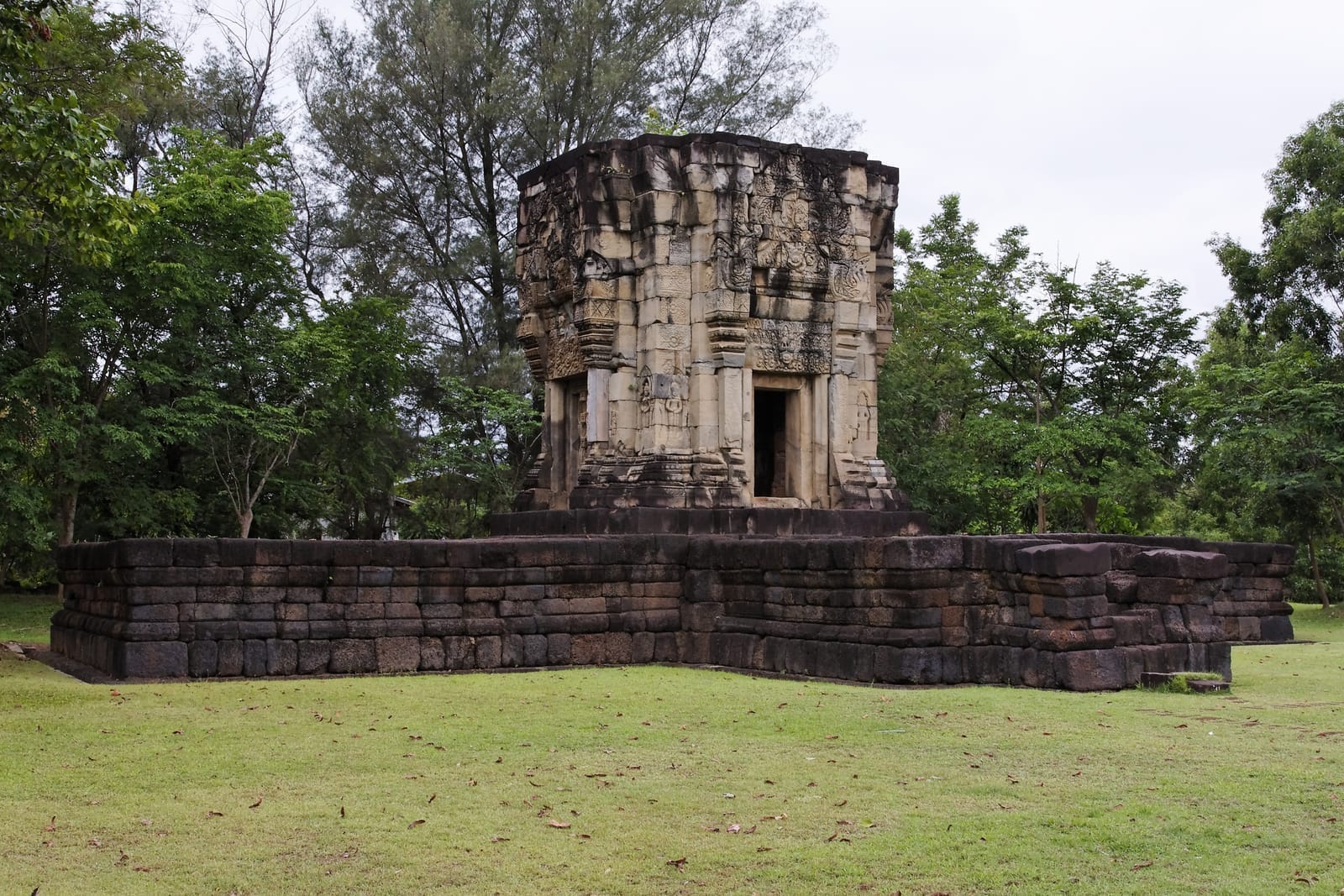
If you've driven out to pay respects at Phra That Na Dun and still have some time, Ku Santarat is worth the few extra minutes to stop by. It isn't grand, and it doesn't have the intricate carvings of the big stone sanctuaries over in Buriram or Surin. What makes it interesting is its old 'job'. This wasn't built as a temple to a god or a typical religious shrine — it was part of an 'arogayasala', a community hospital from the height of Khmer power, which you don't get to see very often in Thailand.
What is Ku Santarat, and why is it called an arogayasala?
Ku Santarat (sometimes called Prasat Ku Phra Santarat or Ku Non Mueang) is a Khmer-style monument built around the 13th century, during the reign of King Jayavarman VII — the Khmer king who followed Mahayana Buddhism. He had the idea to build 'arogayasala', or hospital-shrines, spread out among communities across the empire. An inscription at Ta Prohm temple in Cambodia records that more than a hundred arogayasala were built, and Ku Santarat is one of those that now falls within present-day Thailand.
The word 'arogayasala' comes from aroga (free of disease) and sala (hall), together meaning a place that frees you from illness. In practice it was both a hospital and a religious shrine in one. They enshrined Bhaisajyaguru, the Medicine Buddha of the Mahayana tradition, so the sick could come to pray and receive care at the same time. It's a good reflection of how the Khmer state ran public health some eight hundred years ago.
Want more out of Maha Sarakham? Book tours & activities
Booking online ahead on Klook or GetYourGuide is usually cheaper than the gate and skips the queue. Pick only the experiences you actually want — prices and availability are shown live on each site.
The laterite layout — how to read the temple and enjoy it
Khmer arogayasala follow a nearly identical standard layout almost everywhere, so once you know the plan, walking around makes a lot more sense. Ku Santarat is built mainly from laterite, set on a single-tier base and facing east in the Khmer manner. It's enclosed by a rectangular boundary wall with an entrance gate (gopura) on the east side. Here are the parts worth looking for:
- Main tower (prang) — the central building, built of laterite and facing east. It once enshrined the principal image of the arogayasala.
- Library (bannalai) — a smaller building to the southeast, facing toward the main tower. It's thought to have stored scriptures or been used for ceremonies.
- Boundary wall and gopura — a laterite wall framing the rectangular compound, with an entrance gate on the east side.
- Pond (baray) — a rectangular pool roughly 10×12 metres, sitting outside the wall to the northeast. Every arogayasala had one.
One interesting detail: archaeologists suspect Ku Santarat may never have been fully finished, because some of the stone slabs and pillars were never carved with patterns. Several sandstone lintels are still plain, with no scenes carved into them. That fits with the late part of Jayavarman VII's reign, when a huge amount of construction was happening at once across the empire — both in the royal capital and at the major temples — so many provincial projects were left unfinished.
How to really appreciate it
Look closely at the laterite and you'll see its distinctive porous texture. Laterite is essentially lateritic soil dug up while still soft, cut into blocks and then left to harden in the sun. It was easy to find in Isan, so they used it to build these temples instead of sandstone, which had to be hauled in from far away. Compared with a sandstone temple, you can really feel how the surface is rougher and the colour leans more toward a reddish brown.
The story of the ancient city of Nakhon Champasri
Ku Santarat doesn't stand alone — it sits within the ancient city of 'Nakhon Champasri'. Na Dun district was an important town all the way back in the Dvaravati period and on through the Khmer era, so the area holds both Dvaravati-style Buddhist remains and Khmer art in the same place. The Buddha relics that were excavated and later enshrined in Phra That Na Dun also came from around this ancient city. As for a seated Buddha image in the Bayon style found at Ku Santarat, it is now kept at the Khon Kaen National Museum.
If you want the full picture, it's worth stopping first at the Nakhon Champasri Historical Study Centre and the museum near Phra That Na Dun. You'll see that Ku Santarat is one piece of a city where people actually lived — not just a pile of stones in a field. When you come back and stand in front of the main tower again, it feels different.
How to get to Ku Santarat, opening hours, and is there an entry fee?
Ku Santarat is in Ku Santarat sub-district, Na Dun district, about 4 km from the Na Dun district office and roughly 60–65 km south of Maha Sarakham town. It's not far from Phra That Na Dun, so you can pair the two in a single trip. The route runs along easy rural roads, but it's a good idea to keep a navigation app open, since signage is fairly sparse.
- Location — Ku Santarat sub-district, Na Dun district, Maha Sarakham province (within the ancient city of Nakhon Champasri).
- Distance — about 60–65 km from Maha Sarakham town · about 4 km from the Na Dun district office · near Phra That Na Dun.
- Hours — an open-air historical site, visitable during daylight hours. Mornings or late afternoons are best to avoid the midday heat.
- Entry fee — free, no ticket needed.
- Getting there — easiest by private car; public transport is hard to come by.
Before you go
The site is an open clearing in the middle of fields, with strong sun and little shade, so bring an umbrella, a hat, and drinking water. Wear shoes you can comfortably walk on grass and stone in. In the rainy season the ground can get slippery. Food and shops are scarce out here, so it's best to grab a bite in Na Dun town or bring water and snacks of your own.
What else is there to see around Na Dun?
The nice thing about coming to Na Dun is that the historical sites are clustered close together — just a few minutes' drive apart — so it's easy to make a half-day of temples and archaeology that flows well.
Phra That Na Dun (Buddhamonthon Isan)
The landmark stupa of Maha Sarakham. The white stupa is modelled on the bronze reliquary in which Buddha relics were found in the ancient city of Nakhon Champasri. The grounds are a wide, shady plaza with a museum where you can browse the artefacts, and it's not far from Ku Santarat — easy to pair the two.
Nakhon Champasri Historical Study Centre
A learning centre about the ancient city of Nakhon Champasri and the artefacts dug up in the area. Visiting before the temple gives you much more context. It's over near Phra That Na Dun.
Ku Ban Khwao (Ku Mahathat)
Another Khmer arogayasala temple, this one in the Mueang district. It has been restored, so it reads more clearly as a structure, and it sits beside a pond. It's closer to town than Ku Santarat — a good stop if you're not heading out to Na Dun.
A half-day archaeology route at Na Dun
If you're coming to Na Dun to cover the temples and archaeology properly, try this half-day route — it loops smoothly without doubling back.
Phra That Na Dun → Nakhon Champasri Centre → Ku Santarat
Collect the whole province's Khmer temples
Maha Sarakham has several Khmer arogayasala temples scattered across different districts — Ku Santarat at Na Dun and Ku Ban Khwao near town, among others. If you're really into Khmer temples, try making a single trip to tick them all off across the province. You'll see how the arogayasala layout repeats, and how differently each one has weathered over time.
Plan a full Maha Sarakham trip — where to eat, what to see, where to stay
See the Maha Sarakham travel guide →