🔄 Updated 21 Jun 2026
A lot of people think of Maha Sarakham as a university town with cheap eats and a glut of cafes. But the place actually has deep roots, going back to the era when Khmer civilization spread into Isan. Ku Ban Khwao is one piece of that history, a modest stone sanctuary sitting in the middle of Ban Khwao village, Khwao subdistrict, Mueang Maha Sarakham district. It isn't grand and sprawling like Phimai or Phanom Rung, but it has a quiet charm and a story tied to the history of the whole Isan region.
This one suits people who genuinely care about history more than those who just want pretty photos, because what's left is a restored ruin rather than a complete structure. But if you read up on its background before you go, walking through it makes a lot more sense, and you start to picture what stood here a thousand years ago.
What Ku Ban Khwao is and why it matters
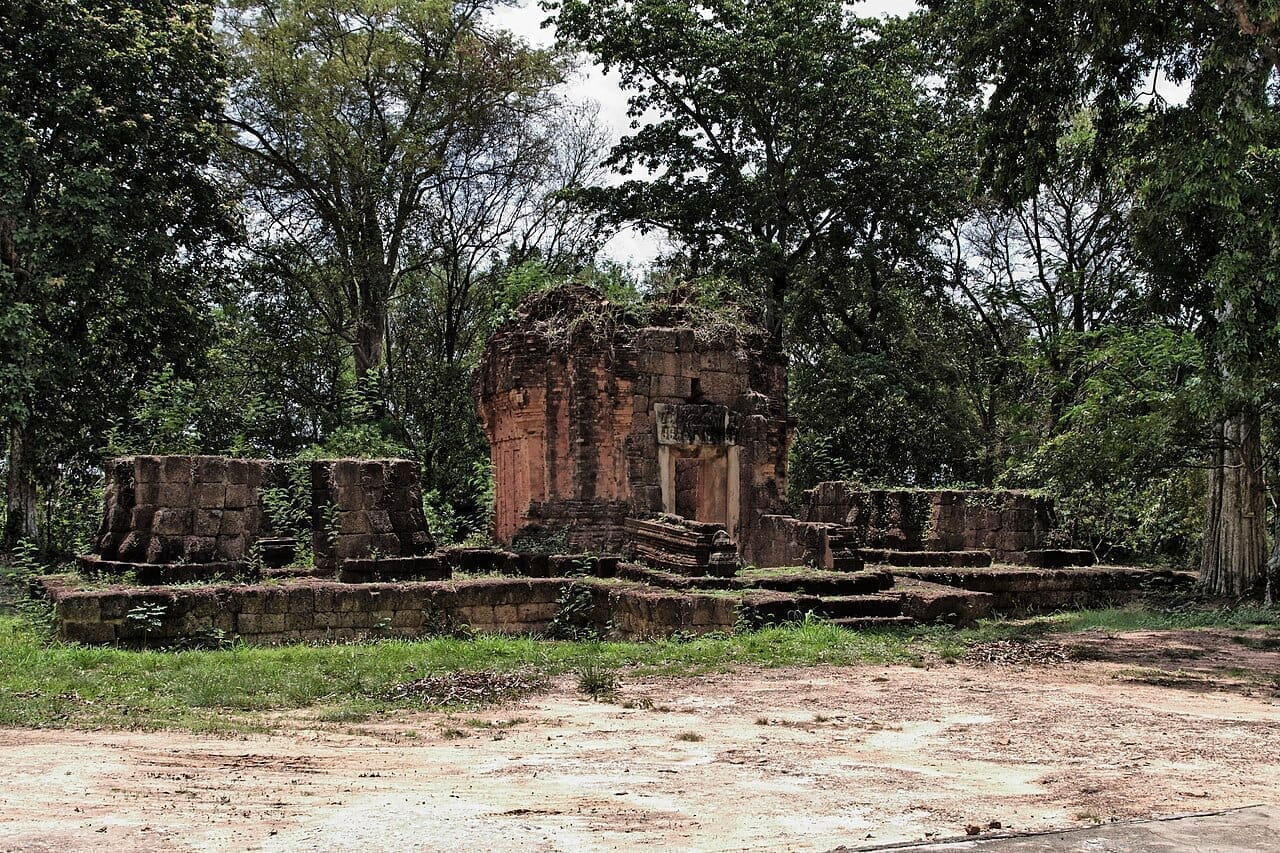
Ku Ban Khwao is a Khmer monument that Thailand's Fine Arts Department classifies as an arogayasala, a hospital chapel built during the reign of King Jayavarman VII, the Khmer king known for building these chapels across his kingdom, including what is now the Isan region of Thailand. The sanctuary is built in the Bayon style and dates to roughly the 13th century, around 800 years ago.
The word arogayasala doesn't mean a hospital in the modern sense. It was a religious site tied to healing of both body and mind, presided over by the Bhaisajyaguru, the Medicine Buddha. The sick came to pray and to be cared for according to the beliefs of that era. So Ku Ban Khwao isn't just a pile of old stone, it's a trace of the ancient public-health network the Khmer laid out along their important routes.
It goes by several names
This place has more than one name: Ku Ban Khwao, Ku Mahathat, and Prang Ku Ban Khwao all refer to the same site. If you're asking locals for directions, Ku Ban Khwao is the easiest one to use, since it's named after the village.
Want more out of Maha Sarakham? Book tours & activities
Booking online ahead on Klook or GetYourGuide is usually cheaper than the gate and skips the queue. Pick only the experiences you actually want — prices and availability are shown live on each site.
What the sanctuary looks like
The sanctuary is built mainly of laterite, laid up into a squarish tower-like shape. The main elements are a central sanctuary tower, a building in front called a bannalai (library), and a perimeter gallery wall forming a rectangle roughly 25 by 37 meters. The main entrance is a gateway, or gopura, on the east side, a layout you'll find across Khmer arogayasala sites.
Laterite was a material readily available in Isan, a porous reddish-brown stone that shows clear signs of weathering after such a long stretch of time. The sanctuary was restored using the anastylosis method, where the stones are dismantled and reassembled in their original positions according to academic principle, between 1997 and 1998. That brought the main structure back to a more stable standing form, even though the whole tower isn't complete.
- Central sanctuary tower — the main square laterite building, once home to the principal image of the arogayasala.
- Bannalai (library) — a small building to the front-right of the central tower, thought to have stored manuscripts or important objects.
- Gallery wall and gopura — a laterite perimeter wall with an entrance gateway on the east side, following the standard arogayasala plan.
Important finds from the site
What gives Ku Ban Khwao its historical weight are the artifacts found here. They include inscriptions in Khmer and Sanskrit script that help confirm the site's age and origin, a sandstone sculpture of Bhaisajyaguru Vaiduryaprabha, the Medicine Buddha often found alongside arogayasala sites, and an image of Vajrapani riding a Garuda. Some of these have been moved into museum collections for safekeeping.
Beyond the Khmer-era pieces, a silver-clad Buddha image in the Lan Xang style was also found in the area, a sign that after the Khmer period, later generations here kept using this site as a place of reverence. It's a layering of beliefs from several eras on a single spot, which is a common thing at Isan's historical sites.
It's more fun if you read up first
There's no resident guide at Ku Ban Khwao, and the explanatory signs may not be very detailed. If you want to fully understand the background, try reading the Fine Arts Department's information or the Sirindhorn Isan Information Center beforehand. You'll get a lot more out of the walk than just looking at a ruin.
Getting there and what to know before you go
Ku Ban Khwao sits about 13 km east of Maha Sarakham town. It's an easy drive: head out of town along Highway 23, the Maha Sarakham–Roi Et road, then turn off into Ban Khwao following the signs. A private car or motorbike is by far the easiest way, since public transport doesn't reach it well. The drive from town takes about 15 to 20 minutes.
- Location — Ban Khwao, Khwao subdistrict, Mueang Maha Sarakham district, about 13 km from town.
- Route — Highway 23, the Maha Sarakham–Roi Et road, then turn off into Ban Khwao following the signs.
- Opening hours — open daily, roughly 08:00–18:00.
- Admission — no entry fee, free to visit.
- Parking — there's a lot in front of the site, an open area within the village.
You won't spend long here. Walking around, taking photos and reading the signs takes about 30 to 45 minutes, so it works better paired with other stops in the same day than as a single destination. Early morning or late afternoon, when the light is softer, makes for nicer photos and a more comfortable walk than midday, when the Isan sun gets fairly harsh.
Continuing the Isan Khmer-temple trail from here
If you've caught the Khmer stone-sanctuary bug, Maha Sarakham and the surrounding provinces have several more ku to track down. Planning a single-day Khmer trail makes more sense than visiting one site at a time, since many of them are within an easy drive of each other.
Ku Santarat (Na Dun)
Another of Maha Sarakham's Khmer arogayasala sites, this one in Na Dun district, fairly well restored and often visited together with Phra That Na Dun.
Na DunPhra That Na Dun
An Isan Buddhist park set amid the fields, the spot where evidence of the ancient city of Nakhon Champasri was found. Easy to visit right after Ku Santarat on the same route.
Khmer trailMaha Sarakham Khmer Ku Trail
Strings together the Khmer sanctuaries and ku of Maha Sarakham into one route, so you can plan a full Khmer-civilization trail through Isan.
Plan your whole Maha Sarakham trip in one go, the Khmer sanctuaries, the cheap university eats and the student cafes.
See the Maha Sarakham travel guide →