🔄 Updated 21 Jun 2026
Most people who come to Nan eat khao soi, nam ngiao and sai ua, much like a trip to Chiang Mai — which is all good food. But drive past the town and up toward Pua, Tha Wang Pha and Thung Chang and you'll find a different set of dishes: the food of the Tai Lue, who migrated from Muang La and Muang Phong in Xishuangbanna (southern China) back in the reign of Rama V. Villages like Ban Nong Bua, Ban Ton Laeng (Tha Wang Pha) and Ban Don Mun still hold onto the language, the flowing-water weave (lai nam lai) textiles and the home cooking.
The appeal of Tai Lue food is that it's light, not heavy-handed, not sweet-forward — built mainly on seasonal wild greens and ferments, because this is the food of rice and field farmers who cooked with whatever grew around the house. Older Nan locals casually call it "plain home cooking," but once you try it you realize it runs deeper and is more moreish than you'd expect.
Tai Lue chili dips worth trying
The heart of a Tai Lue spread is the chili dip (nam prik), eaten with sticky rice and blanched or raw vegetables — a whole meal on its own. Each one tastes nothing like the nam prik num or nam prik ong you already know.
Nam Prik Nam Phak (fermented-greens chili dip)
The signature true-Tai-Lue dish. Whole mustard greens are fermented sour for about two days, then pounded with chili and garlic into a thick, slightly soupy dip with a tangy lead and a fragrant pickled-greens aroma. Eaten with sticky rice it's hard to stop — and you basically can't find it outside Nan.
Nam Pu (crab paste)
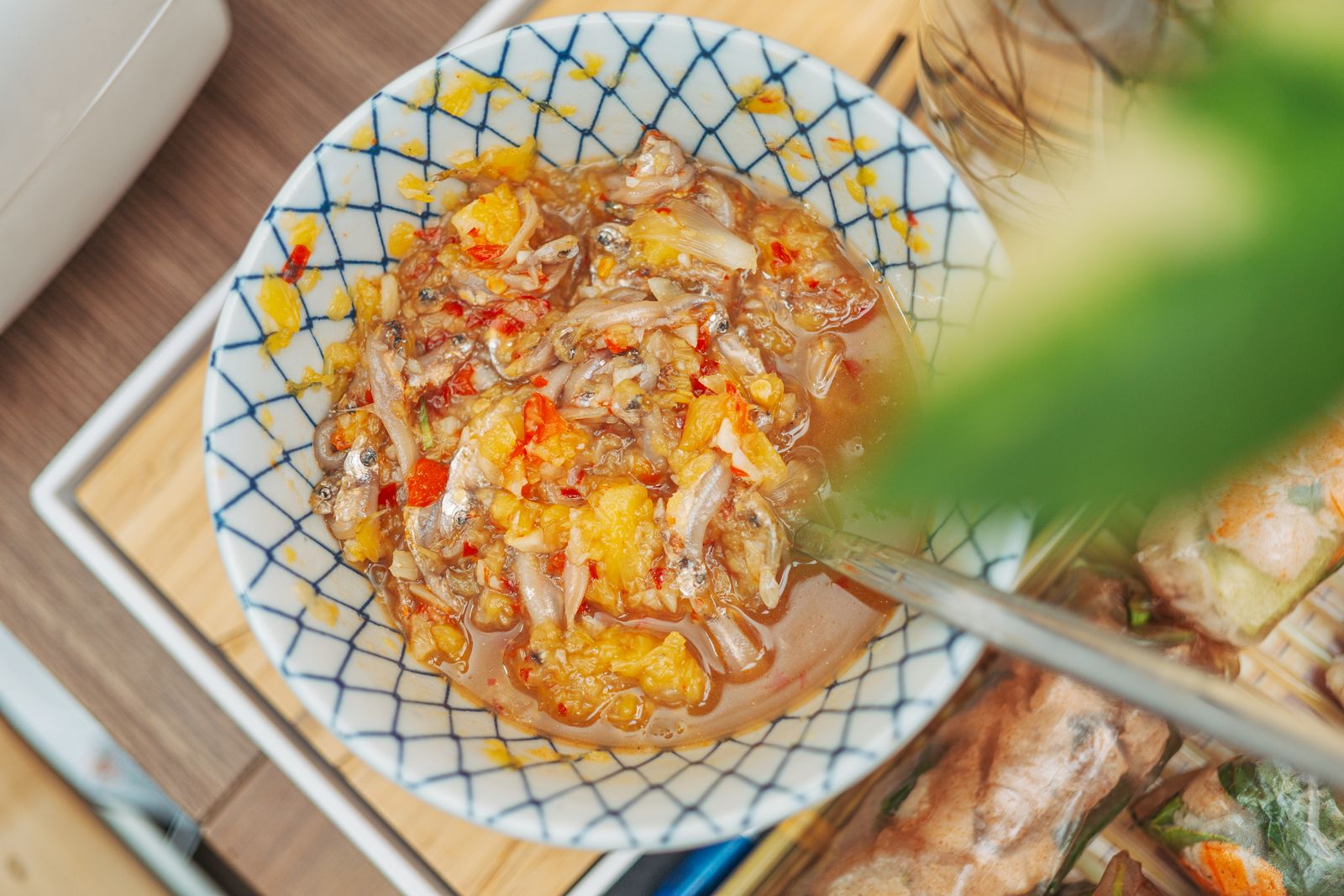
Tiny paddy crabs are pounded and pressed for their liquid, then simmered over low heat for more than a day until it reduces to a black, tar-like paste — intensely salty and umami. Used as a dip for vegetables or stirred into pomelo or eggplant salads. The smell is strong, but people who like it get hooked. It's a famous local souvenir around here.
Nam Prik Maengda / Nam Prik Ta Daeng
A dry local chili dip that's salty and spicy with a hint of sweet; some cooks add giant water bug (maengda) for a distinctive aroma. Eaten with steamed vegetables or simply mixed into sticky rice. It's the household chili dip that keeps for a long time.
Tua Nao + Tua Nao chili dip
Fermented soybeans pressed into discs and sun-dried (tua nao khaep), grilled until fragrant and then pounded into a chili dip, or used to season curries. It's a core ingredient in nearly every Tai Lue kitchen — salty and aromatic like fermented soybean paste, but deeper.
Jin Sam Prik
Grilled pork, cooked through, pounded with roasted chili and garlic and topped with sliced kaffir lime leaf — half chili dip, half main dish, fragrant with that grilled-spice note. A single plate with sticky rice fills you up. Tai Lue families make it on festival days.
Get the most out of a chili dip
Nam prik nam phak and nam pu both smell fairly strong. If it's your first time, order them with blanched vegetables (mustard greens, gourd, long beans) and hot sticky rice — the flavor rounds out a lot. Don't eat them on their own.
Want to taste deeper? Try a Nan food tour or cooking class
Half a day with a local who knows the lanes — or cooking a dish yourself — teaches you more than just eating. Book ahead on Klook or GetYourGuide.
Curries and local vegetable dishes
Tai Lue food leans mainly on seasonal wild greens. The rainy season brings mushrooms, bamboo shoots and pak wan; the cool season brings mustard greens and pak chiang da. So their curries shift with whatever's at the market rather than being fixed.
Gaeng Khae
A mixed-vegetable curry in one pot — acacia, ivy gourd, cha-om, wood ear mushroom, young rattan; some households throw in more than a dozen vegetables. Seasoned with tua nao and chili, with chicken or frog added, it's a well-rounded blend of many flavors. A household curry that lets you eat a lot of greens.
Khua Het (rainy season)
In the rainy season wild mushrooms come out in force — het thop (barometer earthstar), het ra-ngok, het lom — stir-fried with chili, garlic and lemon basil, or made into a curry with cha-om. The sweetness comes from the mushrooms themselves. A seasonal dish you'll only catch around June–September.
Gaeng Sanat / old-style mixed-veg curry
An old Nan curry whose name means "add a lot" — leftover vegetables from the kitchen all combined and seasoned with shrimp paste and kaffir lime leaf, giving a mellow, gentle curry. It's the kind of know-how that wastes no vegetables, and you'll find it at older local restaurants.
Local-veg salad / Pak Chiang Da
Pak chiang da (Gymnema) is stir-fried with egg or blanched for dipping in chili paste — mildly bitter with a sweet finish. Northern Thais consider it a blood-sugar-lowering vegetable. In the cool season you get pickled mustard greens, gourd and ivy gourd, rotating with whatever's at the market.
Pla Ping Ob / Pla Som
The Tai Lue live near the water, so fish is a main protein. Pla ping ob is herb-stuffed fish wrapped in banana leaf and grilled slowly; pla som is fish fermented with rice until sour, then fried or steamed — sour-forward with a salty finish, and it keeps for a long time.
- Khao Kaep — thin sun-dried rice-flour sheets, grilled or fried as a snack. A Tai Lue nibble you can pick up at Pua's morning market.
- Freshly steamed sticky rice — eaten with every dish above; the Tai Lue live on sticky rice like other northern and Isan Thais.
- Nam prik nam phak + blanched veg — the standard set every household has. A simple meal that captures Tai Lue identity best.
About the seasons
Many Tai Lue dishes are seasonal. Wild mushrooms and bamboo shoots arrive in the rainy season (Jun–Sep); mustard greens and cool-weather vegetables come in the cool season. If you want real wild mushrooms you have to come during the rains — don't expect them in the dry season.
Where you can actually eat local food
Up front: places with a sign that says "Tai Lue food" straight out aren't common — most are in the villages or only cook on festival days. But plenty of local restaurants around Pua and Nan town carry chili dips, vegetable curries and Tai Lue dishes on their regular menu. These are the spots Nan locals actually take you to.
Heuan Phukha (Pua)
A plain wooden-house restaurant in Pua cooking northern and local food with a true Nan hand — nam prik num, nam prik ong, vegetable curries, pak chiang da stir-fried with egg, pork fried with makhwaen. Easygoing seating close to the district center.
Khrua Sabiang (Pua)
Local northern home cooking in Pua district, focused on plain home-style dishes — chili dips, seasonal vegetable curries, fair prices. A good lunch stop while exploring Pua.
Kafae Ban Tai Lue (Pua)
A wooden-house cafe in the middle of the rice fields in Sila Laeng subdistrict, decorated with Lamduan's Tai Lue weaving, serving Phu Phayak–Mani Phruek coffee. Drop in to soak up the Tai Lue atmosphere; there are a few local snacks. Open 7:00–18:00.
Local restaurants on the Nan–Thung Chang route
Along the Nan–Thung Chang road (the way up to Pua–Thung Chang) there are local spots making sai ua, pork crackling, fresh nam prik num and river fish — easy roadside stops. For genuine Tai Lue dishes, though, you'll need to ask whether they have nam prik nam phak or nam pu.
Pua morning market / Thung Chang market
If you want to taste real Tai Lue food in the morning, walk the market — khao kaep, nam pu, nam prik nam phak, wild greens, seasonal mushrooms, ferments, sold by the bag. The place to buy edible souvenirs that are actually worth it.
Straight talk
We haven't sat down and eaten at every place ourselves. This list is drawn from Nan locals' reviews and local media; hours and menus may change, especially the village spots that open unpredictably. Calling ahead is safer, and some genuine Tai Lue dishes need to be ordered in advance.
Want real Tai Lue food? Which village to visit
- Ban Nong Bua–Ban Ton Laeng (Tha Wang Pha) — an old Tai Lue community, home to Wat Nong Bua with its antique murals and lai nam lai weaving; some households cook Tai Lue food for groups of visitors.
- Ban Don Mun / communities around Pua — a hub of weaving and Tai Lue life; walk the morning market and you'll find plenty of local food.
- Thung Chang — the northernmost district before the border, where Tai Lue, Hmong, Khmu and Lua live mixed together, so the food varies by ethnic group. Good for anyone who likes the real thing off the tourist trail.
If you want a serious Tai Lue spread, the best way is to contact a homestay or community tourism group in advance. They'll lay out a full Tai Lue khantoke with nam prik nam phak, gaeng khae, grilled fish and khao kaep in one meal — which you can't get at ordinary restaurants.
Plan a full eat-and-explore trip around Pua–Thung Chang
See the Nan travel guide →