🔄 Updated 21 Jun 2026
Talk about southern Thailand's traditional performing arts and two names always come first: nang talung and Manora. Phatthalung is the province bound up most deeply with both. Scholars believe Nora began around the Songkhla Lake basin, with a founding legend that ties it to the ruler of Phatthalung and a princess named Nuan Thong Samli. Nang talung, meanwhile, counts several of its great master puppeteers as people from these parts. So a cultural trip through Phatthalung isn't just about snapping photos with the puppets — it's about sitting and listening to people who have spent their whole lives on this craft.
Let's clear this up first, because plenty of people get them confused. Nang talung is storytelling through the shadows of figures cut from cowhide or buffalo hide, worked behind a lit white cloth screen, with one master puppeteer voicing every character, singing the verses and conducting the band all at once. Manora is a dance performed by real people in beaded costume and long metal nails, with set movements and improvised sung verse. They are two different things, but they usually turn up at the same temple fairs, merit-making events and rituals across the south.
Nang talung — shadow puppetry worked by one pair of hands
The magic of nang talung lives in the master puppeteer, who has to do everything alone: voicing the hero, the villain and the clowns so each sounds different, improvising verses that weave today's news and local life into the old tales, and keeping the band beside him in time. Phatthalung puppets have a detail most people never notice — the upper body is longer than the lower half, because puppeteers from these parts press the figure to the screen from the waist up, unlike other lineages who press the whole body flat.
The teacher the field reveres as its grand master is Nang Kan Thonglo, named a National Artist in the performing arts (nang talung) in 1986. He performed shadow theatre his whole life, thousands of times over, wrote hundreds of scripts and left students spread across the south. Though he was a Songkhla man, the Songkhla Lake basin lineage of nang talung joins Phatthalung and Songkhla into a single body, and many later carvers and puppeteers in Phatthalung trace their training back this way.
- The puppets — cut from thinly tanned cowhide or buffalo hide, either coloured or left as a black silhouette. Key figures like the hermit, Shiva and the clowns are treated as sacred and must be honoured before a show.
- The clowns — the heart of the fun, characters like Theng, Nu Nui and Si Kaeo. Every puppeteer has his own jokes and accents, and audiences come back for the clowns more than the heroes.
- The band — thap, drum, mong gong, ching cymbals and pi oboe set the rhythm, telling the audience whether things are turning sad, fun or about to kick off.
- The stage hut — a raised platform with a white cloth screen at the front and a light behind. The audience sits out front watching the shadows, while the real action is behind the screen where the puppeteer performs.
How to watch it properly
When you watch a real nang talung show, walk round behind the screen for a moment. You'll see a single puppeteer juggling figures in both hands, switching between a dozen-odd voices and improvising verse all at the same time. That's where the skill is, and from out front you'd never see it.
Want more out of Phatthalung? Book tours & activities
Booking online ahead on Klook or GetYourGuide is usually cheaper than the gate and skips the queue. Pick only the experiences you actually want — prices and availability are shown live on each site.
Masters' homes, an art house and a place to carve puppets
In and around Phatthalung town there are learning spots genuinely open to the public, not just sealed-off museums. Only a handful are well known and easy to reach. We've picked the ones still open with people actively working there, but because these are masters' homes and community groups, opening times are less fixed than at official sites. Calling or messaging ahead is the surer bet.
Nang Talung Art House, Phatthalung
On Phetkasem Road, opposite the City Pillar Shrine in Mueang Phatthalung district. Founded by local carvers and puppeteers, it has an open-roofed stage hut for shadow theatre inside and displays the puppets and the story of the shadow art. A good place to start if you're just getting into it.
Baan Nang Talung / Khao Chaison carving group
Near the front of Tham Phra cave in Khao Chaison district, led by the artist Khun Nok (Thawatchai Chuchit). The draw here is that they let you carve your own puppet, from sketching the design to punching it out, then take it home. Great if you're with kids or want a souvenir you made yourself.
Local nang talung troupes
Phatthalung still has several puppeteers who take bookings for temple fairs and merit-making events. If you want to catch a full night's performance for real, ask at the art house or TAT Phatthalung whether any temple fair during your visit has hired a shadow theatre troupe.
Roughly what it costs
Most art houses and masters' homes don't charge a fixed admission, but it's good to bring 50–100 THB to make merit or support the craft. A puppet-carving workshop where you take the piece home usually runs around 100–300 THB per person, depending on the size of the puppet and the group. Booking ahead gets you a firmer price and time slot.
Manora — a dance that is heritage of humanity
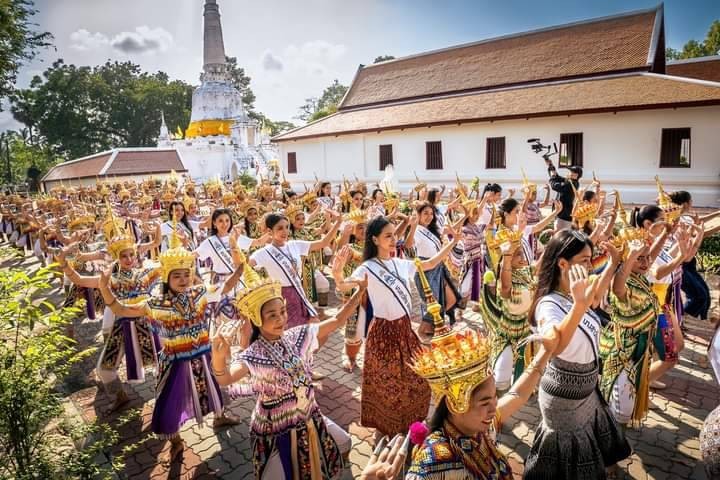
Nora was inscribed by UNESCO as intangible cultural heritage in 2021. What makes it special is the clearly patterned movements, the supple fingers, the long metal nails worn on the fingertips, the bead costume strung by hand into patterns, and the soet crown on the head. The dancer also has to improvise sung verse — it isn't just moving in time to a beat.
Nora's origin legend ties directly to Phatthalung. The story goes that the ruler had a daughter named Nuan Thong Samli, a gifted dancer. When she fell pregnant without a husband she was cast adrift on a raft, and finally gave birth to a son who trained in the dance and became the root of the Nora craft. Because of this legend, southerners treat Nora as a matter of ancestors and teachers, not just entertainment to perform.
- The costume — a hand-strung bead shirt, leg coverings, a swan tail, swallow-wing pieces and the soet crown on the head. Each outfit takes months to make.
- The nails — long metal nails worn on eight fingers, lengthening the hands and making them look graceful as you dance. They're the giveaway that tells you it's Nora the instant you see it.
- The music — thap, drum, mong gong, ching cymbals and pi oboe, much like nang talung, but with a faster, more driving rhythm because it has to carry the dance.
- Nora rong khru — not a stage show but a ritual to honour the teachers and ancestors, with specific dances you won't see at ordinary events.
Nora rong khru at Wat Tha Khae — the real rite, once a year
If you want to see Nora in a way that means more than a performance, the place to go is the Nora rong khru at Wat Tha Khae, Tha Khae sub-district, Mueang Phatthalung district. This temple is regarded as the site of an important rong khru hall for the local Nora lineage. The event is held every year in the sixth lunar month, around late April to May, when Nora dancers, descendants of Nora families and local people gather to honour their teachers and hold the rites.
The event includes rituals you'd struggle to see elsewhere, such as the swan-lassoing dance performed in homage to the ancestors, the crocodile-stabbing dance tied to beliefs about warding off misfortune, and the yiap sen rite, a traditional form of healing. The atmosphere is that of a genuine community gathering, not an event staged for tourists. If you go, carry yourself accordingly — treat it as taking part in a ceremony, not just turning up to take photos.
Go to the rong khru with the right manners
The rong khru is a sacred ritual, so dress modestly, take off your shoes where indicated, and feel free to photograph — but don't walk in front of the dancers or step into the ritual space. And if locals invite you to make merit or share a meal, accept the kindness gladly. That's the charm of a southern community gathering.
A 2-day, 1-night cultural itinerary
For anyone who wants to follow nang talung and Manora without rushing, here's a two-day plan that takes in the displays, the hands-on craft and a bit of Phatthalung's nature along the way. A private or rented car is the smoothest option, since the various spots are spread across several districts.
Phatthalung town — getting the backstory
Khao Chaison — carving a puppet by hand
If you have 3 days
Add a day for Thale Noi in the morning, to see the water buffalo and the red lotuses, and if you go in late April to May, time it to coincide with the Nora rong khru at Wat Tha Khae so you catch the real rite that sits at the heart of Phatthalung's Nora culture.
When to go and how to get there
- Timing — the art house and the carving group are open year-round, but to see the Nora rong khru at Wat Tha Khae you need to hit late April to May. Full-night nang talung shows usually fall during temple fairs and merit-making events, so ask around locally first.
- Getting there — fly into Hat Yai or Nakhon Si Thammarat and continue by road, or take the train to Phatthalung station. It's about 30 minutes from the town to Khao Chaison, and Wat Tha Khae is closer still.
- Transport — a rented or private car is the most convenient, since the cultural spots are spread across several districts and public transport within the province is thin.
- Contact ahead — masters' homes and community groups keep irregular hours, so call or message each place's page, or ask the TAT Phatthalung office, before you set off.
Plan a full Phatthalung trip across culture, nature and food
See the Phatthalung travel guide →