🔄 Updated 21 Jun 2026
Nong Bua Lamphu split off from Udon Thani in 1993 to become Thailand's 76th province. The town itself isn't big — you can drive a loop around it in a few minutes — so what's good here suits people who want to take it slow: pay respects at a forest temple, sit and watch the reservoir, and stop by an archaeological site older than most people expect. This isn't a place where you race through a checklist. We've gathered the main spots that locals and people passing through tend to stop at, all in one place.
Wat Tham Klong Phen — the town's forest temple of Luang Pu Khao
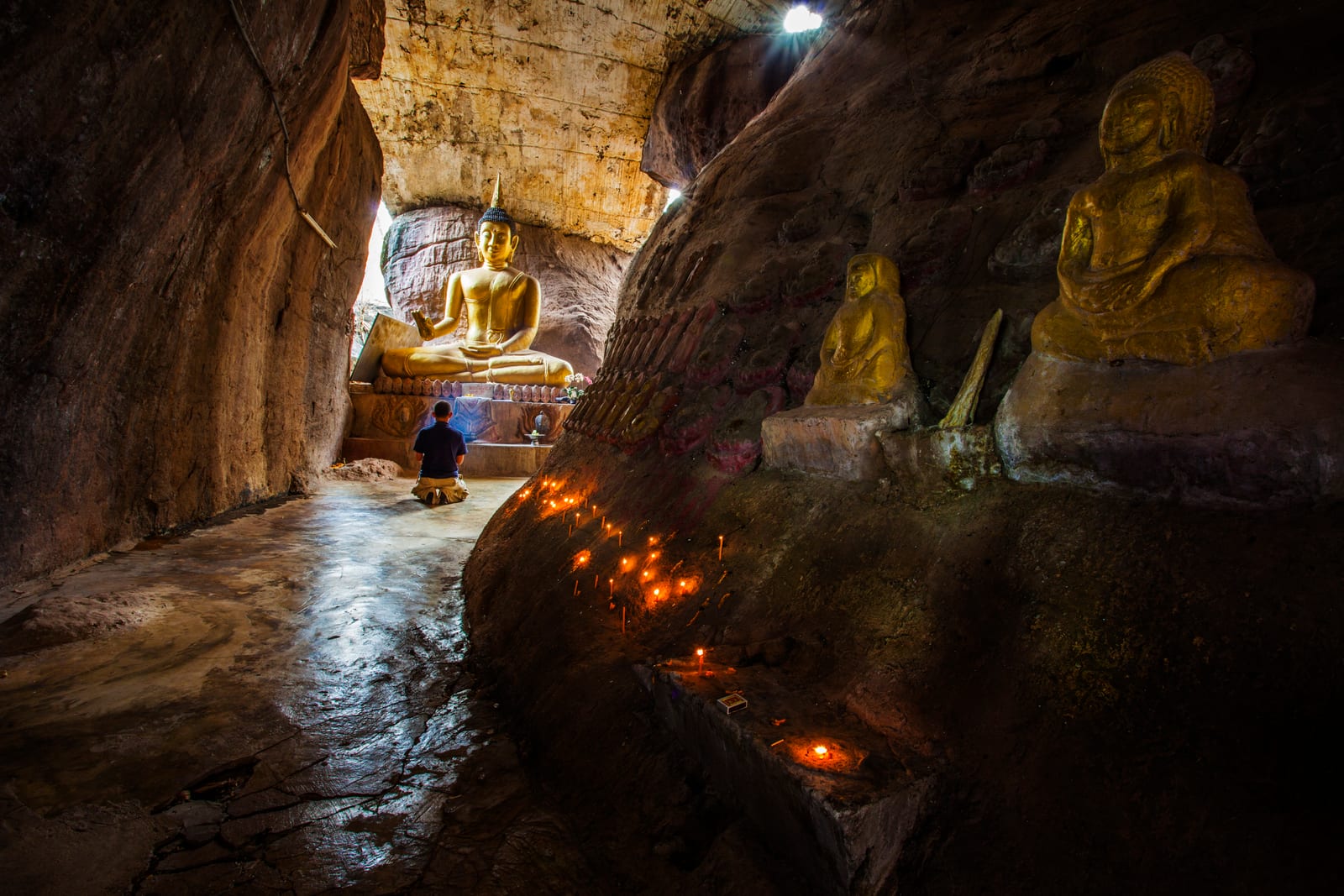
Ask anyone in Nong Bua Lamphu where you have to stop, and this is usually the first answer. Wat Tham Klong Phen is a sprawling forest temple on the lower slopes of the Phu Phan range. It was once the meditation retreat of Luang Pu Khao Analayo, a forest-tradition monk deeply respected across Isan. Inside, there's a cave that holds an ancient double-headed drum (klong) that gives the temple its name, a walking-pose Buddha image carved into the rock, and oddly shaped rock formations scattered across the grounds. The area is large enough to drive into, and the atmosphere is shaded, quiet, and calm.
Another highlight is the Luang Pu Khao Analayo Museum, which displays his monastic belongings and a wax figure made in his likeness for visitors to pay their respects. Anyone interested in the forest-meditation tradition shouldn't skip this. The temple is open during normal daytime hours, with no entry fee — dress modestly, as it's a practicing monastery.
Tip
Wat Tham Klong Phen is huge and it's not just one spot. Allow about 1–1.5 hours of walking to cover the drum cave, the rock garden, and the museum. Wear comfortable shoes, since you'll be walking across rock terraces and forest paths for a fair stretch.
Want more out of Nong Bua Lamphu? Book tours & activities
Booking online ahead on Klook or GetYourGuide is usually cheaper than the gate and skips the queue. Pick only the experiences you actually want — prices and availability are shown live on each site.
Phu Kao–Phu Phan Kham National Park — sandstone, forest, waterfalls
Phu Kao–Phu Phan Kham is Thailand's 50th national park, covering roughly 322 square kilometers across several provinces. It splits into two zones: Phu Kao, made up of nine interlocking hills with forest, caves, waterfalls, and wide rock terraces, and Phu Phan Kham, a ridge running alongside the Ubolratana Reservoir. The Nong Bua Lamphu side is reached via Non Sang district. It suits people who like easy hiking and nature photography, and from late rainy season into early winter the trees are green and the weather is just right.
- Rock terraces and caves on Phu Kao — walking trails cross sandstone terraces and oddly shaped boulders, good for photos and short hikes.
- Wat Phra Phutthabat Phu Kao — at Ban Dong Bak, Nikhom Phatthana subdistrict, Non Sang district; it has a Buddha footprint and a prehistoric rock-painting site in the same area.
- Camping and park lodging — there are tent grounds and park bungalows; book ahead through the National Parks Department system.
Come prepared
This is a natural area where facilities are limited. It's best to check on trail conditions and which spots are open with the park rangers first. Bring your own water, wear shoes with good grip, and leave plenty of time so you can walk at an easy pace.
Chong Khao Khat viewpoint — looking over Ubolratana Reservoir
If you had to pick the single best photo spot in Nong Bua Lamphu, a lot of people would say this one. The Chong Khao Khat viewpoint sits on the boundary between Non Sang district (Nong Bua Lamphu) and Ubolratana district (Khon Kaen), about 275 meters above sea level, looking down on the wide lake above Ubolratana Dam stretching off into the distance. The viewpoint is about 100 meters before the entrance to Phu Kao–Phu Phan Kham National Park, right on a bend in the road, and people like to slow down and pull over here for photos. Late afternoon, when the sun sets over the water, is the prettiest.
Tip
This spot is on a road bend where traffic moves fast, so be careful when you park and walk around for photos. Go in the late afternoon to evening for soft light and cooler temperatures. In the rainy season the view can be hidden by mist, so check the weather beforehand.
King Naresuan Shrine — in the center of town
The King Naresuan the Great Shrine stands at Naresuan Field, in front of the Mueang Nong Bua Lamphu district office. It was built to commemorate the time King Naresuan the Great marched his army through and camped in Nong Bua Lamphu in 1574, on the way to Vientiane. It's a spiritual focal point for the whole province, and locals come regularly to pay respects and ask for blessings. It's right in the middle of town and easy to reach, open all day with no entry fee — you can pair it with the lake right next door in one stop.
Right beside it is Nong Bua, the large pond in front of the district office. Behind it you can see the long ridge of Phu Phan Kham, and it's the source of the province's name. Locals come to sit, catch the breeze, and exercise in the evenings — an easy place to relax with no entry fee.
Tao Toh Waterfall and the Pu Lup Shrine
Tao Toh Waterfall sits beside the Nong Bua Lamphu–Udon Thani road, in Mueang district. It's a small roadside waterfall shaded by forest and oddly shaped boulders, with a cool, comfortable feel — an easy stop with no long walk, good for a break along the way. Nearby is the Pu Lup Shrine, a sacred local landmark that the people of Nong Bua Lamphu hold in deep faith and come to pay respects at. Lately more people have been visiting these two spots together.
Straight talk
Tao Toh is a small waterfall. The water looks best and runs strongest from the rainy season into late rains. If you come in the dry season the flow may be low or dried up. Think of it as a shady rest stop rather than a big, dramatic waterfall.
Other spots worth a stop
Wat Tham Klong Phen
The town's forest temple, with an ancient drum cave, a rock garden, a walking-pose Buddha carved in stone, and the Luang Pu Khao Analayo Museum. Large grounds you can drive into.
Chong Khao Khat viewpoint
A viewpoint above Ubolratana Reservoir, around 275 meters up, looking out over the wide lake. Beautiful sunsets in the evening.
Phu Kao–Phu Phan Kham National Park
A sandstone park with forest, caves, waterfalls, and wide rock terraces, plus Wat Phra Phutthabat Phu Kao and prehistoric rock paintings.
King Naresuan the Great Shrine
The town's shrine at Naresuan Field, in front of the Mueang district office, marking King Naresuan's army camp here in 1574. Right in the center of town.
Nong Bua (in front of the district office)
A large pond in the middle of town, with the Phu Phan Kham ridge behind it — the source of the province's name. People come to sit in the breeze in the evening.
Tao Toh Waterfall + Pu Lup Shrine
A small roadside waterfall on the Udon Thani route, shaded by forest and boulders, paired with the Pu Lup Shrine, a sacred local landmark.
Wat Phra Phutthabat Phu Kao
Inside Phu Kao park, with a Buddha footprint and a prehistoric rock-painting site. Ban Dong Bak, Nikhom Phatthana subdistrict.
Ubolratana Reservoir (Phu Phan Kham side)
The wide reservoir that backs the Chong Khao Khat view. The Nong Bua Lamphu side runs along Phu Phan Kham, with scenic drives along the water.
How to plan a Nong Bua Lamphu trip that works
Nong Bua Lamphu's main attractions are spread across two zones: around the town itself (Wat Tham Klong Phen, the King Naresuan Shrine, Nong Bua pond, Tao Toh Waterfall) and the Non Sang district zone along Ubolratana Reservoir (Chong Khao Khat, Phu Kao–Phu Phan Kham, the rock paintings). The town is small enough to cover in one day, but if you want to include the Non Sang zone and walk the park as well, allow two days. Here's a rough plan you can actually follow.
Around town — temples and the forest monastery
Non Sang zone — Ubolratana Reservoir, Phu Kao
Getting around
Nong Bua Lamphu has no airport and little public transport in town, so the easiest way to get around is your own car or a rental. Most people fly into Udon Thani and drive in from there — about an hour. The attractions are scattered across different districts, so if you arrive by bus into town, it's worth arranging a rental car or motorbike for the day.
Want a full Nong Bua Lamphu itinerary covering the whole province
See the Nong Bua Lamphu travel guide →