🔄 Updated 21 Jun 2026
Nong Bua Lamphu is a small province in the upper Isan region, bordering Udon Thani and Loei. Ask a local which temple you have to stop at, and Wat Tham Klong Phen is one of the first names you'll hear. Not because it's grand, but because it's a forest temple in a rocky hollow that still keeps its cool, quiet atmosphere intact — and because it honours Luang Pu Khao Analayo, a meditation master respected across the country. The temple sits at the foot of the Phu Phan range, where huge boulders stack on top of each other to form caves and natural chambers, with big trees shading the whole grounds. It stays cool to walk through even when the sun is fierce outside.
What Wat Tham Klong Phen is, and why it matters
Wat Tham Klong Phen sits in Non Than subdistrict, Mueang Nong Bua Lamphu district. It's an old temple believed to date back a long way — some accounts say it could be as old as the Khmer era, though there's no firm proof. It was abandoned for years until 1958, when Luang Pu Khao Analayo came through on a forest pilgrimage, found it, and stayed for the rains retreat. From there it was gradually restored into a meditation centre that draws a steady stream of monks and lay visitors. The name "Klong Phen" comes from the ancient two-headed drum kept in the temple's cave.
Luang Pu Khao Analayo was a forest monk of the Dhammayut order and a key disciple of Luang Pu Mun Bhuridatto. He lived at Wat Tham Klong Phen from 1958 until his death in 1983 — a long stretch, which is why the temple is so tied to his life and practice. These days some people come to enjoy the nature and the architecture, while others come specifically to pay respects at the master's body and relics.
Read before you go
Wat Tham Klong Phen is a working meditation temple, not a casual check-in spot. Dress modestly, keep your voice down, and stay respectful. The paths through the rock clefts and caves change levels in places and can get slippery in the rain. Comfortable shoes that slip on and off easily are best, since you'll need to take them off at several points before going up.
Want more out of Nong Bua Lamphu? Book tours & activities
Booking online ahead on Klook or GetYourGuide is usually cheaper than the gate and skips the queue. Pick only the experiences you actually want — prices and availability are shown live on each site.
Highlights you shouldn't miss
The grounds are spacious and easy to wander — close to an hour if you're not rushing. There are several spots people tend to stop at, which we've laid out in the order you'll come across them on the walking route.
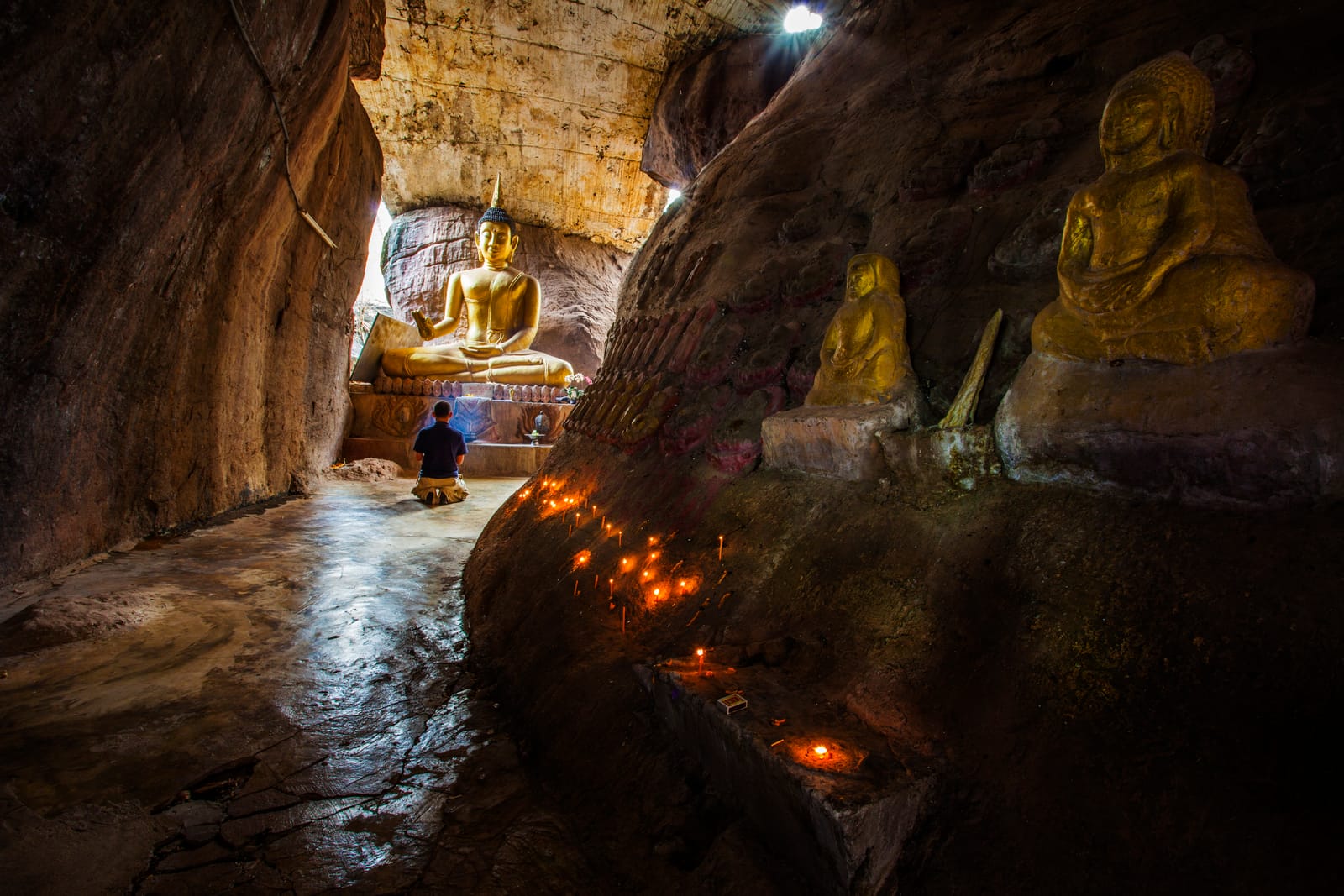
- The cave and natural rock chambers — the heart of the temple is a cluster of massive boulders stacked together to form caves and wide chambers. Some are big enough to hold hundreds of people and are used for meditation and ceremonies. Inside it's cool and silent — the kind of place that makes you understand why forest monks chose this spot.
- The ancient two-headed drum — the source of the name "Tham Klong Phen" is an old two-headed drum kept in the cave, once used to mark the time of the midday meal (phen is a monk's lunch). It's a rare piece that goes with the temple.
- Buddha images carved into the rock — around the grounds there are Buddha images, especially in the walking posture, carved into the clefts and natural boulders. They blend into the stone so well they take on a quietly powerful feel.
- Luang Pu Khao relics museum — a building holding the master's relics, requisites, and personal belongings, with a wax figure in his likeness for visitors to pay respects to. This is the spot most people specifically come to honour.
- The stupa and old kuti — the temple also has a stupa connected to Luang Pu Khao and the old kuti (monk's hut) he once used, which help you picture how forest monks lived in earlier times.
In 2022 there was a consecration ceremony for the relics museum and the stupa connected to the temple, so the buildings and surrounding area are kept in good condition — fitting for a quiet walk and respectful photos.
Photo spots and the best time
Morning light and late-afternoon light filtering through the big trees onto the boulders and the rock-carved Buddha images is when photos come out best. Mid-morning the sun is harsher and there are more people. If you really want a quiet atmosphere, try coming right after opening in the early morning, while the air is still cool and the grounds are silent.
The atmosphere and walking the grounds
The one thing everyone agrees on is the shade. The grounds are covered in big trees and natural rock gardens, so you can walk under cover almost the whole way, and the air is noticeably cooler than outside. Most of what you hear is birds and wind, not traffic, which lets you walk slowly without feeling rushed. It suits both people who come to seriously pay respects and anyone who just wants a quiet place to rest their mind for a while.
For the devout and meditators
Come to pay respects at Luang Pu Khao's body and relics in the museum, then sit quietly in the stone chamber for a while. It's the main reason many people come.
For nature and architecture
Walk among the giant boulders, the cave, the ancient drum, and the Buddha images carved into rock, photographing the rocky forest-temple atmosphere.
A stop along the way
It sits on the Nong Bua Lamphu–Udon Thani road, so it's an easy stop as you drive past. About an hour is enough to see it all.
Getting to Wat Tham Klong Phen
The temple is about 13 km from Nong Bua Lamphu town, along Highway 210 (the Nong Bua Lamphu–Udon Thani road), then about 2 km off onto the temple access road. Driving from town takes around 15–20 minutes. The route is paved the whole way with clear signs, so it's easy to find, and there's a parking area at the temple.
- Private car / rental car — the most convenient option. From Nong Bua Lamphu town, drive toward Udon Thani on Highway 210 for about 13 km, then turn off to the temple for another 2 km. Around 15–20 minutes.
- Coming from Udon Thani — Nong Bua Lamphu is about 45–50 km from Udon Thani. Drive along Highway 210 for roughly 45 minutes to an hour. The temple is before you reach Nong Bua Lamphu town, so it's an easy stop.
- By bus — buses on the Udon Thani–Loei route run along Highway 210 and can drop you at the junction for the temple, but from there you'll need to catch a ride or walk the remaining 2 km. Without your own vehicle, allow extra time and ask the driver ahead.
- Hired car / motorbike — there are some hired-car services and motorbike rentals in town, good for anyone who wants to hit several spots in one day.
Entry fee and opening hours
The temple is open daily and there's no entry fee. It's best to go during the day when the light is good and the staff are fully on hand. If you'd like to make merit or offer a donation, there are donation boxes and points around the temple. The museum's opening hours may differ slightly from the temple grounds, so if you're coming specifically to see the museum, mid-morning to afternoon is a safer bet.
Where to go next from Wat Tham Klong Phen
Wat Tham Klong Phen doesn't take long to see, so it's easy to pair with other spots in the same day. For more nature, drive to Phu Kao–Phu Phan Kham National Park and the Ubol Ratana Dam in the south of the province. If you'd rather stay in town, stop at the Somdet Phra Naresuan Maharat Shrine and the lake (Nong Bua), the central landmark in town, then finish with a meal at a punchy Isan restaurant.
- Phu Kao–Phu Phan Kham National Park — forest, hills, and viewpoints in the south of the province, a good follow-on from the temple for nature lovers.
- Ubol Ratana Dam (Phu Phan Kham side) — wide reservoir views and waterside restaurants, good for a lunch or dinner stop.
- Somdet Phra Naresuan Maharat Shrine & Nong Bua lake — the central landmark in Nong Bua Lamphu town, good for a stroll and a moment of respect before finding food.
Plan a full day in Nong Bua Lamphu — see everything to do, eat, and where to stay
See the Nong Bua Lamphu travel guide →