🔄 Updated 21 Jun 2026
Before we start walking, here's the big picture. Nong Bua Lamphu is an old town with deep historical roots. Its former name was 'Mueang Nong Bua Lum Phu', and it's where King Naresuan camped his army in 1574 (BE 2117) on the way to Vientiane. In later eras the town became home to forest-meditation monks, most notably Luang Pu Khao Analayo, an important disciple of Luang Pu Mun Bhuridatta, who stayed at Wat Tham Klong Phen until the end of his life. So the temple trail here blends forest-tradition devotion with the folk beliefs of Isan.
Wat Tham Klong Phen — the heart of the trail
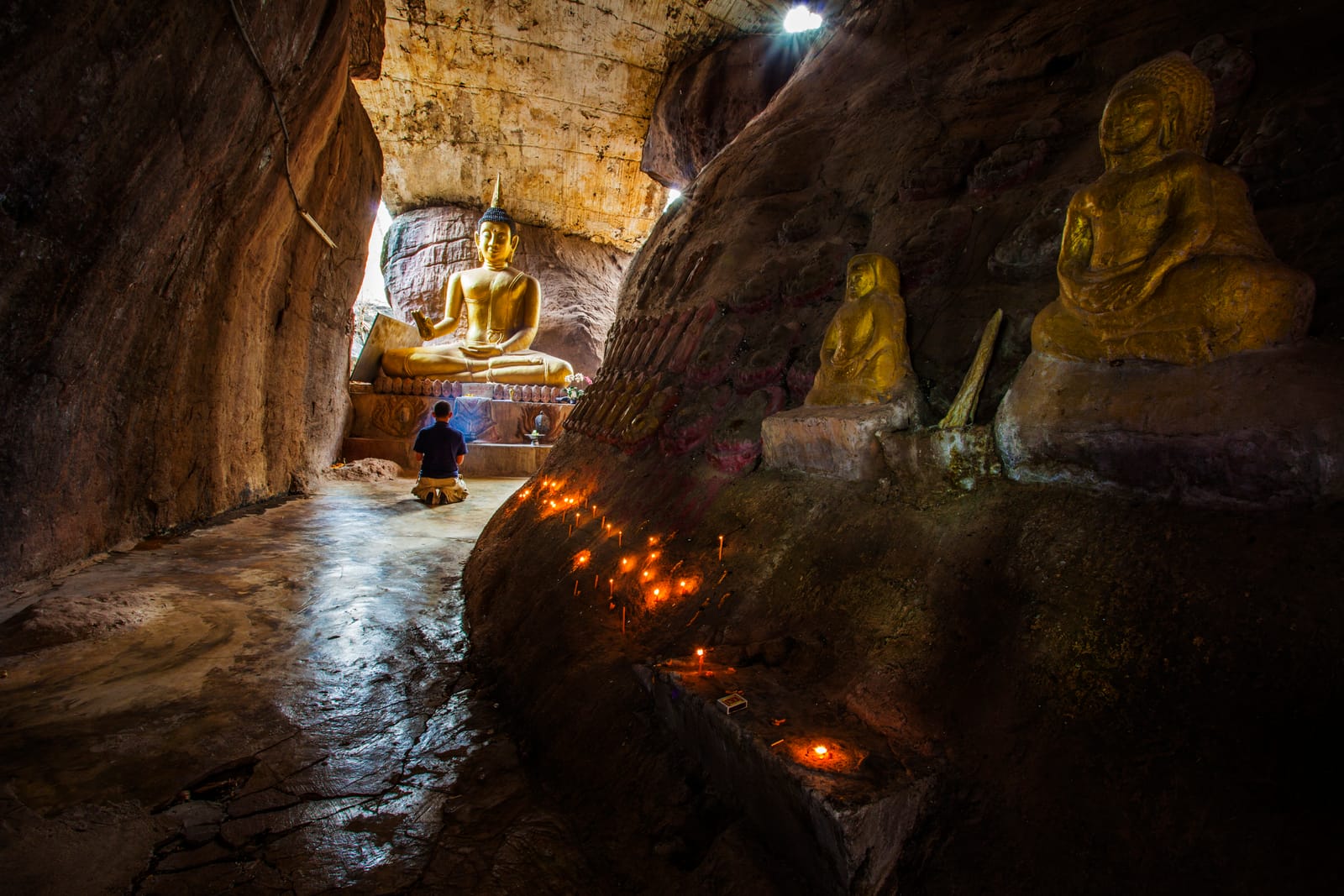
If you only have time for one stop, this is the one we'd pick. Wat Tham Klong Phen is a very large forest monastery, over a thousand rai, set on the shaded slopes of the Phu Phan range under big old trees. The draw is the genuinely quiet, true forest-temple atmosphere. Walk along the paths and you'll come across oddly shaped boulders, a cave that once held a pair of ancient double-headed drums (which gave the temple its name), and a walking Buddha image carved into the rock. The grounds are big enough to drive into, so you don't have to do all of it on foot.
What gives this temple its meaning is that it was the residence of Luang Pu Khao Analayo, a forest-meditation monk in the Luang Pu Mun lineage. He stayed here from 1958 (BE 2501) until he passed away in 1983 (BE 2526). Today there's the Luang Pu Khao Relics Museum, built of marble inside Tham Klong Phen, holding his relics, his monastic requisites, and a wax figure of him for people to pay respects. His Majesty King Bhumibol Adulyadej (Rama IX) once came to preside over the museum's consecration, so it's a place locals are very proud of.
- Location — on Highway 210, the Nong Bua Lamphu–Udon Thani road; head out of town toward Udon for about 13 km, then turn off and go in another 2 km or so.
- Opening hours — open daily, morning to evening. We'd come in the morning when the air is still pleasant and the sun isn't harsh yet.
- Admission — free; you can make a donation as you see fit.
- Dress — it's a forest temple with a museum, so dress modestly with shoulders and knees covered to feel more at ease.
Tip
The grounds are wide and there's plenty of shade, so if you like wandering and taking photos in the quiet, set aside an hour or more. Bring drinking water too, since there aren't many shops inside.
Want more out of Nong Bua Lamphu? Book tours & activities
Booking online ahead on Klook or GetYourGuide is usually cheaper than the gate and skips the queue. Pick only the experiences you actually want — prices and availability are shown live on each site.
King Naresuan the Great Shrine — the town's guardian
Back in town, the spot that brings the people of Nong Bua Lamphu together is the King Naresuan the Great Shrine, set in Naresuan Field near the district office. It's a cluster of Thai-style buildings raised to commemorate the time the king camped his army here in 1574 (BE 2117). Locals hold it in high regard and come regularly to ask for blessings, good fortune, and help with their careers.
The signature vow offering here is the cement rooster: when someone's wish comes true, they bring a cement rooster to give thanks, until the area around the shrine is lined with rooster figures everywhere. It's a sight that tells you instantly how much faith the people here have. Around the shrine is Nong Bua public park, with a lake in the middle of town and a waterside walking path. In the evening locals come out to exercise and relax — a nice, laid-back atmosphere.
- Location — Naresuan Field, Pho Chai Road, Nong Bua subdistrict, Mueang district — right in the center of town.
- Offerings — flowers, incense, and candles can be bought near the shrine; the cement rooster is for giving thanks once your wish is granted.
- Annual festival — every 25 January the province holds a celebration and ceremony honoring King Naresuan the Great, when the town gets especially lively.
- Pair it with — stroll around Nong Bua lake right after; it's a favorite downtown spot for locals to relax.
Wat Phra That Nong Bua — a Bodh Gaya–style chedi
Another temple worth your time is Wat Phra That Nong Bua, home to the Phra That Chedi Sri Maha Pho, built in 1957 (BE 2500) to mark the 25th Buddhist century. What people remember it for is the chedi's shape, modeled on the Bodh Gaya stupa in India, the site of the Buddha's enlightenment. Inside it enshrines relics of the Buddha. It's a temple in town that's easy to visit right after the King Naresuan shrine — they're not far apart.
One more for folk-belief fans is Pu Lup shrine, another sacred spot the people of Nong Bua Lamphu turn to for good fortune. It's not far from town, and locals often stop to pay respects before a journey or before starting something important. It's a small spot, but it reflects the way of faith in Isan well.
Straight talk
Nong Bua Lamphu is a small town, and the temple sights aren't as numerous as in a big city. The upside is that it's not crowded, so you can pay respects fully without jostling for space. If you're expecting grand temples like Chiang Mai's, this isn't it — but if you want calm and stories with real weight, this place delivers.
Local culture and souvenirs
Beyond the temples, Nong Bua Lamphu has Isan culture you can actually take home, especially its crafts. Handwoven textiles and indigo-dyed cotton are what the province is known for, sold at souvenir shops in town and by community weaving groups. They make a useful keepsake that supports local people directly.
Handwoven & indigo-dyed cloth
Handwoven work from community groups in natural indigo with Isan patterns — a souvenir you'll actually use.
Evening market in town
After the temples, swing by the evening market for home-style Isan food, both savory and sweet, at friendly prices.
25 Jan ceremony
The annual festival honoring King Naresuan, with a procession and local cultural activities to watch.
A relaxed 2-day temple trail
If you want to take it easy without rushing, here's a 2-day, 1-night plan. Start with the sacred sites outside town, then loop back into the center in the evening.
Forest temples & the meditation lineage
In-town temples & souvenirs
Getting there and when to go
- Your own car — the most convenient option; Wat Tham Klong Phen is outside town with easy parking, and the route links Udon Thani and Loei easily.
- From Udon Thani — about a 45 km drive along Highway 210, passing Wat Tham Klong Phen just before you reach town.
- Best time — late rainy season into the cool months (Nov–Feb), when the weather is comfortable and walking the forest temple is a pleasure; skip the harsh midday heat.
- Special period — around 25 January there's the King Naresuan ceremony, so aim for then if you want the festival atmosphere.
Plan a full Nong Bua Lamphu trip — food, sights, and where to stay
See the Nong Bua Lamphu travel guide →