🔄 Updated 21 Jun 2026
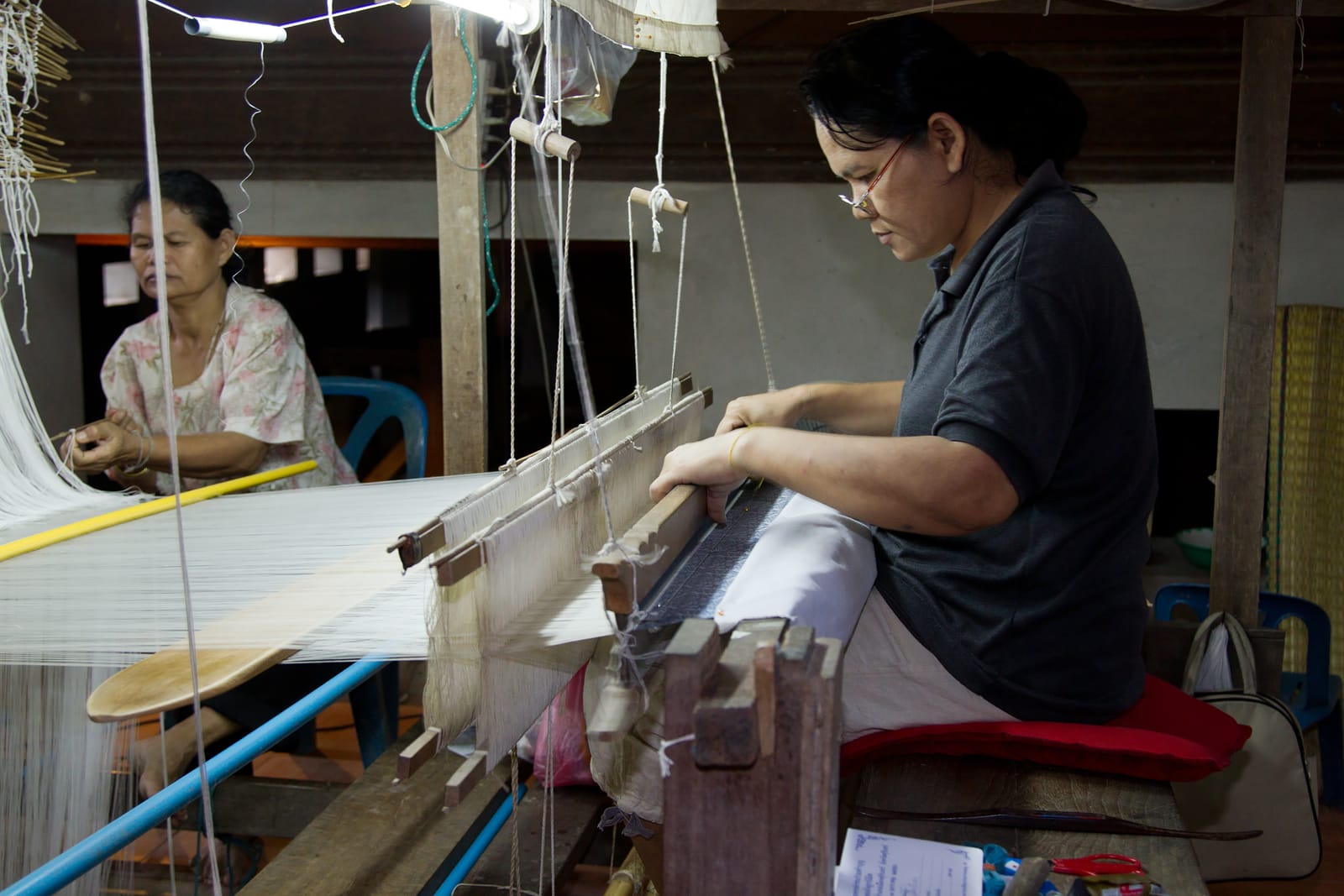
When people talk about northern Thai silk that's known across the country, Lamphun yok dok brocade is always one of the first names mentioned. It was once the cloth of the royal courts, it has appeared on major fashion runways, and many people still keep a piece to wear for special occasions. What a lot of visitors don't realise is that the source of all this cloth sits very close to Lamphun town — just a few minutes' drive from Wat Phra That Hariphunchai and you're in a neighbourhood that still weaves every single day.
Lamphun's main weaving areas cluster in two spots close to each other: Wiang Yong sub-district, just across the Kuang River from town, and Nong Chang Khuen sub-district, known for its longans as much as its weaving. Neither is a staged tourist village — these are communities that genuinely earn a living from the loom. That's where the charm is: you see daily life moving at the pace of people doing real work.
Why Lamphun cloth is special
Lamphun brocade silk has its roots with the Yong people, an ethnic group who migrated and settled in Lamphun and were already skilled weavers. Later, Princess Dara Rasmi brought the knowledge of intricate brocade weaving from the royal court and passed it to the households of Lamphun's ruling family. From cloth made in the palace, the skill gradually spread out to ordinary villagers and became a trade handed down over many generations.
The term "yok dok" refers to a weaving technique that lifts certain warp threads up and pushes others down, then sends the shuttle through with silver or gold thread or coloured silk woven in. This makes the pattern stand out in relief from the fabric as if it were embroidered, even though it's pure weaving. A good piece can take a weaver a month or several months to finish — which is exactly why genuine hand-woven cloth costs several times more than factory fabric.
How to spot the real thing
Genuine Lamphun brocade has a pattern that stands out in relief on both sides, you can feel the metallic thread when you touch it, and it comes with a GI mark or the royal peacock seal. If it's a very cheap printed cloth, the pattern will sit flat against the fabric — that's not woven brocade.
Want more out of Lamphun? Book tours & activities
Booking online ahead on Klook or GetYourGuide is usually cheaper than the gate and skips the queue. Pick only the experiences you actually want — prices and availability are shown live on each site.
Dok Pikun — the town's signature pattern
If you want one piece of Lamphun cloth that truly captures the local character, look for the dok pikun (bullet-wood flower) pattern, the province's signature design — small flowers repeated across the whole cloth, understated but full of detail, and easy for any age to wear. Beyond dok pikun there are other popular patterns too, like the candlestick pattern, the lotus-petal pattern and the old sang wian motif that older weavers still make. The more complex the pattern, the longer it takes to weave, and the price climbs accordingly.
- Genuine brocade silk — 100% silk with a bold raised pattern; a fine piece runs from a few thousand to tens of thousands of THB per outfit, depending on how detailed the design is.
- Cotton brocade — comfortable to wear and cheaper than silk, a good choice to wear yourself or as a souvenir on a smaller budget.
- Scarves and shawls — small pieces starting in the low hundreds to a thousand-odd THB, an easy-to-carry souvenir that's still genuinely hand-woven.
- Cloth lengths for tailoring — sold as pha sin (tube-skirt) cloth or shirt lengths; this is the priciest category and the one collectors want most.
Where to go to watch the weaving
Weaving in this area is spread across individual homes and community weaving groups rather than concentrated in a single factory. The best approach is to stop at a shop or group that has a storefront, then ask the owner's permission to watch the weavers at the back. People here are friendly and proud of their work, and are usually happy to explain it to you. The spots below are easy-to-find starting points that welcome visitors.
Wiang Yong community weaving group
The traditional weaving neighbourhood across the Kuang River, with several weavers' homes and community groups — you can walk between several houses in one small area, and some dye with natural colours themselves.
Nong Chang Khuen weaving community
A sub-district known for longans alongside weaving, with cotton and brocade-silk weaving groups in the community — a good stop as you head out of town.
Brocade silk shops in town
Short on time? Several GI brocade-silk shops have storefronts right in Lamphun town near the temple, so you can browse and buy everything in one spot.
Etiquette when you visit
If you want to photograph the weavers or a loom, always ask first. Don't touch cloth that's still being woven on the loom — the tension on the warp threads affects the pattern. And if they've let you watch until you understand the process, buying a piece is a kindness the community appreciates.
Tips for buying well
- Buying direct from a weaving group gets you a better price than a mall counter or a souvenir shop in the centre of town, because there's no middleman.
- Ask to see the GI mark or the royal peacock seal before you pay — it's your guarantee the cloth is genuine hand-woven Lamphun work.
- Real silk is hard to care for and needs dry-cleaning or gentle hand-washing; if you want to wear it often and keep it easy, cotton brocade does the job better and costs less.
- On a tight budget, start with a scarf or shawl — genuinely hand-woven at a price you can manage — then move up to cloth for tailoring on your next trip.
Plan a cloth-lover's day
Old town + weaving district
Nong Chang Khuen + souvenirs
Plan a full day in Lamphun
See the Lamphun travel guide →