🔄 Updated 21 Jun 2026
Before we start, here's the lay of the land. The three sites in this plan are spread out at different distances. Wat Pho Chai sits in the town center, just a few minutes' walk or drive from the riverfront. Sala Kaew Ku is on the edge of town, about 3 km out. Wat Phra That Bang Phuan is well outside town, around 22–23 km away toward the inland part of the district. A car or a rented motorbike is by far the easiest way to get around. So we set up Day 1 to cover the two in-town and edge-of-town sites, then on Day 2 you drive out to Bang Phuan in the morning and loop back. This pace isn't tiring, and it leaves plenty of time to sit by the Mekong in the evening.
Why Nong Khai is a genuine town of faith
Nong Khai sits right on the Mekong and was once part of the Lan Xang kingdom, so the belief in the naga runs deep here. Many temples have their own naga legend, and the naga fireballs that rise from the middle of the river every year at the end of Buddhist Lent happen in this very province. Important Buddha images like Luang Pho Phra Sai trace back to Lao royalty across the river. People who travel for the spiritual side get both the chance to make merit and the feeling of stories that are still alive in the community — not just somewhere you photograph and leave.
Book the activities in your Nong Khai trip ahead
Booking online ahead on Klook or GetYourGuide is usually cheaper than the gate and skips the queue. Pick only the experiences you actually want — prices and availability are shown live on each site.
Day 1 — Luang Pho Phra Sai, Wat Pho Chai, and Sala Kaew Ku
In town and on the edge of town
About the bathing of Luang Pho Phra Sai
Luang Pho Phra Sai is brought out for the ceremonial bathing just once a year, during Songkran. On ordinary days you can still pay respects and ask for blessings in the ordination hall as usual. If you make a point of coming during Songkran, you'll see the procession and get to join the bathing of the actual image. It's busier, but the atmosphere is lively.
Day 2 — The naga at Muchalinda pond, Wat Phra That Bang Phuan
Out of town, following the naga
Straight talk about Muchalinda pond
Muchalinda is an ancient pond, and depending on the season the water can be murky or have algae — don't expect it to be clear and pretty all the time. The appeal is in the age and the belief, not in how the water looks. On Buddhist holy days and long weekends it gets crowded with people coming to ask for blessings. If you want a calm atmosphere, a weekday morning is best.
The three main sites — what to know before you go
Wat Pho Chai (Luang Pho Phra Sai)
A royal temple in the center of town on Prajak Road, originally called Wat Phi Phiu. It houses Luang Pho Phra Sai, a Buddha image that Lan Xang royalty had a hand in creating alongside Phra Suk and Phra Soem, and one deeply revered by people on both banks of the Mekong. The broken-cart legend is the reason Phra Sai ended up here, and people stop in to pay respects all day long.
Sala Kaew Ku (Wat Khaek)
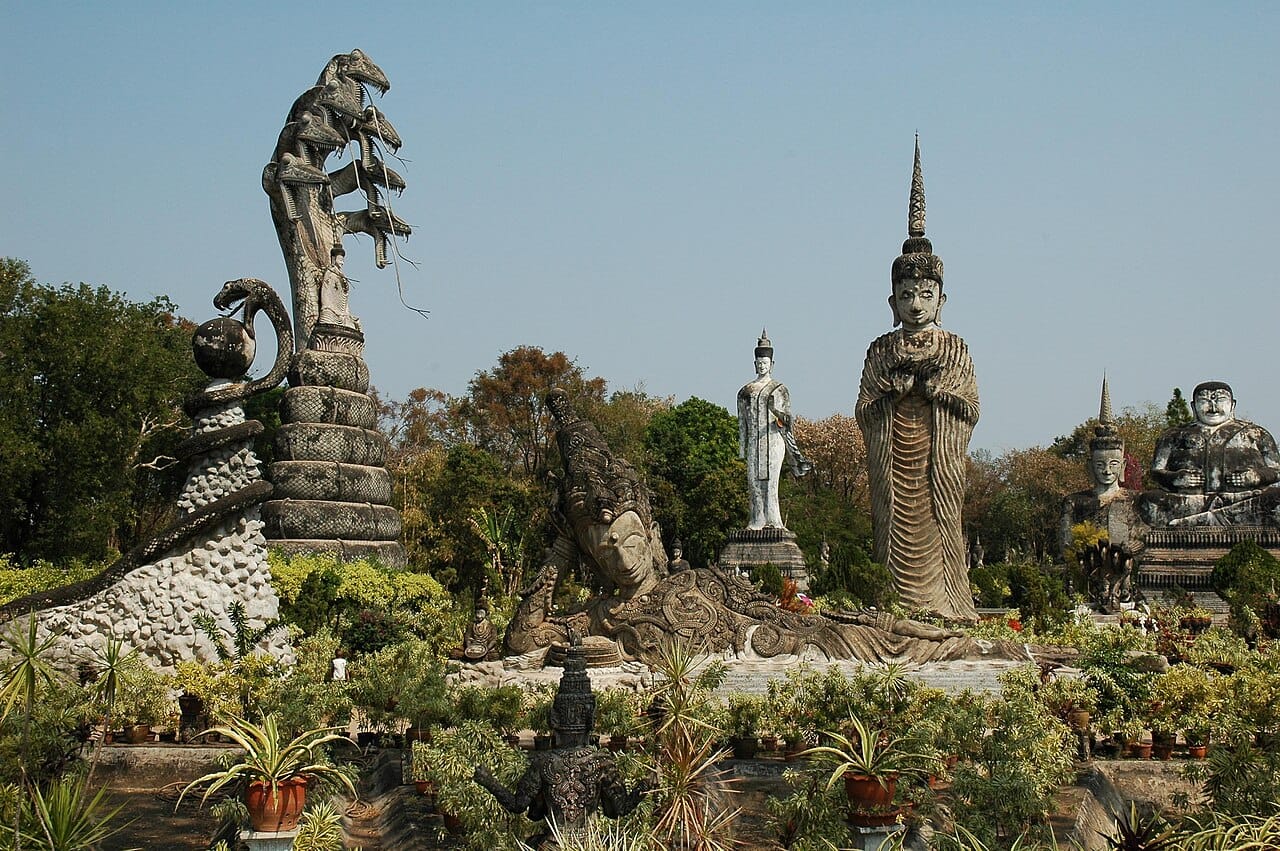
An open-air sculpture park with more than 200 large concrete figures — Buddha images, bodhisattvas, Hindu deities, Christian figures, folk beliefs, and characters from the Ramakien. The largest stands dozens of meters tall. It's belief-driven sculpture you won't easily find anywhere else.
Wat Phra That Bang Phuan (Muchalinda pond)
An old stupa that has stood with the town since the Lan Xang era, built on a square base. The spot people come for is Muchalinda pond, an ancient pool with a seven-headed naga statue at its center, where wishes for luck and success are believed to be granted. There's a cluster of old ruins to wander around too.
Temple-trip food worth stopping for along the way
A full day of temples calls for good eating. Nong Khai is a border town that blends Isan with Vietnamese and Lao food, and most spots are in town within walking distance of one another, so you can fit them neatly between temple stops. Here are the dishes and places Nong Khai locals actually go to.
Naem nueang — Daeng Naem Nueang
The town's famous name. The naem nueang is made fresh each day, skewered and grilled over charcoal the old way, then wrapped in rice paper with fresh herbs and dipped in the house sauce. It makes a lunch that fits a day of in-town temple visits.
Mekong river fish — riverside restaurants
A Mekong town means you have to try the freshwater fish — tom yum, larb pla, or fried with chili sauce, all with fish straight from the river. Paired with a river view in the evening it works even better. A good dinner to close out Day 1.
Nong Khai-style breakfast
Khao piak sen, old-style coffee, sangkhaya custard toast — a border-town breakfast that's easy to find all over town. Eat your fill before driving out to Wat Phra That Bang Phuan on Day 2.
Pâté baguette — Tha Sadet Market
A baguette crisp outside and soft inside, filled with liver spread and Vietnamese pork sausage — a Vietnamese influence. A fun snack while you walk the riverfront market in the evening.
Coffee in an old downtown building
A café set in a colonial-era building nearly a century old, with a Luang Prabang feel. A good place to rest out of the afternoon heat after an afternoon spent walking Sala Kaew Ku.
Riverside Isan food
Som tam, larb, koi, grilled pork neck — bold, full flavors you'll find at the riverside places. A solid lunch option on Day 2 when you loop back into town from Bang Phuan.
Pork sausage & naem — Nong Khai souvenirs
The standout souvenirs to carry home: firm-textured Vietnamese pork sausage and naem with just the right tang. Find them at Tha Sadet Market and shops in town before you head back.
Getting around and preparing for the temples
- Coming from Bangkok — fly into Udon Thani, then take a car to Nong Khai (about 1 hour), or take the train/bus straight to Nong Khai station.
- In town and on the edge — Wat Pho Chai is in the center, Sala Kaew Ku is about 3 km out. A car or rented motorbike is easiest; the riverfront spots are within walking distance.
- Getting to Wat Phra That Bang Phuan — it's out of town, about 22–23 km away, so you'll need a vehicle. Leave early for fewer crowds and cooler air than midday.
- Temple dress code — cover shoulders and knees, no spaghetti straps or short shorts. Sala Kaew Ku is an open-air walk with little shade, so bring a hat and water.
Straight talk
This temple plan is about belief and quiet, not flashy sightseeing. Some people love Sala Kaew Ku for how strange it is; others find it a bit eerie, since there are so many statues and some look genuinely unsettling. Muchalinda pond is about faith, not the beauty of the water. Come with an open mind for the stories and the age of these places and you'll enjoy it. If you're hoping for theme-park-style spectacle, this may not be your thing.
Rough budget for 2 days, 1 night
- 1 night's lodging — a hotel or guesthouse in town by the river starts at around ฿500–1,200 per night.
- Food — main meals at Vietnamese or riverside spots run around ฿150–300 per meal, plus snacks and coffee.
- Entry fees — ฿20 for Sala Kaew Ku; the rest are free (Wat Pho Chai, Wat Phra That Bang Phuan). Set aside some money for merit-making as you wish.
- Local transport — a motorbike rental runs around ฿200–300 per day, or use your own car / a hired ride in town.
- Total per person — taking it easy, around ฿1,500–2,500 per person (not counting travel to reach the province).
Want a well-located riverside hotel where you can easily walk to the temples and Tha Sadet Market?
See the Top 10 Nong Khai hotels →