🔄 Updated 21 Jun 2026
If you only have time for one truly one-of-a-kind place in Nong Khai, we'd point you straight to Sala Kaew Ku. The first time you walk in, it genuinely stops you in your tracks — grey concrete figures several metres tall stand in rows across the whole garden. Some are Buddha images, some are Hindu gods, and some are mythical creatures or half-human, half-animal beings with faces so strange you won't forget them. Every figure has a story and a meaning behind it; none of them were made just for show.
What is Sala Kaew Ku, and why is it special?
Sala Kaew Ku sits in Wat That sub-district of Mueang Nong Khai district, about 5–6 km east of town along Highway 212. It isn't a temple in the formal sense — it's a faith-driven sculpture garden. Locals call it Wat Khaek because many of the figures are Hindu deities. What sets it apart from anywhere else is the scale: the figures are all sculpted by hand in concrete, some standing more than 20 metres tall, set across an open garden you can walk all the way around.
The idea behind it all was Bunleua's belief that every religion can live side by side. So the Buddha, Shiva, Vishnu and other gods stand together in one garden without clashing. As you wander through, it starts to feel like reading one big book of Dharma told through sculpture instead of words.
Want more out of Nong Khai? Book tours & activities
Booking online ahead on Klook or GetYourGuide is usually cheaper than the gate and skips the queue. Pick only the experiences you actually want — prices and availability are shown live on each site.
Bunleua Sulilat — the man who sculpted the whole garden
Bunleua Sulilat was a Lao mystic who had already built a similar sculpture garden — Buddha Park (Xieng Khuan) — across the river near Vientiane. After political upheaval in Laos, he crossed the Mekong to the Nong Khai side around 1978, bought land and started Sala Kaew Ku from scratch. He sculpted it himself alongside his followers, adding one figure at a time over more than 20 years, until it grew into the huge garden you see today.
Bunleua died in 1996. His body is kept on the top floor of the museum building inside the garden, where the faithful can climb up to pay their respects. If you want to really understand this place, we'd suggest stopping by that building too — it holds photos, personal belongings, and the story of his life to read through.
Highlights you shouldn't miss
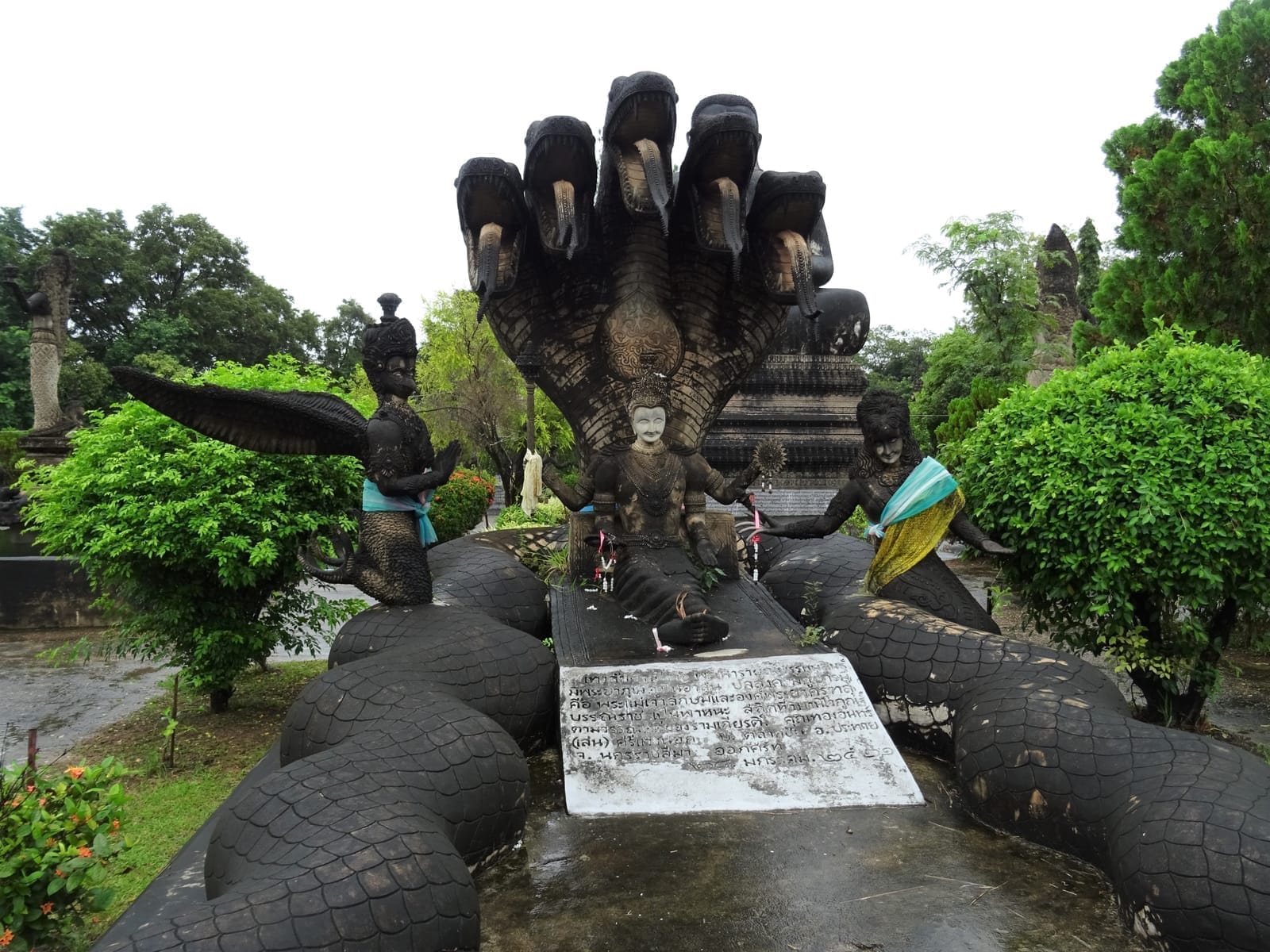
The seven-headed naga
The image people picture when they think of Sala Kaew Ku. A giant naga spreads all seven of its heads as a backdrop to a Buddha image seated in front, so tall you have to crane your neck to take it in. It's the single most popular photo spot here.
The Wheel of Life (cycle of existence)
A circular plaza of sculptures telling the cycle of a human life — birth, ageing, sickness, death. Follow it clockwise toward the centre and you watch life unfold stage by stage. It's the moral riddle Bunleua most wanted visitors to pause and reflect on.
Giant Buddha images in various poses
Enormous Buddha images in different poses are scattered across the garden — some walking, some in meditation, all sculpted in plain concrete yet with sharp detail. In the harsh afternoon sun, the shadows they cast make the atmosphere feel even more solemn.
Hindu gods — Shiva and Vishnu
Hindu deities stand right beside the Buddha images in seamless harmony, reflecting Bunleua's idea that every belief can coexist. Each god comes complete with its mount and symbols as told in the legends.
The elephant trampling demons
A massive elephant figure trampling a crowd of demons — a metaphor for overcoming desire and defilement. People love standing next to this one for a sense of scale, since you look tiny right beside it.
The museum housing Bunleua's body
A multi-storey building holding his belongings and photos, with Bunleua's body kept on the upper floor. Climb up to pay your respects and read the life story of the man behind this entire garden.
Tips for an easy visit
The garden is wide open with almost no shade. Mid-morning (08:00–10:00) or late afternoon (16:00–17:00) is when the sun is gentlest and the walk is most comfortable. Bring water, a hat and an umbrella if you come midday. Wear comfortable walking shoes, since you'll be on your feet covering the whole garden.
Entry fee and opening hours
- Entry fee — around 20 THB for Thai adults, about 10 THB for children, and roughly 40 THB for foreign visitors (prices may change, so bring cash).
- Opening hours — open daily, roughly 08:00–18:00.
- Time needed — a relaxed walk takes about 1–1.5 hours; if you want to read every moral riddle, allow up to 2 hours.
- Facilities — there are toilets, parking, and a small souvenir-and-drinks stall near the entrance.
Getting to Sala Kaew Ku
Sala Kaew Ku is about 5–6 km east of central Nong Khai along Highway 212. It's easy enough to reach, but no public transport runs right up to the gate, so most people use their own vehicle or hire a ride.
Private car / rental
The easiest option. Drive from town along Highway 212, about 10–15 min, with parking right by the garden. Ideal if you plan to visit other spots the same day.
Tuk-tuk / samlor
Hire one for the round trip with about an hour's wait. Expect around 200 THB and up depending on what you agree on — settle the price clearly before you get in.
Bicycle / rented motorbike
Many guesthouses in town rent these out, so you can cycle or ride along the Mekong yourself. It's a lovely route when the weather isn't too hot.
An honest heads-up before you go
This isn't a theme park. Some figures have frightening faces and deal with death head-on, so small children may find them scary. But if you take it as philosophical art, it's a real treat. Allow plenty of time to walk slowly and don't rush — the best part of this place is thinking your way through it, one figure at a time.
What else to do nearby
Sala Kaew Ku isn't far from central Nong Khai, so it's easy to pair with more in a single day. From the garden, loop back into town to stroll Tha Sadet Market on the Mekong, pay your respects to Luang Pho Phra Sai at Wat Pho Chai, then finish with a riverside dinner watching the sun set over the Mekong — a really well-rounded one-day trip.
Plan your whole Nong Khai trip without missing the best spots
See the Nong Khai travel guide →