🔄 Updated 21 Jun 2026
To understand Nonthaburi on a level deeper than markets and cafes, you have to start with the Mon people. They fled war and settled along the Chao Phraya in several waves, the biggest of them during the Thonburi era and the early Rattanakosin period. They brought their Mon (Raman) Buddhism, their clay-shaping skills, and their sweets with them. Today those traces still live on in the temples, in the kilns, and in the small sweet shops on Koh Kret. We've laid out a route you can actually follow, from the key temples through to the food and souvenirs that are part of the Mon legacy.
Wat Poramaiyikawat — the Mon heart of Koh Kret
This is the first place to come if you're talking about Mon culture in Nonthaburi. It was originally called Wat Pak Ao, with the Mon name "Phia Mu Kiak Toeng", meaning the temple at the cape, because it sits right at the tip of Koh Kret. The temple fell into ruin around the fall of Ayutthaya, then the Mon migrants restored it. Later, King Chulalongkorn (Rama V) ordered a full renovation and granted it its current name.
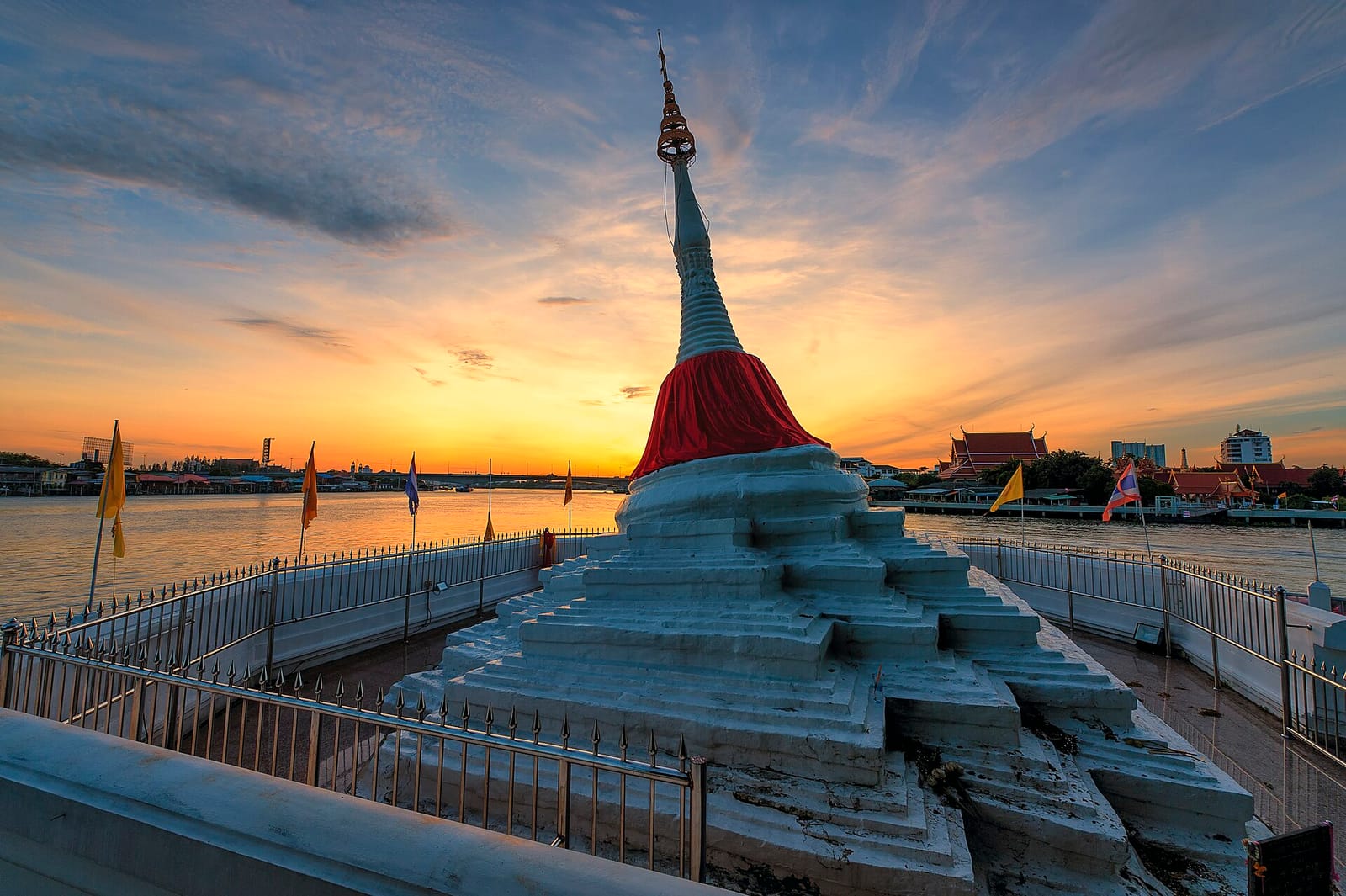
The symbol of the temple is the white Mon-style Mutao stupa standing right at the riverside cape. A red cloth is tied around its spire, a marker of Mon culture, and many people call it the "leaning stupa" because the current has eroded the foundation enough to tilt it slightly. It has become the most photographed landmark on the island. Inside the temple there's also a museum holding old artifacts, a Mon-language palm-leaf Tripitaka, and a reclining Buddha you can go in to see.
Opening hours aren't like a typical temple
The museum and inner buildings of Wat Poramaiyikawat open Monday–Friday 1:00–4:00 PM, and Saturday–Sunday and public holidays 9:00 AM–3:00 PM. If you want to see everything, come on a weekend morning. The riverside stupa itself is open to walk around and photograph any time.
Want more out of Nonthaburi? Book tours & activities
Booking online ahead on Klook or GetYourGuide is usually cheaper than the gate and skips the queue. Pick only the experiences you actually want — prices and availability are shown live on each site.
Wat Chaloem Phra Kiat Worawihan — Thai-Chinese art from Rama III's reign
Cross over to the Nonthaburi town side and you'll find Wat Chaloem Phra Kiat, a riverside temple whose artwork is beautiful enough to be worth a trip on its own. It was built around 1847–1849 at the wish of King Nangklao (Rama III), to honour Queen Sri Sulalai, his royal mother. It's said to be one of the last temples that held Rama III's personal devotion.
The ordination hall and the vihara are works of royal-favoured Thai architecture mixed with Chinese influence: Chinese-style ridged-tile roofs, with pediments decorated in brightly glazed tiles imported from China, arranged into hibiscus-flower patterns. Inside the ordination hall is enshrined Phra Phuttha Mahalokaphinanthapatima, a copper-cast principal Buddha in the subduing-Mara posture, with a lap span of about 6 sok (roughly 3 metres). Legend has it Rama III ordered copper mined from Nakhon Ratchasima to be used in the casting. The temple is calm and uncrowded, a good spot to sit, rest, and catch the river breeze.
What to look for here
Besides the copper Buddha, take a look at the boundary wall around the ordination hall and the corner turrets built to imitate a fortress, fine craftsmanship from Rama III's era that you don't often get to see. The temple is open roughly 5:30 AM–6:30 PM, free entry.
Other old temples worth a stop
If you've got time to spare, Koh Kret and the surrounding area have several more old temples to walk on to. Each has something different to see, from Mon-style stupas and mural paintings to the still-quiet atmosphere of a riverside temple.
Wat Sao Thong Thong
An old temple on Koh Kret, formerly named Wat Suan Mak. Behind the ordination hall stands a stupa said to be the tallest in Pak Kret district. It was also the site of the district's first primary school. An easy walk on from the pier.
Wat Phai Lom (Koh Kret)
Another old Mon temple on the island, with a lovely ordination hall and finely detailed stucco work on the pediment. The grounds are shaded by big trees, and it's a temple people walking the island often stop at to pay respects along the way.
Wat Bua Khwan Royal Monastery
A town-side temple dating to King Rama V's reign, and a regular merit-making spot for locals. The ordination hall is handsome and the grounds are shady, a good stop if you want a town-side temple that's easy to reach by car or the MRT Purple Line.
Wat Chom Phuwek
An old Mon temple in Tha Sai sub-district, with a mural of Mae Phra Thorani wringing her hair that art historians rate as exceptionally beautiful, plus a Mon-style stupa. Great for travellers who are serious about ancient temple art.
Pottery — handed down by Mon craftsmen
The Nonthaburi specialty most tied to the Mon people is pottery. It's believed to have been made on Koh Kret since the Ayutthaya era. Its hallmarks are the orange-red clay and the finely pierced fretwork patterns around the neck of each pot. The intricately patterned Koh Kret water jars have even been registered as a GI (Geographical Indication) product. To this day there are still potters making them by hand in the community.
A spot worth stopping at is the Ban Kwan Aman Pottery Museum. The phrase "Kwan Aman" in Mon means village of potters. It displays pottery in ancient patterns and gives shaping demonstrations, so you can see how many steps a single pot passes through in a craftsman's hands. It's on Koh Kret, in Koh Kret sub-district, open daily 9:00 AM–5:00 PM.
Buy it as a souvenir
Planters, vases, fretwork water jars, and tiny tabletop pieces, with plenty to choose from at the stalls around the island. Prices start from a few dozen baht up into the hundreds, with larger, finely patterned pieces costing more depending on the craftsmanship.
Watch the potters at work
Many homes on the island still set up the wheel and shape pots live for you to watch, just ask the shop owner. Some places even let you try shaping one yourself, great for bringing kids along to learn.
Sweets and Mon local food
Mon culture doesn't live only in the temples, it's in the food too. Koh Kret still has Mon sweets and dishes that are hard to find in Bangkok, and visitors almost always buy some to take home as a souvenir.
- Thot Man Nor Kala (fried fish cakes with nor kala) — a Koh Kret specialty, made by chopping nor kala (a riverside plant) into the fish cake mix for a crisp, lightly sweet flavour all its own, hard to find elsewhere.
- Mon-style khao chae — rice in chilled, flower-scented water, eaten with crisp fried side dishes, a Mon hot-season cooling dish that's usually sold during summer.
- Mon sweets — thong yot, foi thong, khanom kong, and rare old-style sweets still made and sold by individual specialists on the island, perfect to take home as a gift.
- Dok mai krop and look choop — finely crafted Thai sweets, with several shops to choose from in the Koh Kret market.
To taste it all, come on a weekend
The sweet shops and eateries on Koh Kret are only fully open on Saturday–Sunday and public holidays. On weekdays a lot of shops are closed. If you're set on stocking up on food and souvenirs, choose a weekend and come mid-morning, before the crowds build up.
Getting there & planning a temple-culture route
The temple-and-culture route is an easy single-day trip. Start with Koh Kret, since it bundles the temples, the pottery, and the sweets all in one place, then cross over to the town side if you still have the energy. Getting there is easier than you'd think.
- Getting to Koh Kret — drive or take a taxi to Wat Sanam Nuea in Pak Kret, then take the cross-river ferry to the island. The boat costs THB 2–4 and takes just a few minutes.
- Getting to the town side — Wat Chaloem Phra Kiat and Wat Bua Khwan are reachable via the MRT Purple Line plus a short onward ride, or take the Chao Phraya express boat to Tha Nam Non pier.
- Suggested order — Morning: Koh Kret (Wat Poramaiyikawat → Ban Kwan Aman → wander the market sampling sweets). Afternoon: cross over to riverside Wat Chaloem Phra Kiat, finishing at Wat Bua Khwan in town.
Plan a full Nonthaburi trip — where to stay, eat, and explore
See the Nonthaburi guide →