🔄 Updated 21 Jun 2026
Beneath Pai run several underground geothermal veins, so the water that surfaces is naturally warm to scalding hot — no boiler needed. The two big spots most travelers head for are Tha Pai Hot Springs, inside Huai Nam Dang National Park, and Sai Ngam Hot Springs, in a wildlife sanctuary. Both are deep in the forest with great air, but the water itself and the way you soak are clearly different. The other option is the mineral pools and spas that in-town resorts have built — if you can't be bothered to drive out, you can soak right in town.
Tha Pai Hot Springs — hot enough to boil eggs, with stepped pools
Tha Pai Hot Springs is in Mae Hi sub-district, inside Huai Nam Dang National Park, about 8 km from Pai town — a hot spring set among pine and dipterocarp forest. The source temperature runs around 80–100°C, hot enough to actually cook an egg, and plenty of people drop a basket of eggs in to boil at the edge of the pool. The water flows down a stream from the source, cooling gradually in stages; only the lower stretch, where it mixes with cool water, is warm enough to soak in.
- Opening hours — daily, roughly 8:00 AM–4:30 PM (per national park hours)
- Entry fee — charged at national-park rates: a few tens of baht for Thai adults, less for children, and a much higher rate for foreigners, plus a separate vehicle fee. Bring cash
- Getting there — from Pai town take Highway 1095 (Pai–Mae Malai), cross the Pai River bridge, and the Tha Pai Hot Springs sign appears on your left shortly after; turn in and continue about 1.5 km
- What's there — parking, a restaurant, toilets, an egg-boiling spot, and camping grounds within the park
Straight talk on the heat
The source pool signed at 80–100°C will scald you. Plenty of traveler reviews warn that even dipping a foot in the upper pool blisters. Never get into the source pool, and don't let kids run around the rim. Only soak in the lower stretch where staff have set it off and the water has cooled to a comfortable temperature. The rocks at the edge are slippery — walk slowly.
Want more out of Pai? Book tours & activities
Booking online ahead on Klook or GetYourGuide is usually cheaper than the gate and skips the queue. Pick only the experiences you actually want — prices and availability are shown live on each site.
Sai Ngam Hot Springs — clear emerald water you can soak in fully
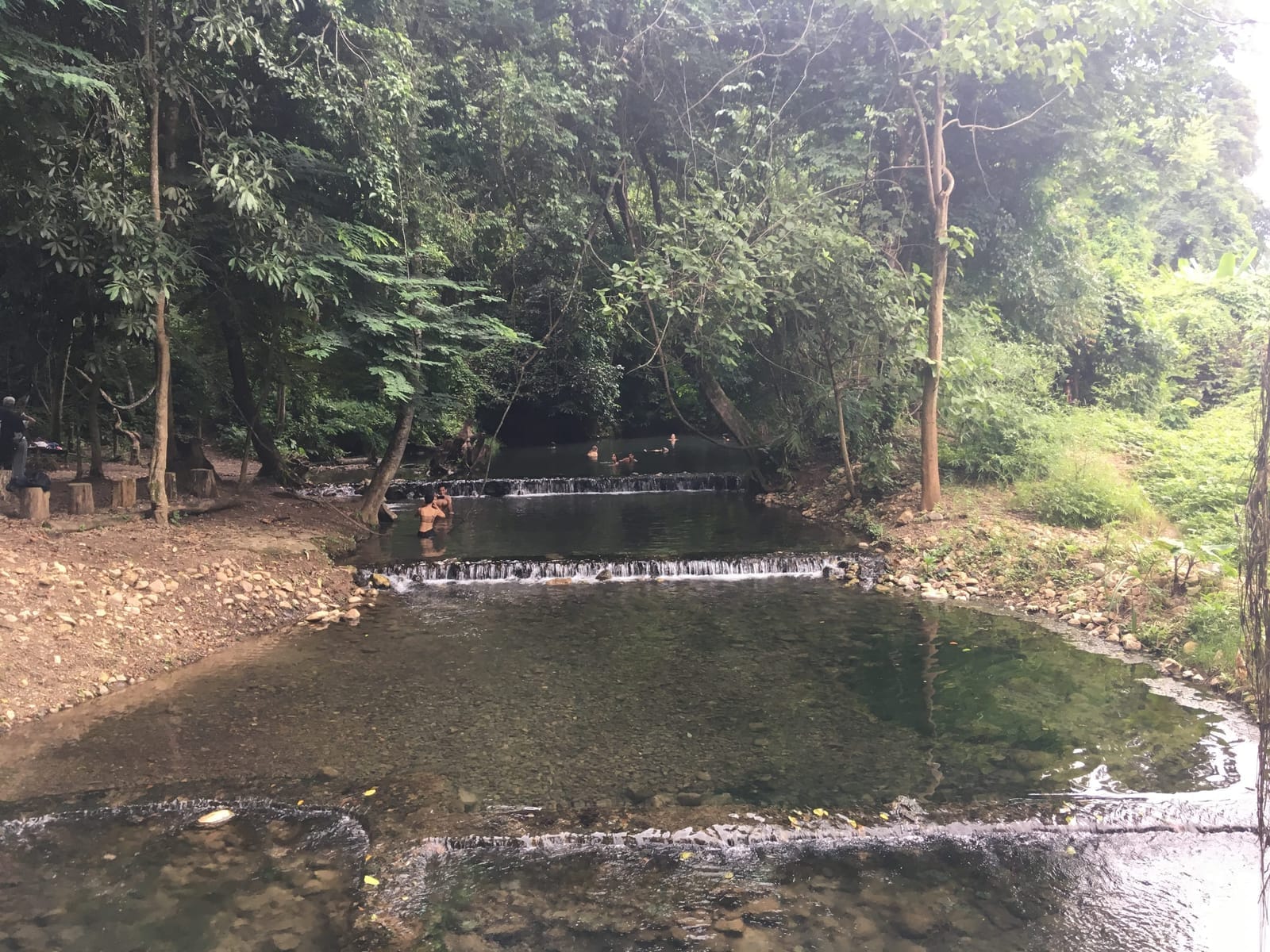
If Tha Pai is too hot to get into, Sai Ngam is the side where you can really soak full-body. Sai Ngam Hot Springs is in Mae Na Toeng sub-district, inside the Pai Wildlife Sanctuary, about 15 km from town. The water here is so clear you can see the sandy bottom, and the light gives it a emerald-green tint. At around 36–38°C it's pleasantly warm, which is why people call it Thailand's onsen. The springs run as a warm stream through the forest, with several pools at different depths to soak in, ringed by big banyan trees and pines — cool and shady.
- Opening hours — daily, roughly 8:00 AM–6:00 PM
- Entry fee — a small fee of tens of baht per person for Thais, plus a motorbike/car fee; foreigners pay several times more. Bring cash
- Getting there — most people ride a motorbike out; a 150cc or larger bike is recommended, as the final stretch up to the pools is steep and unpaved dirt
- What's there — changing rooms, several natural soaking pools at different depths, and seating areas by the water
When Sai Ngam looks its best
In the cool season (Nov–Feb), the cold air makes steam rise off the water in the morning — the prettiest, most blissful time. In the rainy season the stream can turn murky and the dirt road gets slippery, so take extra care.
In-town mineral pools and spas — when you don't want to drive far
Some days you've sightseen yourself out and don't want to go anywhere. Several resorts in Pai pipe mineral water from the underground source into their own on-site soaking pools. The best-known area is Mae Hi, near Tha Pai Hot Springs, because it sits on the same mineral vein.
Pai Hotsprings Spa Resort
A resort in the Mae Hi area near Tha Pai Hot Springs that pipes mineral water into the rooms and runs several open-air onsen soaking pools. It has a Thai-massage spa and a shuttle to the walking street — good for anyone who wants a mineral soak without heading to a public pool.
Private mineral baths at your stay
Plenty of resorts and homestays in the mineral-water zone have soaking pools or mineral tubs in the rooms. Check at booking whether the listing says hot spring or onsen, so you can soak right at your accommodation without traveling.
Soak safely
Don't stay in longer than 15–20 minutes at a time before getting out to rest, and drink plain water while you soak so you don't get faint. Anyone with heart conditions or blood pressure issues should check with a doctor first, and don't get in right after a heavy meal or after drinking alcohol.
Getting up to Pai and the mountain roads — straight talk before you go
The route up to Pai from Chiang Mai is Highway 1095, famous for its 700-plus curves, winding up and down the mountains the whole way. If you get carsick easily, take motion-sickness medicine beforehand; sitting up front and looking at the horizon helps. The roads into both hot springs are winding mountain roads too — steep and unpaved in places — so if you're riding a motorbike you need to be genuinely confident. Wear a helmet, ride slowly, and watch out especially when it rains, as the roads get very slippery.
- Mar–Apr — Northern Thailand often gets haze from agricultural burning; visibility is poor and the air is bad, and mountain views can be hazy. Avoid this window if you can
- Morning sea of mist — depends on the weather and isn't there every day. You're more likely to catch it on cold, humid cool-season mornings, but there's no guarantee
- Rainy season (Jun–Oct) — the forest is lush green and the streams are full, but the dirt roads into the pools get slippery and there can be landslides in spots. Check road-condition news first
- Cool season (Nov–Feb) — the best weather; soaking in hot water in the cold is the most blissful. But it's crowded and rooms fill fast, so book ahead
A Pai hot-springs trip you can build out from
The two hot springs are in different directions, so they pair nicely with nearby sights. Here's a sample half-day plan for anyone short on time.
Sai Ngam route — soak in mineral water in the forest
Tha Pai route — boil eggs and a roadside cafe
Want a place to stay in the mineral-water area or right in central Pai? See the options reviewers genuinely rate.
See the Top 10 Pai hotels →