🔄 Updated 21 Jun 2026
Wat Phra That Mae Yen is an old temple that has been part of Pai for a long time, sitting on a hill on the east side of the district about 2–3 km from Pai's Walking Street — a 7–10 minute drive. The busiest spot isn't the temple at the bottom but the big white Buddha up on the crest of the hill above it. You have to climb a stretch of Naga stairway to reach it, and the town view opens up wider with every step on the way up.
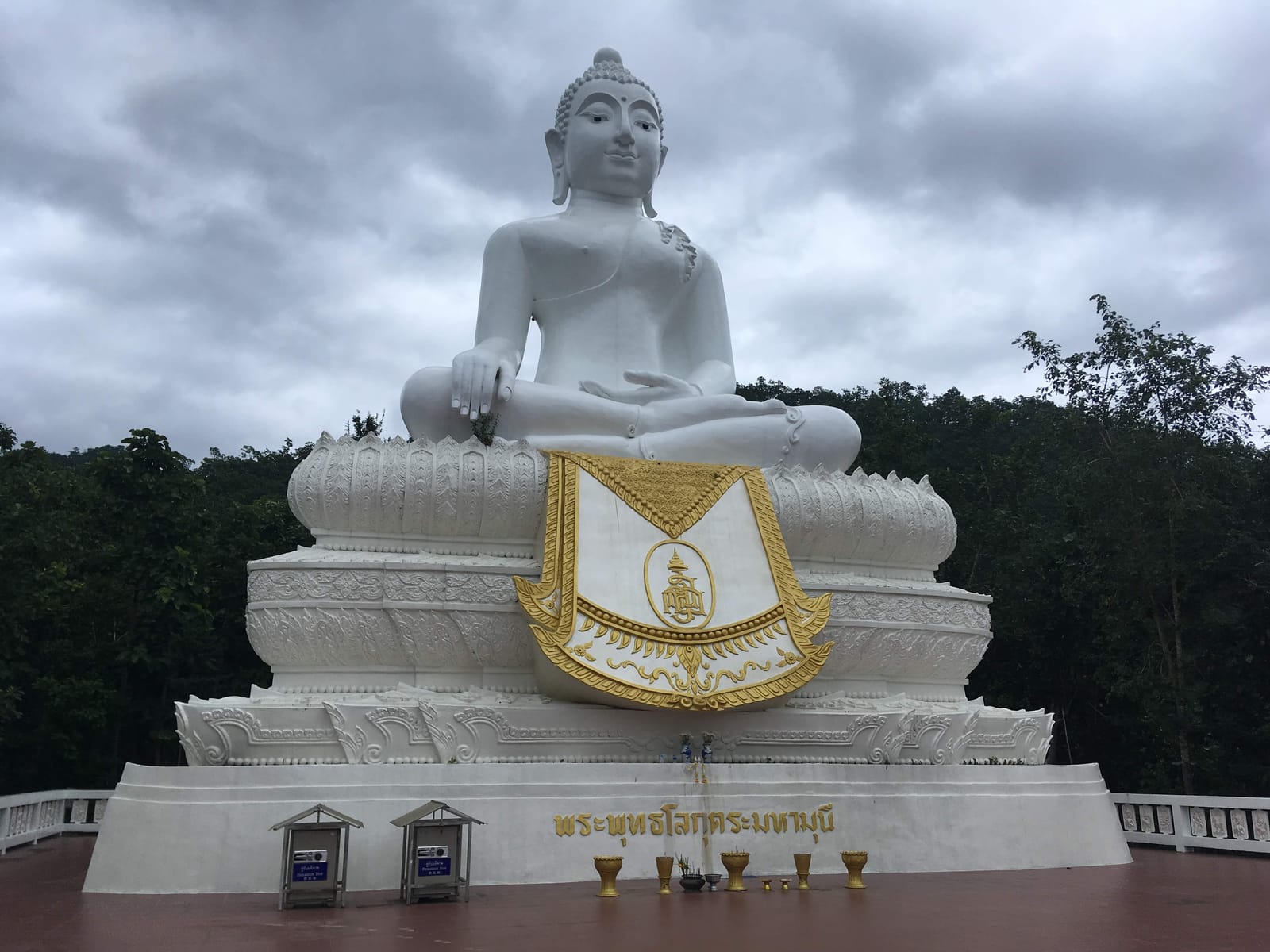
The Big White Buddha — Phra Phutta Lokuttara Maha Muni
The main image at the top of the hill is Phra Phutta Lokuttara Maha Muni, a large white Buddha in the Maravijaya (subduing Mara) posture, standing out on a wide tiled terrace. You can see it clearly from town, and it's a symbol locals have felt close to for years. The terrace around the Buddha is open, you can walk all the way around it, and there's a view in every direction. Behind the image runs the Doi Chik ridge, with the Buddha facing west — the direction of the sunset.
Down at the temple itself there's also the original Phra That Mae Yen chedi and a reclining Buddha hall. If you have time, stop to pay your respects before heading up top. The lower temple feels quieter and calmer than the big-Buddha terrace, which fills up with people in the late afternoon.
Want more out of Pai? Book tours & activities
Booking online ahead on Klook or GetYourGuide is usually cheaper than the gate and skips the queue. Pick only the experiences you actually want — prices and availability are shown live on each site.
The 353 Steps — How to Climb Without Wearing Yourself Out
The way up to the big Buddha is a Naga stairway people count at around 353 steps (some say it's just over 300). It climbs steadily — not super steep, but long enough to tire you out if you go straight up in one push. Take breaks along the way; there are spots to stand and look back at the view, which gets wider the higher you go. No need to rush.
- Wear comfortable shoes — the staircase is long and the sun gets hot midday, so slippery flip-flops aren't ideal.
- Bring water — it's breezy up top, but the climb up is sweaty work.
- Take your shoes off before stepping onto the Buddha terrace — it's a sacred area, so you walk barefoot on the tiles.
- Can't manage the stairs? There's a road up — a winding road takes you near the top to park, good for older travellers or anyone with bad knees.
An option for those who can't manage the climb
Besides the stairs, there's a winding road you can drive up to park near the upper terrace. If you're travelling with elderly relatives or have bad knees, drive up and walk just the short final stretch. The road is narrow and bends a lot, though, so go slowly and watch for oncoming traffic.
The View From the Top — The Whole Pai Valley
The real reason people climb up is the view. From the Buddha terrace you look down over almost all of Pai — sheets of rice fields, the Pai River winding through town, little houses, and the mountains that wrap around the whole valley. From the rainy season into early winter the fields are bright green and the view is at its best. In the late afternoon, near sunset, the sky turns orange-gold against the white Buddha — a shot a lot of people come up to catch.
A lot of people assume you can see a sea of mist here like at the viewpoints up on the surrounding peaks. In reality Phra That Mae Yen isn't all that high compared to Yun Lai or Doi Kiew Lom, so your odds of seeing a full sea of mist are lower. If you're set on the mist specifically, the other spots give you a better shot. But if you want a wide town view that's close and easy to reach, this one delivers.
Opening Hours, Entry Fee and Dress Code
- Opening hours — roughly 06:00–18:00 daily (sometimes it opens earlier, depending on the temple).
- Entry fee — none; it's a temple, so you can drop a donation in the box as you wish.
- Dress code — it's a temple, so dress respectfully with shoulders and knees covered. Down below they rent sarongs for around 20 THB if you've come in shorts or a strappy top.
- Parking — park at the foot of the hill (a lot of stairs) or drive up to the upper terrace near the Buddha.
Times to avoid
From March to April, northern Thailand often gets smoke haze from crop burning, and visibility drops — the town view can turn so murky you can barely see it. If you're planning the trip mainly for the view, go from the rainy season into early winter (July–January) for clearer skies and greener fields.
Getting to Wat Phra That Mae Yen
From Pai's Walking Street, head toward Mae Hi sub-district, cross the bridge over the Pai River, look for the Earth Tone vegetarian restaurant on your right, then turn left into the temple gate. It's a short distance and you can go by motorbike or car — about 7–10 minutes from the centre of town.
A word of caution about getting to Pai in general — the road up to Pai from Chiang Mai (Highway 1095) has 762 curves and is famous for making people carsick. If you're prone to motion sickness, bring medication and take it before you set off. Around Pai itself, many roads to the sights are winding mountain roads too, so if you're riding a motorbike yourself, go slowly, watch for slick surfaces in the rain and for oncoming traffic on the bends.
Where to Go Next After the White Buddha
Pai Canyon (Kong Lan)
Narrow earthen ridges you can walk along, and another popular sunset spot in Pai, just south of town.
Hot springsTha Pai / Sai Ngam Hot Springs
Soak in natural hot water to ease your legs after a day on the stairs, not far from the town centre.
NightlifePai Walking Street
Head back into town in the evening for street food, live music and an easy end to the day.
Plan your whole Pai trip at an easy pace
See the Pai travel guide →