🔄 Updated 21 Jun 2026
If you want one Chinese New Year festival in Thailand that's more than just red lanterns and snacking your way down a street, the Pak Nam Pho celebration is the one people across the upper central region point to. It's a genuine community event. The locals wait all year for it, kids who've moved away for work come home to march in the procession, and shops close so their owners can pitch in. That's an atmosphere you just don't get from festivals put on only for tourists.
How it started, and why they carry the gods through town
The story passed down goes like this: more than a century ago, a cholera outbreak hit the Pak Nam Pho area hard, and many people died. The local Chinese community carried the images of the gods through the streets to drive the sickness away. When the outbreak finally eased, people believed it was thanks to the gods' protective power, so they held a procession every year afterward to give thanks and repay their vows. Over time it grew into a tradition that has carried on for well over a hundred years.
The event is held during Chinese New Year each year, anchored to the first day of the first lunar month on the Chinese calendar. The two presiding deities are Chao Pho Thepharak (the guardian god) and Chao Mae Thapthim (the goddess), enshrined at the Chao Pho Thepharak–Chao Mae Thapthim Shrine on the banks of the Chao Phraya River on the Pak Nam Pho side. In 2018 the Pak Nam Pho God Procession was officially registered as part of Thailand's national intangible cultural heritage.
Know before you go
The dates shift every year with the Chinese lunar calendar, usually falling somewhere between late January and mid-February. In 2026, for example, the festival runs February 10–21. Before you go, check that year's schedule on the official "Pak Nam Pho God Procession" Facebook page, which is the festival's official channel.
Want more out of Nakhon Sawan? Book tours & activities
Booking online ahead on Klook or GetYourGuide is usually cheaper than the gate and skips the queue. Pick only the experiences you actually want — prices and availability are shown live on each site.
The highlights you shouldn't miss
This festival is known for one of the longest and most varied processions in Asia, running a full 12 days and 12 nights with dozens of day and night parades combined. But if your time is limited, these are the things not to miss.
The golden dragon
The Nakhon Sawan golden dragon troupe was the first dragon troupe in Thailand, founded in 1964, and it's the largest dragon in the province. The performers train for about 21 days before the real thing. The way they coil the dragon as it chases the pearl, amid firecrackers and fireworks, is the image people remember most from this festival.
Lions from 5 ethnic groups
Genuinely hard to see anywhere else, because it brings together lion troupes from five Chinese communities — Beijing, Cantonese, Hainanese, Hokkien, and Hakka — at a single event. The Hokkien lion head comes in five colors representing the five elements of Taoism, and each troupe has its own distinct dancing style.
Eng Kor, Pha Bu, and the Lo Ko drums
A procession of performers dressed as characters from Chinese literature, faces painted in bold colors and carrying weapons, moving to the rhythm of the Lo Ko drums. It's the parade people love to photograph most.
The Guan Yin procession
A procession of beauties and 'angels' alongside a figure representing Guan Yin on a flower float. It's a softer, brighter stretch of the parade that contrasts with the intensity of the dragons and lions.
The god palanquins and the fire-walking ritual
The spiritual high point: bearers carry the palanquins holding the gods at a run, charging through the smoke of firecrackers. Some years there's a fire-walking ritual by the spirit mediums. This is when the community's faith is at its most intense.
Timing: how the day and night parades differ
The festival runs 12 days, but there isn't a big procession every single day. The two busiest days are the key ones on the Chinese calendar, so if you can plan around them, aim for these two.
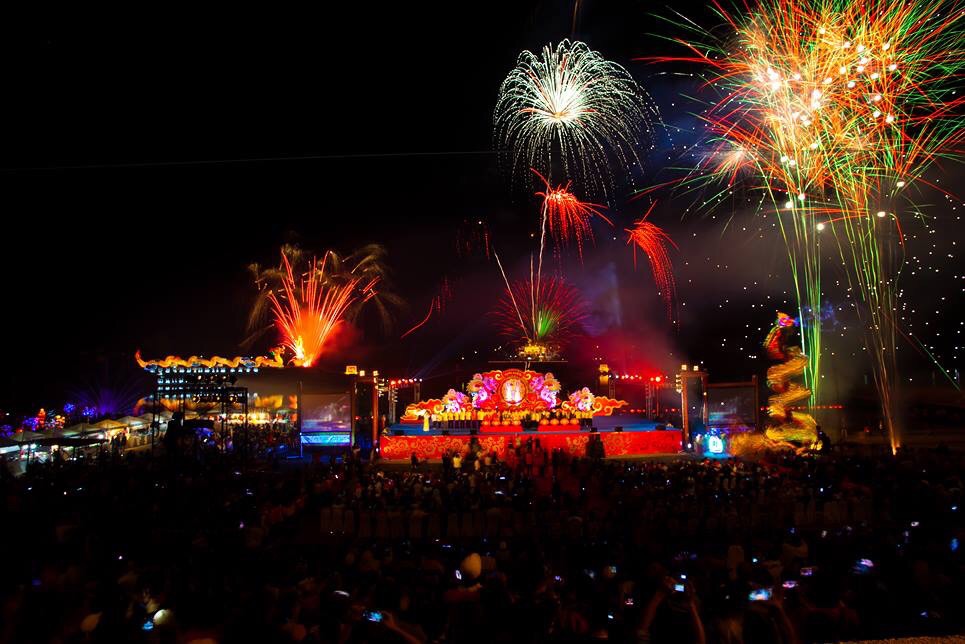
- The night procession (Chiu Sa) — the night parade starts around 6 PM, setting off from the area near the Nakhon Sawan municipal office. The highlights are the fire dragon, the lions, and the glow of fireworks and firecrackers in the dark. Good for anyone who loves a lively atmosphere and night photography.
- The day procession (Chiu Si) — the biggest parade of the festival. The procession forms up from 5 AM at Sawan Park (Utthayan Sawan) and moves off around 7 AM, looping around the Pak Nam Pho market. You can see the costumes and the deity images clearly in full daylight, and it's the day when the city's faith comes together most powerfully.
- Other days during the festival — there are worship ceremonies, Chinese opera performances, evening food markets, and offering booths at the shrines. Good if you want to avoid the biggest crowds but still soak up the Chinese New Year atmosphere.
Pick the day that suits your style
If you want to see the full procession in clear detail, choose the day parade (Chiu Si) — but be ready to wake up early and put up with the heat. If you want the lively fireworks atmosphere, choose the night parade (Chiu Sa). Both days are packed, so arrive at least 1–2 hours early to grab a good spot.
Good viewing spots
The procession loops around the Pak Nam Pho market district and the main roads within the municipal area. There are only a handful of spots the locals recommend staking out.
Sawan Withi Road
The festival's main walking street. The procession definitely passes through, and there's food, offerings, and souvenirs lining both sides. Good for staking out a spot and snacking while you wait.
Sawan Park (Utthayan Sawan)
Where the day parade forms up. Come early and you'll see the performers getting into costume and the procession lining up before it moves — shots most people don't get.
In front of the Chao Pho Thepharak–Chao Mae Thapthim Shrine
On the Chao Phraya riverbank on the Pak Nam Pho side, the sacred heart of the festival. When the god palanquins enter the shrine, that's the moment when faith runs deepest.
Along the Chao Phraya River embankment
On some nights there are fireworks over the water, and the view is more open than inside the market. Good for shooting fireworks against the river.
Getting there, parking, and where to stay
Nakhon Sawan is about 240 km from Bangkok, roughly a 3-hour drive via the Phahonyothin Highway. You can also take a coach or van to the Nakhon Sawan bus terminal, or the train to Nakhon Sawan (Pak Nam Pho) station and then transfer into town.
- Parking — during the festival many roads are closed off to stage the procession, traffic is heavy, and parking fills up fast. It's best to park on the outskirts of the market area and walk in or take a motorbike taxi. Allow at least half an hour just to find a spot.
- Where to stay — hotels in town fill up very quickly during the festival, and some are booked months in advance. If you're coming for the grand procession day, book your accommodation ahead, or stay in the zones around the city and drive in.
- Food — during the festival there's a food market running the length of the street, with Chinese dishes, ritual offerings, and local street food. It's a great chance to try Pak Nam Pho specialties like guay tiew pak mor (steamed rice noodle rolls) while you're at it.
Come prepared
Wear comfortable shoes because you'll be standing and walking for a long time. Bring drinking water, a hat or umbrella for the daytime parade, and earplugs if you're sensitive to firecrackers. Wear lucky colors like red or gold to match the mood, and keep an eye on your valuables in the crowds.
What else to see around Pak Nam Pho
If you're making the trip, leave some time to explore the area, because Pak Nam Pho is where the Ping and Nan rivers meet to form the head of the Chao Phraya River. There are viewpoints and natural spots worth a stop.
- The Chao Phraya River source – Pasan landmark — an architectural landmark right at the river confluence, lovely for an evening stroll and photos.
- Sawan Park (the in-town wetland) — a public park in the center of the city, with Khao Kop hill to climb for a view over town.
- Bueng Boraphet — Thailand's largest freshwater lake, good for birdwatching and boat trips, not far from the city center.
Plan your full Nakhon Sawan trip — food, sights, and where to stay
See the Nakhon Sawan travel guide →