🔄 Updated 21 Jun 2026
Paknampho is where the Ping and Nan rivers meet to form the Chao Phraya, and this very source of Thailand's main river is where the Chao Pho Thepharak–Chao Mae Thapthim Shrine sits. The shrine faces the water, directly across from Paknampho market, which made it both a landmark for old-time boat traders and a gathering point for the Chinese who migrated here and put down roots.
An old shrine that grew up with Paknampho
There's no clear record of who built the shrine or in what year, but the best clue to its age is an antique bell inside. A Chinese inscription on it says that a man named Hong Piao of the Phu clan, from Hainan province, crossed the sea to donate it back in 1870 — Buddhist year 2413. That means the shrine is at least 130-odd years old, dating back to when Paknampho was one of the busiest river-trading hubs in the upper central plains.
Inside, the presiding deity is Bun Thao Kong, with Guan Yu (Kuan U) on the right and Chao Mae Thapthim — the Heavenly Mother — on the left. Chao Mae Thapthim has long been revered by boat people and river traders, who believe she watches over their journeys and their fortunes. That fits a river town like Paknampho perfectly.
Want more out of Nakhon Sawan? Book tours & activities
Booking online ahead on Klook or GetYourGuide is usually cheaper than the gate and skips the queue. Pick only the experiences you actually want — prices and availability are shown live on each site.
What people pray for, and how to do it
Most people come here to ask for luck, success in business, and Chao Mae Thapthim's protection through the year. The other big draw is the chong-year ritual to offset bad luck for those born under an unlucky zodiac sign — the shrine gets packed for this around New Year and Chinese New Year. If it's your first visit, don't stress; just follow what the locals do. The basic offerings are sold right out front.
- Incense, candles and offerings — stalls in front of the shrine sell ready-made offering sets, so there's no need to bring anything from home.
- Pray to one deity at a time — start with the presiding Bun Thao Kong in the center, then move on to Guan Yu and Chao Mae Thapthim, focusing on one wish at a time.
- Fortune sticks and chong-year rituals — there are siamsi fortune sticks to draw, plus a spot for the chong-year ritual if your sign falls under bad luck that year. Just ask the staff inside.
- Donate to maintain the shrine — there's a donation box for upkeep; give what feels right.
A small tip
If you'd rather pray in peace without the crush, skip the Chinese New Year festival and long holiday weekends and come on a weekday morning instead. The air off the river is at its best then, and you'll get nicer photos of the shrine too.
The center of Paknampho's Chinese New Year parade
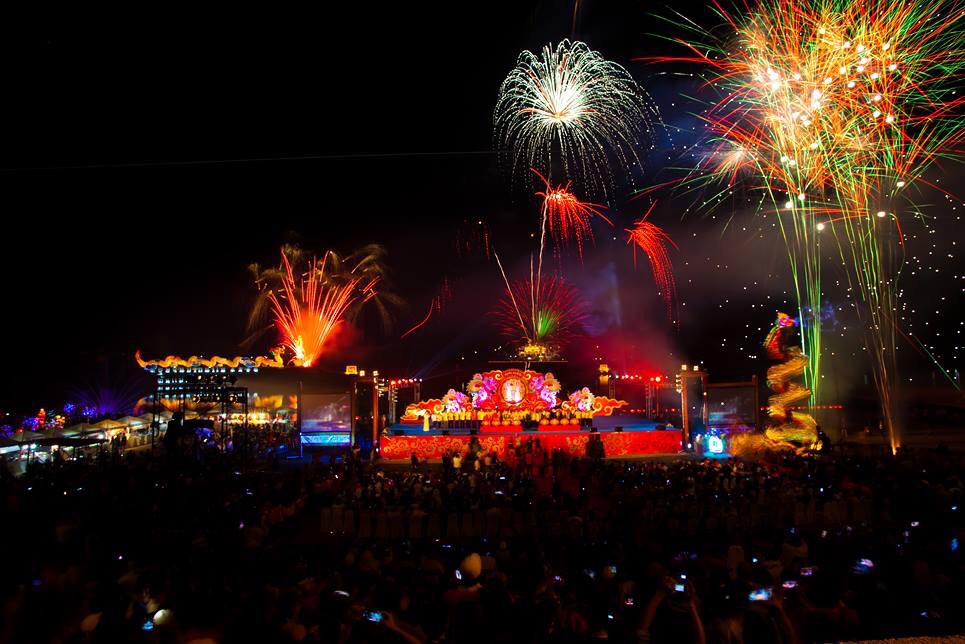
What sets this shrine apart from an ordinary one is its role in the Paknampho Chinese New Year festival. Every year, the people of Paknampho carry the gods out from two sacred shrines — this one, Chao Pho Thepharak–Chao Mae Thapthim, and the Chao Pho–Chao Mae Na Pha Shrine — to parade them around Paknampho market for good fortune. The event, known as the Paknampho god procession, has run for so long that it was registered as national intangible cultural heritage in 2018 (B.E. 2561).
In 2026, the festival runs from 10 to 21 February — 12 days and 12 nights — under the theme "110 Years of a Colorful Chinese New Year, Heavenly City of Five Languages." The highlight is the daytime parade on the fourth day of the new year (Chiu Si), the longest parade procession in Thailand.
Golden dragon procession
A long golden dragon winding down the street — the image of Paknampho's Chinese New Year that the whole country pictures.
Lions from five ethnic traditions
Lion-dance troupes from several cultural lineages in a single procession, vivid color the whole way down the route.
Eng Kor–Pa Bu and the Hainan bowl dance
Processions of traditional Chinese performing arts that reflect the roots of the many Chinese groups who settled in Paknampho.
Spirit mediums and the firewalking rite
The rituals people wait all day for — gods incarnate in spirit mediums, and a nighttime firewalking ceremony.
Planning to watch the parade
The daytime parade days draw huge crowds, so claim a spot along the route early in the morning. Bring a hat, an umbrella, and water. Parking in town fills up fast — if you stay in central Paknampho and walk out, that's by far the easiest way.
Opening hours and getting there
- Location — No. 469, Khwae Yai subdistrict, Mueang Nakhon Sawan district, on the Chao Phraya River, across from Paknampho market.
- Opening hours — roughly 8:00 AM–5:00 PM daily (longer hours and especially big crowds during Chinese New Year).
- Getting there — it's right in central Paknampho; you can walk over from Paknampho market, or drive or take a motorbike taxi from town easily.
- Pair it with — wander Paknampho market, stop for pak mo noodles and riverside snacks, then head on to Pasan, the source of the Chao Phraya, all in the same day.
Want to plan a full day in Paknampho?
See the Nakhon Sawan travel guide →