🔄 Updated 21 Jun 2026
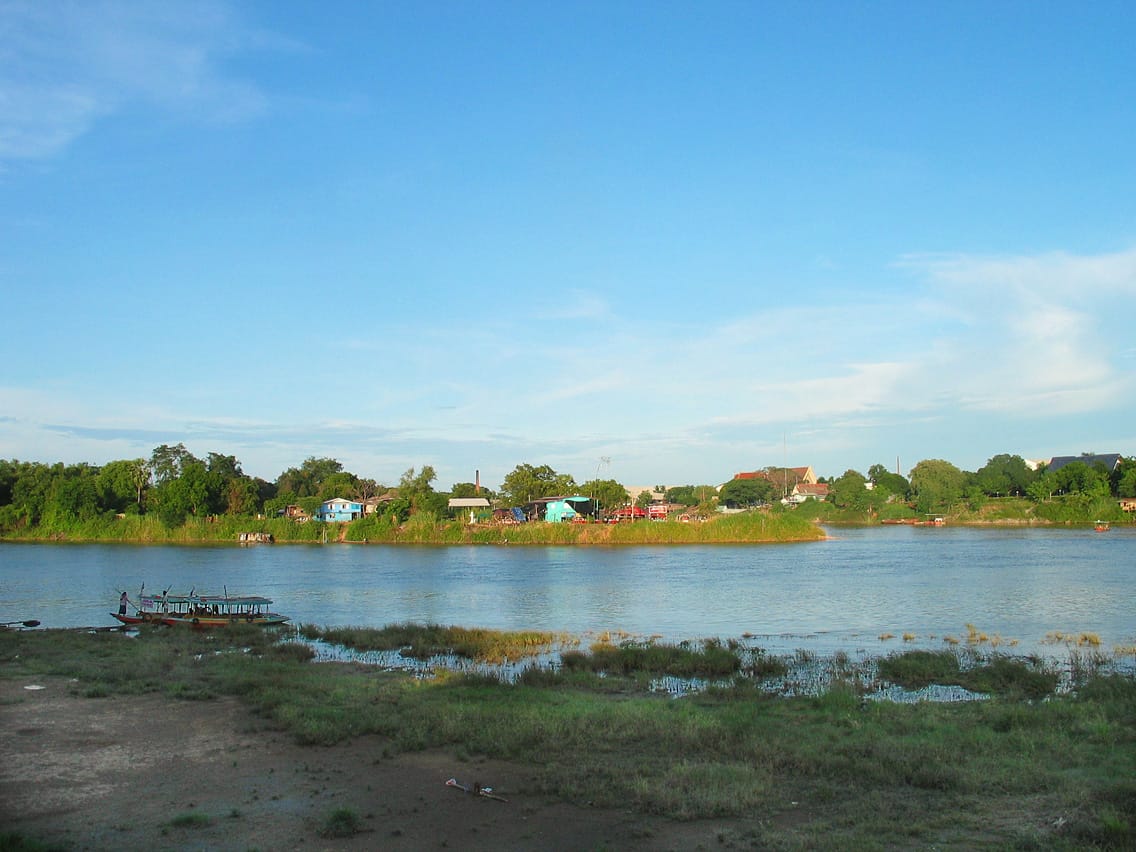
Ask anyone in Nakhon Sawan what the city's landmark is and most will say Pasan. The name comes from the Thai word 'phasan', meaning to join or merge, because this is the exact spot where the Ping, Wang, Yom and Nan rivers come together to form a single river, the Chao Phraya, the source of the waterway that feeds the entire central plains. The building stands on Koh Yom, a spit of land that juts out right at the confluence, so standing here you can actually watch the waters merge with your own eyes.
What Pasan is and why it's worth seeing
Pasan is a landmark structure built from timber in a long, winding curve. The four curving sections of the frame represent the four rivers flowing together. You walk along a path with gaps and glass panels along the sides, and at the far end there's a marker for kilometre 0 of the Chao Phraya River, a spot plenty of people come specifically to photograph. The lower floor holds an exhibition telling the story of the Pak Nam Pho district and the history of the river's source.
Construction started around 2016 on a site of roughly 3 rai, and it opened to visitors in 2019. Because the building has a shape unlike anything else and sits right out in the middle of the water, it became a check-in spot that locals in Nakhon Sawan are proud of and travellers tend to stop by.
- Confluence of four rivers — the Ping, Wang, Yom and Nan merge into the Chao Phraya, and you can watch it from the building
- Curved architecture over the water — a long timber walkway that winds like a river, photogenic from any angle
- Kilometre 0 marker — the starting point of the Chao Phraya River, a popular spot for a photo
- Pak Nam Pho exhibition — the history of the old Chinese quarter and the river's source, on the building's lower floor
Want more out of Nakhon Sawan? Book tours & activities
Booking online ahead on Klook or GetYourGuide is usually cheaper than the gate and skips the queue. Pick only the experiences you actually want — prices and availability are shown live on each site.
The two-tone water, something you have to see for yourself
What gets a lot of people excited at Pasan is the two-tone water right where the rivers meet. The water from the Nan, which runs fairly murky and reddish-brown, flows into the clearer, greener water from the Ping, so you can see a distinct line between the two colours before they gradually blend into one. How sharp that dividing line looks depends on the season and the water levels, sometimes it's very clear, other times it's faint.
Straight talk
The two-tone water isn't equally clear every day, it depends on the season and the water level. From the rainy season through to the late rains, when the rivers run high, the colour difference shows up more clearly. If you're coming specifically for this shot, check the latest water conditions on Pasan's page before you set off so you don't end up disappointed.
How to walk around and get good photos
Pasan works from just about every angle. The curving building gives you natural leading lines, the timber walkway and glass railings make a nice frame, and the backdrop is the wide river and the horizon. Try heading up to the building's upper level for a high angle that takes in the full confluence, then come back down to shoot eye-level shots along the water.
- The curved frame — stand under or beside the curving timber and use the curve as a frame for a shot with depth
- The km 0 marker — a photo with the marker for the source of the Chao Phraya, the classic check-in shot here
- The sunset angle — in the late afternoon the orange-gold light reflects off the water, the best time of day
- From the opposite bank — look back and you'll see the whole building floating in the middle of the river, best caught from the embankment on the Pak Nam Pho side
Timing tips
Midday is hot with strong sun, since the building is open to the elements out over the water. Come in the late afternoon before sunset, around 5pm, for both nice light and cooler, more comfortable air. Early morning is also quiet, with no crowds in your photos.
Hours, entry fee and getting there
Pasan is in central Nakhon Sawan, in the Pak Nam Pho district, and easy to reach. The riverside plaza around it is free to enter, with no admission fee, which is why locals come here to stroll and relax in the evening as a regular thing.
- Hours — the plaza and riverside area are open roughly 06:00–20:00 (the exhibition building may have its own opening hours, check on site or on the page)
- Entry fee — free
- Location — Koh Yom, right at the confluence that forms the source of the Chao Phraya, in the Pak Nam Pho district, Mueang Nakhon Sawan
- Getting there — you can drive or take a vehicle right onto the island, and there's parking; some people choose to take a boat across from the Pak Nam Pho side for the atmosphere
Getting there
From Bangkok it's a drive of a little over 3 hours to reach central Nakhon Sawan. Pasan is near the Pak Nam Pho district, just navigate to 'Pasan' or 'Source of the Chao Phraya River landmark' on your map app. If you don't have your own car, there are taxis around town that can take you right there.
More to do near Pasan
The good thing about Pasan is that it's in the city, so you can easily pair it with nearby spots in a single relaxed day.
Pak Nam Pho district
An old Chinese riverside quarter across from Pasan, with shrines, an old market, Chinese-Thai food shops and local treats like mochi. Great for grazing and strolling, and busiest of all during Chinese New Year.
Uttayan Sawan Park
A large public park in the middle of the city with a lake, fountains and a heavenly dragon statue. Good for an easy walk or an evening chill, free to enter, and not far from Pasan.
Wat Kiriwong / Khao Kop
A hilltop temple in the heart of the city with a viewpoint over the river and the town from above. Easy to pair with Pasan in one day, head up to pay respects and take in the Nakhon Sawan skyline.
An easy plan: spend the late morning walking the Pak Nam Pho quarter and finding something to eat, stop by Uttayan Sawan Park or climb Khao Kop for the view in the afternoon, then finish at Pasan in the evening to wait for the sunset. It's a tidy in-town trip that won't wear you out.
Plan a full Nakhon Sawan trip, where to stay, eat and explore
See the Nakhon Sawan guide →