🔄 Updated 21 Jun 2026
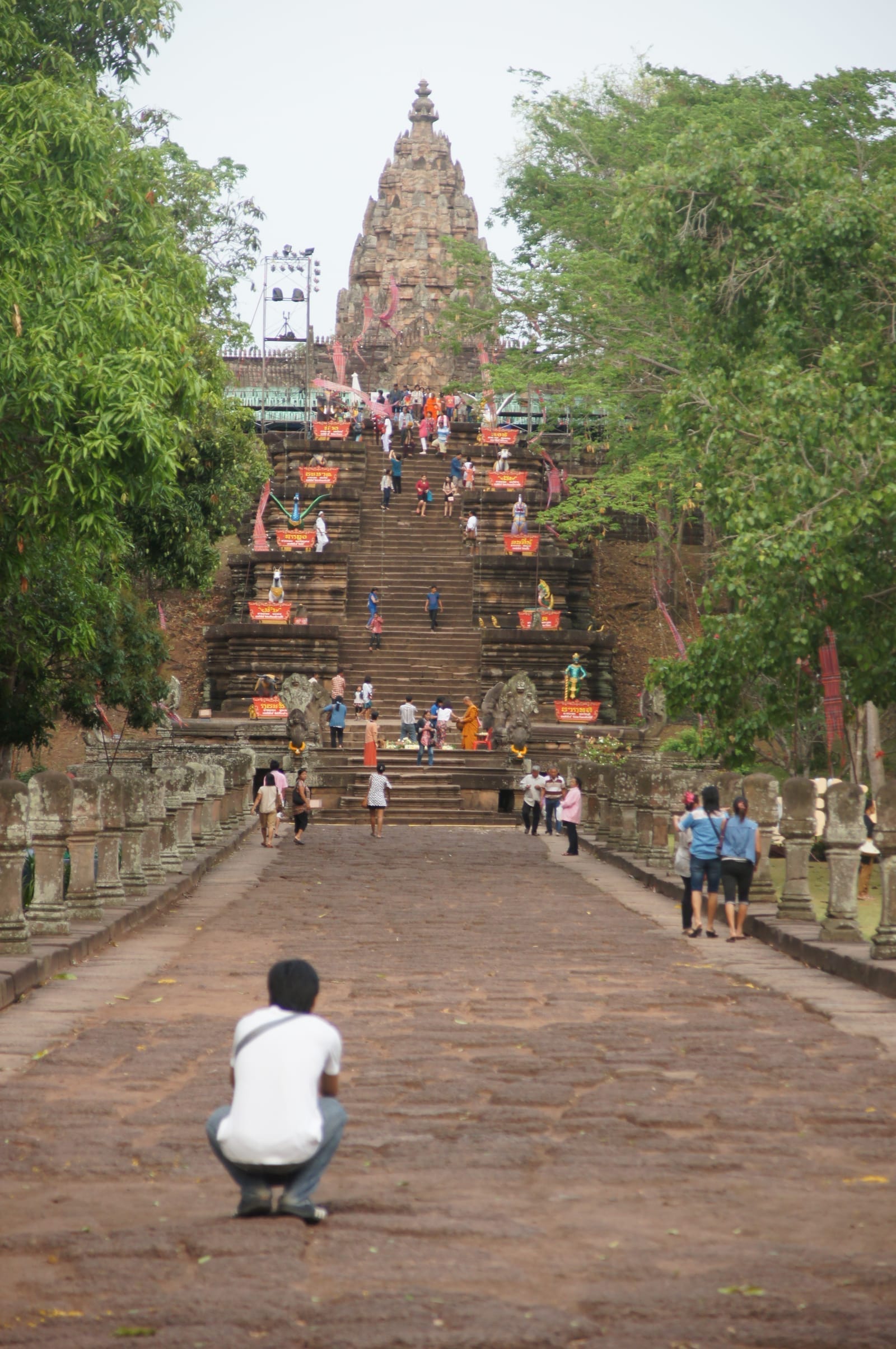
Phanom Rung is a Khmer temple built on the rim of an extinct volcano. Its main axis runs east–west, from the outermost gateway through the walkways and galleries all the way to the central sanctuary. All the doorways line up on one straight line — 15 openings in total. For just a handful of days each year the sun moves into perfect alignment with this axis, and the light pierces every doorway right through to the inner chamber. Stand at the end of the axis and you'll see the sun floating in the middle of the doorframes, stacked one inside the next.
This isn't a story passed down through generations — it's a genuine astronomical calculation the ancient builders set in stone, and it still repeats every single year. That's why it has become the peak season for travel in Buriram, with people booking rooms weeks ahead and standing in line before the sky even brightens.
It happens 4 times a year — sunrise and sunset
The thing most people get confused about: there are two versions. The sunrise alignment (watched in the early morning, facing east) and the sunset alignment (watched in the evening, facing west), each happening twice a year — four times total. Based on recent years' calendars, here's roughly when:
- Sunrise alignment #1 — around April 3–5. The sun rises about 05:55–06:00. This coincides with the Khao Phanom Rung festival, the busiest time of the year.
- Sunrise alignment #2 — around September 8–10. The sun rises about 05:55–06:00. Fewer people than April, but still busy.
- Sunset alignment #1 — around March 5–7. The sun sets about 17:55–18:15. An evening event, so no pre-dawn wake-up needed.
- Sunset alignment #2 — around October 5–7. The sun sets about 17:55–18:15. People start claiming spots in front of the temple from around 17:30.
The dates shift every year — always check first
The dates and times above are a rough frame that holds up most years, but the real figures can move by a day or two based on the Fine Arts Department's calculations of the sun's position. Before you plan your trip, always check the announcements from Phanom Rung Historical Park or the TAT Buriram office page. You can call the park to ask at 044-666251.
Want more out of Buriram? Book tours & activities
Booking online ahead on Klook or GetYourGuide is usually cheaper than the gate and skips the queue. Pick only the experiences you actually want — prices and availability are shown live on each site.
Sunrise or sunset — which suits you?
If you can choose and don't mind getting up early, the April sunrise is the liveliest round, because it lines up with the Khao Phanom Rung festival — there are processions, a light-and-sound show, and a cultural market. The trade-off is huge crowds and the hot Songkran-season heat. The March and October sunset rounds suit anyone who doesn't want to wake up at 3 a.m.: you just turn up in the late afternoon to early evening, the climb is easier, and the softer evening light photographs more gently too.
April sunrise
Full festival atmosphere with processions and performances, but the biggest crowds and the most heat. You'll need to arrive by 4–5 a.m.
September sunrise
The same light-through-the-doorways shot, but with fewer people than April. It's late in the rainy season, so the sky can cloud over easily — that's the gamble.
March sunset
An evening event — no pre-dawn wake-up. Turn up in the late afternoon and you're fine. Soft evening light shoots beautifully, and it's the easiest round for the climb.
October sunset
Evening like March, with cooler, more comfortable weather — but it's also late in the rainy season, so brace yourself for clouds.
Where to stand to see the light through all 15 doorways
The key is to stand on the temple's central axis, because the light passes through in a single straight line. Stand off to the side and you'll only see some of the doorways, not the full row. For the sunrise round, people gather inside the temple and look back out toward the eastern gateway. For the sunset round it flips: you wait in the courtyard in front of the temple on the east side and look through the doorways toward the west. Staff rope off the area and organise the main standing spots, so the earlier you arrive, the more central-axis position you'll get.
- Stand on the central axis — the prime spot is dead-centre of the doorway line; look straight in and you'll see the doorframes stacked like a tunnel.
- Sunrise: look out to the east — stand inside the temple and face out toward the rising sun.
- Sunset: look in toward the west — wait in the courtyard on the east side and look through the doorways toward the setting sun.
- Follow the staff's barriers — at peak times it's packed, with zones and queues. Don't cross the line, or you'll block others and ruin the overall view.
Brace yourself for cloudy skies
This phenomenon depends entirely on the weather. If clouds sit on the horizon right when the sun appears or disappears, you won't see the light clearly. There have been plenty of years when people waited all night only for the sky to close in and miss it — that's just part of watching a natural event. Our advice: treat it as a chance to visit a lovely temple at dawn or dusk anyway, and if you catch the light through the doorways, count it as a bonus. That way you won't be too disappointed.
Day plan for the sunrise round (April / September)
The sunrise round takes the most planning, because you have to arrive before the sky brightens and it's crowded. Here's a timeline that actually works, assuming you're staying in Buriram town or around Nang Rong:
Pack and turn in early
Up before dawn to wait for the light
Day plan for the sunset round (March / October)
The sunset round is far more relaxed — no pre-dawn wake-up. Turn up in the late afternoon, explore the temple to your heart's content, then wait for the evening light. It suits anyone already travelling in Buriram who wants to catch the phenomenon without losing sleep:
Explore the temple before waiting for the light
What to pack
- Flashlight or phone light — for the sunrise round when you climb in the dark; the rough stone path needs lighting.
- A light jacket — pre-dawn and after sunset it's cold and breezy on the hill, especially in October.
- Water and a hat — the April round gets fierce sun once the sky brightens, and there's no shade up top.
- Comfortable, non-slip shoes — there are 52 steps and stone paths; the stone gets slippery late in the rainy season.
- A fully charged camera or phone + a small tripod — the peak light is very short, so setting up in advance gets you a sharper shot.
- Small cash — the entrance fee and some shops at the foot of the hill take cash only.
Where to stay and eat near Phanom Rung
Phanom Rung sits in Chaloem Phra Kiat district, about 70 km from Buriram town. The closest places to stay cluster around Nang Rong district and the foot of the hill, ranging from small resorts to homestays. If you want more hotel choices, it's better to stay in Buriram town and drive over in the morning. During the festival, accommodation around the hill fills up fast, so book several weeks ahead. For early-morning food there are coffee stalls and snacks set up at the foot of the hill and within the festival, but for a proper meal, head back into town or stop in Nang Rong.
If you're coming for a full Buriram trip, it works better to schedule the sun phenomenon on the first day, then work through Mueang Tam temple, Khao Kradong, and the town's food on the following days — because the morning light viewing leaves you fairly tired and sleepy.
Plan a full Buriram trip — temples, football stadium, and food
See the Buriram travel guide →