🔄 Updated 21 Jun 2026
The nice thing about visiting temples in downtown Phitsanulok is that you don't have to drive around hunting for parking. The three main temples — Wat Phra Si Rattana Mahathat (Wat Yai), Wat Nang Phaya, and Wat Ratchaburana — line up side by side on the east bank of the Nan River, with only Ja Karn Bun Road between them. Park once at Wat Yai and you can walk to all three. Half a morning or half an afternoon is plenty.
Wat Yai — Where Everyone Starts
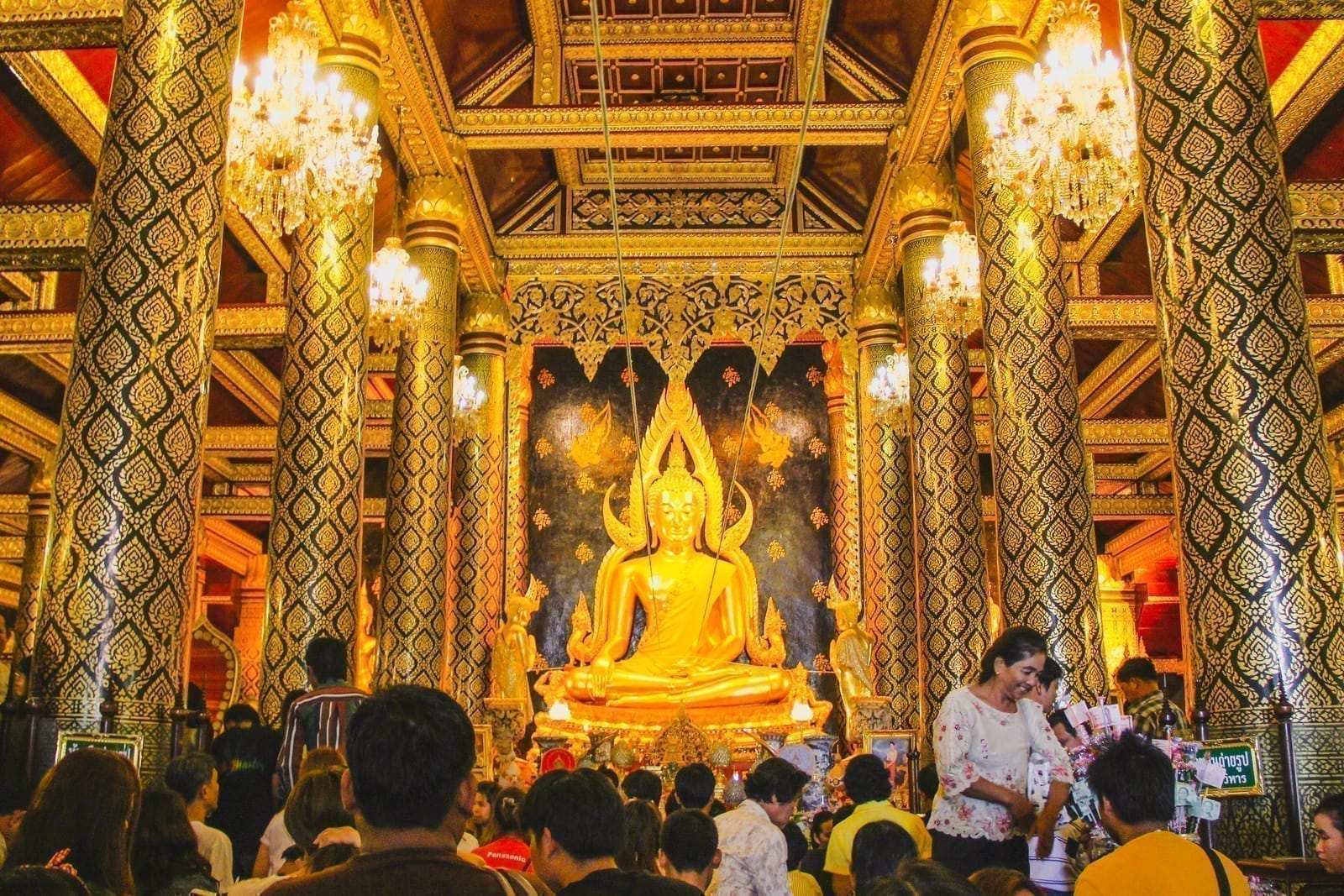
Wat Phra Si Rattana Mahathat Woramahawihan, known to locals simply as Wat Yai ("the big temple"), is the heart of the city and home to Phra Buddha Chinnarat — a Sukhothai-era Buddha image many Thais consider one of the most beautiful in the country. What people love is the flame-shaped halo around the head and the intricate lines of the ornate arch behind it. The main hall opens very early, around 6 a.m., so if you want a quiet atmosphere before the crowds build, come before 9 a.m.
What to know before entering the hall
Inside the Phra Buddha Chinnarat hall you can't stand to take photos — you must sit or kneel. Dress modestly: women should avoid shorts, short skirts, and sleeveless tops. There's no entry fee, but there are donation boxes and offering stations if you'd like to make merit.
- Opening hours — The temple grounds are open roughly 06:30–18:00, while the Phra Buddha Chinnarat hall stays open longer, around 06:00–20:00.
- On-site museum — The Phra Buddha Chinnarat National Museum is open Wed–Sun, 09:00–16:00 (closed Mon–Tue). Worth a look if you have time.
- Souvenirs — The area around the temple has stalls selling amulets, flowers, incense and keepsakes before you walk on.
Want more out of Phitsanulok? Book tours & activities
Booking online ahead on Klook or GetYourGuide is usually cheaper than the gate and skips the queue. Pick only the experiences you actually want — prices and availability are shown live on each site.
Wat Nang Phaya — Birthplace of the Nang Phaya Amulet
From Wat Yai, it's just a short hop across Ja Karn Bun Road to Wat Nang Phaya. Amulet collectors know this name well, because this is where the "Phra Nang Phaya" was found — a terracotta amulet often called the queen of Thai amulets and one of the five great classics (Benjapakee). The story goes that the amulets emerged from the temple's chedi around 1901, during King Rama V's visit to Phitsanulok. Genuine pieces fetch eye-watering prices among collectors, but most visitors come simply to pay respects to the principal Buddha image and ask for blessings on work and money.
The temple is thought to date back to the Sukhothai period and was restored by Phra Wisuthikasattri, consort of King Maha Thammaracha, around 1552–1557. The structures registered as historic monuments are the wihan (now used as the ordination hall) and two redented twelve-cornered chedis. It doesn't take long to walk through, but it's a temple that sends you home with a story.
A tip for the spiritually inclined
If you've come to ask for blessings on money or trade, locals like to pay respects to the principal Buddha at Wat Nang Phaya and then continue straight to Wat Ratchaburana right next door — just a few steps away, no need to drive anywhere new.
Wat Ratchaburana — The Old Riverside Temple People Walk Past
Wat Ratchaburana sits right beside Wat Nang Phaya and Wat Yai, close to the bank of the Nan River. It's an ancient temple believed to date to the Sukhothai period, and its name is tied to the legend of casting Phra Buddha Chinnarat. As the story goes, when King Lithai finished casting Phra Buddha Chinnarat, Phra Buddha Chinnasi and Phra Si Sasada, there was leftover bronze — which was used to cast "Phra Lueua" (the leftover Buddha). Seeing that this temple had fallen into disrepair, the king restored it, and so it came to be called Ratchaburana ("royal restoration").
The thing not to walk past is the old ordination hall, its eaves decorated with the flowing three-headed naga of Sukhothai-style art. Inside are murals of the Ramakien, painted by local artisans in the early Rattanakosin era (around the reign of King Rama IV); the colours and lines are still visible. There's also an old bell tower and a swan statue beside the hall to photograph. It's quieter than Wat Yai, and a good spot to sit and rest before walking back.
- Highlights — The three-headed naga ordination hall, the Ramakien murals, and the old bell tower.
- Atmosphere — Far fewer people than Wat Yai, easy to wander, plenty of room to take photos.
- Note — The murals are old and fragile, and parts are undergoing restoration. If the hall is closed, ask the temple staff.
The Downtown Temple Walking Route
These three temples are so close together you can do them all in one go. Park at Wat Yai's lot, which is the largest, then loop back to where you started — the whole route is under one kilometre.
Walking Three Riverside Temples Along the Nan
The best times to go
If you'd rather skip the heat and the crowds, come before 9 a.m. or in the late afternoon after about 3 p.m. Weekdays are noticeably quieter than weekends. On Buddhist holy days and during the Phra Buddha Chinnarat festival (usually early February), it gets especially busy.
Nearby Temples If You've Still Got Energy
Wat Chula Mani
The oldest temple in Phitsanulok, about 5 km south of the city. It has a Khmer-style prang and a replica Buddha footprint — worth adding to the trip if you have a car.
Along the Nan River
After the temples, take a stroll along the Nan River embankment. In the evening there are markets and riverside restaurants for a relaxed atmosphere.
Want a full Phitsanulok plan with temples, food, and where to stay?
See the Phitsanulok travel guide →