🔄 Updated 21 Jun 2026
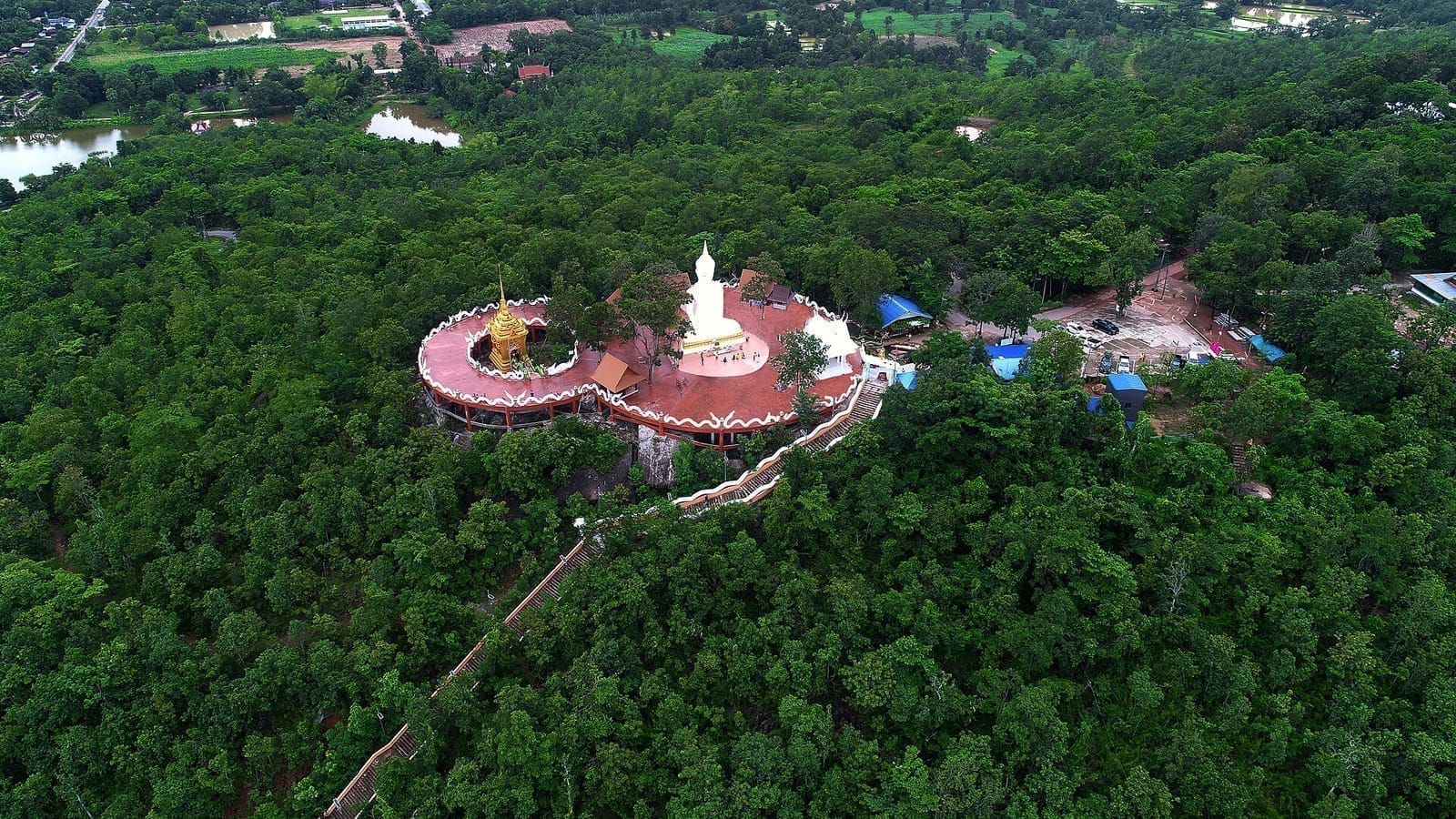
Phra Phrom Phumipalo is a white Buddha in the Maravijaya posture, with a lap width of 10.50 metres and a height of 17.80 metres, set on top of Phu Sing hill at around 346 metres above sea level. It's one of the largest Buddha images in the Isan region. What makes it special is the location: Phu Sing sits right beside Lam Pao Dam, so when you look up from below or out from the middle of the water, the Buddha stands out clearly above the wide reservoir. That view has become an enduring image associated with Kalasin.
The story — a Buddha built when villagers fled the rising dam
The story of Phra Phrom Phumipalo is tied inseparably to Lam Pao Dam. When the dam was being built, the water flooded several original village sites in the Sahatsakhan area, and villagers had to move and resettle on higher ground. This Buddha image was built on top of Phu Sing hill in 1968 to be a gathering point for the hearts of people who had to leave their old homes behind. As the years passed, the Buddha became both a source of spiritual support and a landmark the whole province feels connected to.
Today the site is Wat Phutthawat, which locals more often call Wat Phu Sing. It's both a place for Buddhist practice and a faith-tourism spot where people stop by to pay respects, ask for blessings, and take in the dam view at the same time.
Want more out of Kalasin? Book tours & activities
Booking online ahead on Klook or GetYourGuide is usually cheaper than the gate and skips the queue. Pick only the experiences you actually want — prices and availability are shown live on each site.
How to get up to the Buddha — 654 steps or drive
There are two ways up Phu Sing, depending on how much energy you have. People who want to earn the full merit usually choose to walk what's known as the Stairway to Heaven, 654 steps that you take slowly with rest points along the way. Anyone who can't manage that, or who's bringing older relatives, can drive up a paved road about 2 kilometres long and park at the top instead.
- Walk the 654 steps — the main route up the temple. It's tiring, but you can take it slowly, and there are handrails the whole way. Good for anyone who wants to make merit on foot and get those stairway shots.
- Drive up the paved road — a paved route about 2 km long that takes you up to park near the Buddha. Convenient for older visitors, small children, or really hot days.
- Watch out for the Phu Sing monkeys — there are monkeys living on the hill. Keep food and plastic bags well out of sight, and don't tease them or hand them food.
Hours and entry fee
Wat Phutthawat Phu Sing is open for visits roughly 6:00 AM to 6:00 PM daily, with no entry fee (donations as you wish). The popular time to go up is late afternoon to wait for sunset, but you'll want to head down before dark, since the descent isn't easy once the light goes.
What stands out on top — pay respects, take in the view, get your photos
Once you reach the top, the Buddha's terrace opens up with views in every direction. On one side stands the large white Phra Phrom Phumipalo, facing out toward the dam. On the other is a viewpoint that looks far across the whole Lam Pao reservoir, with Phu Kum Khao and the nearby Phu Khao hills in sight.
The Phra Phrom Phumipalo Buddha
A white Buddha in the Maravijaya posture, 10.50 metres wide at the lap and 17.80 metres tall, beautifully proportioned. It's the main spot for paying respects and asking for blessings.
Lam Pao Dam viewpoint
The front terrace looks out over Lam Pao Dam as far as the eye can see, with Phu Kum Khao and Phu Khao as a backdrop. It's the favourite angle for shooting the Buddha together with the water.
Sunset spot
In the evening, golden light spills across the reservoir to the west — the time when Phu Sing looks its best. If you come around then, have your camera ready.
When to go, and the festivals worth catching
You can go up Phu Sing year-round, but the most comfortable weather is at the end of the rainy season into early winter, roughly November to February, when the sky is clear, the reservoir is full, and the views are great. In the hot season the sun is harsh, so if you plan to walk the steps, go in the morning or evening.
- Songkran water-pouring ceremony — around 12–16 April each year, people from Kalasin carry monks' robes up the 654 steps to pour water over the Buddha for good fortune. It's a lively traditional scene.
- Alms-giving at the end of Buddhist Lent — at the end of Lent there's an alms-giving ceremony with a large gathering of monks, around 500, on the hilltop. It's the temple's big annual merit-making event.
- Avoid the long weekends — New Year and Songkran draw big crowds, and the parking at the top fills up fast. If you want a relaxed walk, come on a weekday or get there early.
Where to go next around Sahatsakhan
The nice thing about Phu Sing is that it's in the same zone as several of Kalasin's standout attractions. It's about 28–30 kilometres from the city centre toward Sahatsakhan district, roughly a 40-minute drive, so you can line up a few stops in a single day.
- Sirindhorn Museum (Phu Kum Khao dinosaurs) — also in the Sahatsakhan area, it's the most complete dinosaur museum in Thailand and can keep kids busy all day.
- Reclining Buddha of Phu Khao, Wat Phutthanimit — a reclining Buddha carved into rock without an ushnisha (the topknot crown), unusual to see, and close enough to Phu Sing to drop by.
- Lam Pao Dam — a long dam crest with riverside restaurants serving fresh reservoir fish, good for a lunch stop after coming down from Phu Sing.
- Isan food in Kalasin town — head back into town in the evening for som tam, larb, koi, and other local dishes for dinner.
One day is plenty to make it worthwhile
If you only have a single day, start in the morning at the Sirindhorn Museum at Phu Kum Khao, have lunch beside Lam Pao Dam, then save Phu Sing for late afternoon so you can go up to pay respects and wait for the sunset over the dam. It's a tidy way to round off the day.
Want a well-placed base for exploring Sahatsakhan and Lam Pao Dam
See the Top 10 hotels in Kalasin →