🔄 Updated 21 Jun 2026
Yasothon is a small Isan province that plenty of people drive straight through on the way to Ubon without stopping. But if you've got even half a day, Phra That Kong Khao Noi is worth getting out of the car for, because it pairs two things you rarely see together: a stupa from the late Ayutthaya period and the green rice fields (or gold during harvest) that wrap right around it.
The Kong Khao Noi legend — the story they've passed down
As the legend goes, in the late Ayutthaya period a young farmer went out to plough his field at dawn. He worked so hard he grew ravenously hungry, waiting for his mother to bring his food, but she was running late. When she finally arrived with the kong khao (a small woven basket of sticky rice), he saw how tiny it was and figured it couldn't possibly be enough. Hunger and anger got the better of him, and he lashed out at his mother and killed her.
But when he actually ate the rice from that little basket, he couldn't finish it. He was full with food still left over. Only then did the young man realise the terrible thing he'd done, killing the mother who gave him life over a misunderstanding about a single basket of rice. Wracked with guilt, he built a stupa on the very spot where she died, to ask her forgiveness and dedicate the merit to her. That's where the name 'Kong Khao Noi who killed his mother' comes from.
Straight talk
This is a folk legend that teaches gratitude to your parents and keeping your temper in check. There's no historical evidence that the events actually happened, but it's a moral cautionary tale that's been handed down for generations. Many people come here to pray and ask forgiveness for things they once did wrong by their parents.
Want more out of Yasothon? Book tours & activities
Booking online ahead on Klook or GetYourGuide is usually cheaper than the gate and skips the queue. Pick only the experiences you actually want — prices and availability are shown live on each site.
The stupa itself — genuinely old, tapered brick in the fields
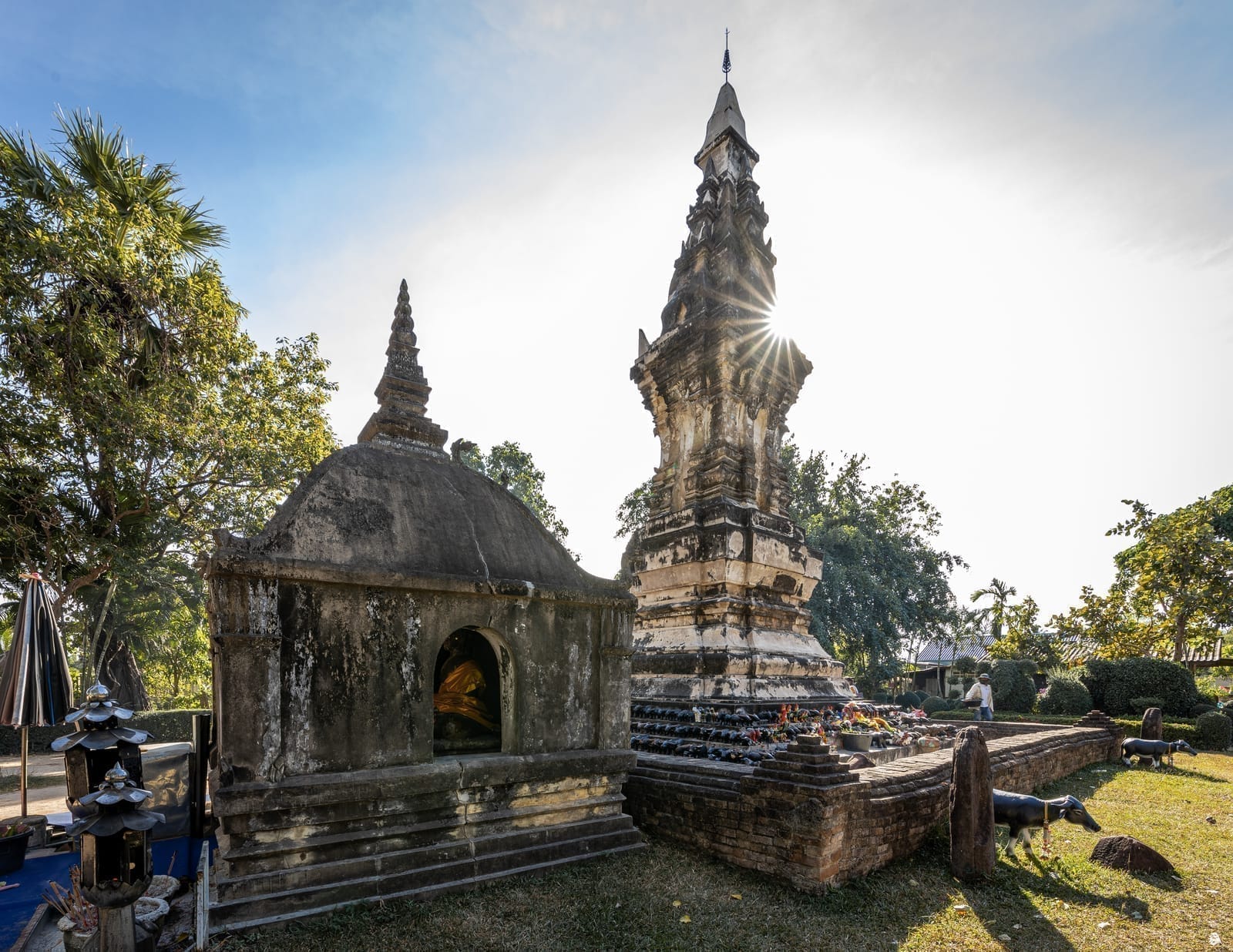
Phra That Kong Khao Noi is a brick-and-mortar stupa with a square base roughly 2 metres on each side. The body tapers gradually up into an octagonal bell, topped with stacked lotus-band tiers, with arched niches on all four sides. The slim, tall shape really does look like an upturned sticky-rice basket, which fits the name perfectly. It's thought to date to around the late Ayutthaya period and has been registered as a historic monument since 1936.
- Material — brick and mortar in the original aged brick colour, with traces of restoration to keep it sound
- Shape — square base, body tapering up into an octagonal bell, crowned with lotus-band tiers
- Backdrop — surrounded by rice fields, green in the rainy season, golden during the late-year harvest
- Grounds — a low wall rings the stupa, with an open courtyard so you can walk all the way around easily
There are two That Kong Khao Noi — don't go to the wrong one
Here's the part that trips people up: Tat Thong sub-district has two stupas named 'That Kong Khao Noi,' not far apart. The popular landmark, the one with clear signposting, is the one standing in the rice fields of Ban Tat Thong. The other sits within the grounds of Wat Thung Sadao. Follow the map or the signs and you'll reach the one in the fields, where everyone comes to take photos.
Nearby there's also Phra That Tat Thong, an archaeological site where prehistoric skeletons and earthenware vessels were unearthed, similar to Ban Chiang. If you're into history, it's an easy add-on stop in the same area.
Where to pray
Most people come here to pay respects and ask forgiveness of their parents, both those still living and those who've passed, in keeping with the legend. Some come specifically to pray for the virtue of gratitude, asking that their family stay in harmony.
- Pay respects at the stupa — walk clockwise around it three times, as tradition has it
- Flowers, incense and candles — small stalls near the car park sell offering sets for a few dozen baht; you're welcome to bring your own if you'd rather prepare ahead
- Ask forgiveness of your parents — many people take the chance to silently ask forgiveness for things they once did wrong by their parents
Photo spots and the best angles
The appeal here is the old stupa set against wide-open rice fields, an angle you simply can't find in a big city. The prettiest times are early morning and late afternoon near sunset, when the light is soft and it isn't too hot.
Stupa + rice fields
Step back and frame the stupa floating in the middle of the green (or gold) fields. This is the signature shot here.
Backlit spire silhouette
In the late afternoon, shoot into the light to catch the tapered silhouette of the stupa against an orange sky.
Niche detail
Move in close to capture the aged brickwork and the arched gateways on all four sides, the old textures up close.
Photo tip
In the rainy season (Jun–Sep) the fields turn lush green, while around Nov–Dec they go golden at harvest time. Those are the two moments where the photos look completely different, so pick whichever you prefer. Midday Isan sun is fierce, so aim for morning or late afternoon.
Getting there
Phra That Kong Khao Noi is about 9 kilometres from Yasothon town, along Highway 23 (Yasothon–Ubon Ratchathani). Around the km 194 marker there's a sign to turn off, then it's roughly 1 more kilometre in. Driving yourself is by far the easiest way.
- Own car / rental — about 15 minutes from Yasothon town; take Highway 23 toward Ubon, then turn off following the Ban Tat Thong signs
- Motorbike — rent one in Yasothon town and ride out; the road is good and the route is easy, great if you like stopping for photos along the way
- Songthaew / hired ride — no vehicle? Ask about hiring a songthaew or a motorbike taxi from town, and agree on the price before you get in
At the site there's a large car park that fits plenty of cars and even tour buses, plus toilets and a small souvenir and offering stall. Entry is free, with no admission fee, and it's open all through the daytime hours.
Where to stop next
Since it sits right on the Yasothon–Ubon route, it makes for an easy stop mid-trip. Around 30–45 minutes here is plenty, then carry on into Yasothon town to explore the old quarter or pray at other temples.
Ban Singha Tha
Yasothon's old quarter, with Sino-Portuguese shophouses along the Chi River, lovely for a wander and photos.
Temple visitWat Maha That, Yasothon
An old temple central to the city, home to Phra That Phra Anon and a beautiful scripture hall set over water.
Plan a half-day or full day in Yasothon without missing a thing
See the Yasothon travel guide →