🔄 Updated 21 Jun 2026
Plenty of people come to Nakhon Phanom set on visiting the great Phra That Phanom, and often forget there are several birthday-day stupas scattered around the province too. Phra That Renu Nakhon is one of them, and it's the one people born on a Monday come to most. What sets it apart from the other stupas is that it doesn't stand alone — it comes with a whole district of Phu Tai people who still live the traditional way for real.
What is Phra That Renu Nakhon, and why is it pink?
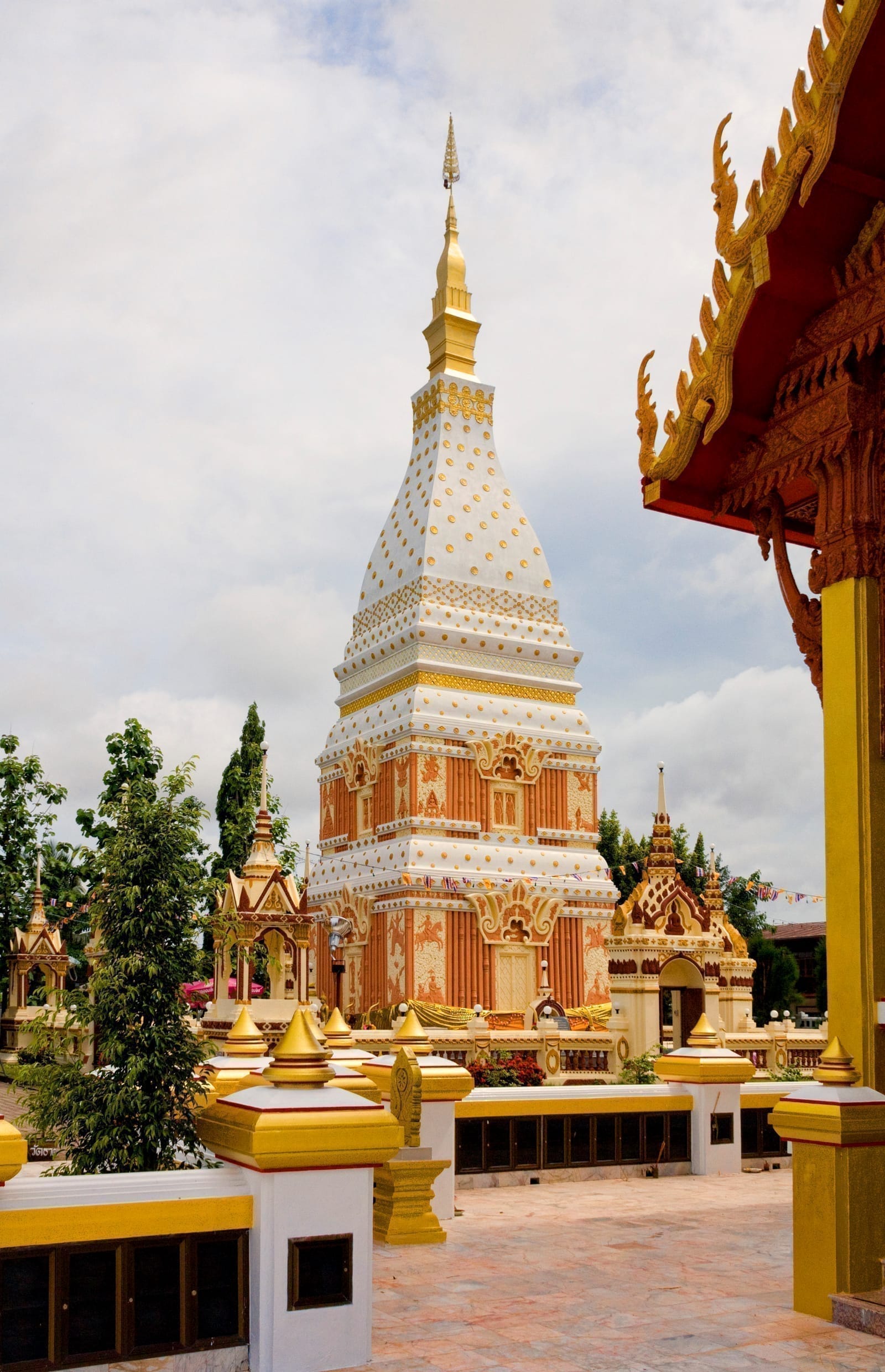
Phra That Renu Nakhon sits at Wat Phra That Renu, in the center of Renu Nakhon town. It was built in 1918 (B.E. 2461) by the abbot Phra Upatcha Inphumiyo. Its form is modeled on the original Phra That Phanom, scaled down to about 35 meters tall with a base a little over 8 meters wide, and arched gateways on all four sides. If you've seen Phra That Phanom before, the shape feels familiar straight away — except this one is painted soft pink, the color of Monday, which has become its signature look.
Inside the stupa is a hollow chamber holding the Tripitaka scriptures, a golden Buddha image, a silver Buddha image, and treasures from the old town rulers. In the ordination hall next door stands Phra Ong Saen, a golden Buddha in the meditation posture, Lao in style and beautifully proportioned — the temple's revered Buddha that locals hold dear. Once you're here, don't just pay respects to the stupa outside; step into the hall and bow to Phra Ong Saen as well.
Want more out of Nakhon Phanom? Book tours & activities
Booking online ahead on Klook or GetYourGuide is usually cheaper than the gate and skips the queue. Pick only the experiences you actually want — prices and availability are shown live on each site.
The Monday stupa — what you come to ask for
Within Nakhon Phanom's full set of birthday-day stupas covering the whole week, Phra That Renu Nakhon is the one for Monday. Belief holds that those born on a Monday who come to pay homage will be blessed with skin and a complexion as bright and lovely as moonlight, along with greater charm and likability. People commonly come to ask for charm and for advancement in their careers.
- People born on a Monday — this is their own birthday-day stupa, visited to boost luck and bring good fortune.
- People collecting all the birthday-day stupas — the full set of 7 days (8 if you count Rahu) is spread across Nakhon Phanom, and this is the Monday one.
- Those praying for charm and likability — they often light incense and candles and walk circuits around the stupa, as many times as they've set their mind to.
Pay your respects the local way
Bring flowers, incense, and candles, and make your offering at the spot in front of the stupa, then walk pradakshina (clockwise) around it three times. Mornings before 10am are best — the sun isn't harsh yet, and you can shoot the pink stupa against the sky beautifully without baking in the heat.
The Renu Phu Tai community — this isn't only about the stupa
What makes Renu Nakhon special is that the people here are Phu Tai (Phu Thai), an ethnic group that crossed the Mekong long ago to settle here, and they've kept their language, dress, and traditions well intact. Walk through town and you'll see elders in handwoven sarongs speaking Phu Tai in everyday life — not a scene staged for tourists, but the real way of things.
The Phu Tai have many ways of welcoming guests that they still practice, and if you come as a group or during a merit festival you'll catch the full set — from the baisri su khwan blessing ceremony and the tying of cotton string around your wrist, to a pha laeng meal (local dishes laid out on a shared tray and eaten together), all the way to being invited to drink u, fermented rice liquor sipped through a bamboo straw the old-fashioned way.
- Baisri su khwan — a welcoming and blessing ceremony, with white cotton string tied around your wrist for good fortune.
- Pha laeng — eating from a shared Phu Tai tray, with local dishes and fermented-fish chili dip.
- Sipping u — fermented rice liquor drunk through a bamboo straw, in a traditional merit-festival mood.
- Phu Tai handwoven cloth — distinctive patterns, available to buy as gifts at the market and shops in the community.
The Phu Tai dance — graceful, with a rhythm all its own
The Phu Tai dance (fon Phu Tai) is a folk performance passed down over generations in this community. The movements are soft and flowing, focused on fluid motion of the hands and body. Dancers wear dark Phu Tai costumes trimmed in red and fit long metal fingernail extensions so the fingertips taper gracefully, dancing to the rhythm of the khaen, drums, and finger cymbals — a sight people coming to Renu Nakhon hope to catch at least once.
To be straight with you, the Phu Tai dance isn't performed every day. If you want to see the full version, the easiest time to catch it is during festivals — especially the Phu Tai Renu Nakhon Day festival, held around early in the year (early to mid February–March, depending on each year's calendar). The festival features a large group Phu Tai dance, mo yao (traditional healers), and cultural booths from each sub-district. If you time your visit to the festival, it's well worth it — but if you come on an ordinary day, set your expectations on paying respects and walking the community as the main draw, and check ahead with the municipality or temple about whether there's a welcoming dance troupe.
To make sure you see the Phu Tai dance
If you're coming as a group and want a welcoming ceremony plus the Phu Tai dance, you can contact the Renu Nakhon sub-district municipality or the community cultural center in advance. They often arrange it with a baisri su khwan ceremony bundled in — a good fit for group trips or study tours.
Markets and food around the stupa
Around Wat Phra That Renu there are community markets to wander. The one people mention most is the Renu Nakhon Tong Chom Market (the Phra That Renu Nakhon Cultural Center market), which opens regularly on weekends and is generally liveliest on Saturdays. It brings together products from occupational groups and OTOP goods from all 8 sub-districts of the district — local snacks, woven cloth, and gifts, at genuine local prices.
- Renu jicama (man kaeo) — the local specialty, sweet and crunchy, good to snack on or take home, at a few tens of THB per bag.
- Phu Tai–Isan food — som tam, grilled chicken, fermented-fish chili dip, sticky rice, roughly ฿20–60 a plate.
- Handwoven cloth + OTOP goods — Phu Tai-patterned sarongs and souvenirs, starting from the low hundreds of THB depending on the piece.
Straight talk
The market here is busy in spurts, depending on the day and the festival calendar. If you come on a weekday afternoon it may be quieter than you expect. Some food shops around the temple still stay open, but if you want the full market atmosphere, aim for a Saturday or a time when there's a merit festival on.
How to get to Phra That Renu Nakhon
Phra That Renu Nakhon is about 51 km south of Nakhon Phanom city. The main route is Highway 212 (the Nakhon Phanom–That Phanom road) to around the 44 km mark, then turn right onto Highway 2031 for about another 7 km to reach Renu Nakhon town. Driving from the city takes about 50 minutes to 1 hour.
- Private car / rental car — the most convenient; you can park at the temple, and it suits hitting several stops in one day.
- Pair it with Phra That Phanom — Renu Nakhon is on the same route as That Phanom district, so you can visit Phra That Phanom and carry on to Renu in a single trip.
- No car — you can hire a tuk-tuk / local ride from That Phanom over to Renu, but arrange your pickup time in advance, since direct public transport on this route isn't frequent.
Plan the route to make it worthwhile
The Nakhon Phanom–That Phanom–Renu Nakhon loop works well as a half-day to full-day temple trip: visit the great Phra That Phanom in the morning, carry on to Phra That Renu mid-morning, then have lunch around That Phanom before heading back into the city.
Renu Nakhon at an easy pace — a sample schedule
Merit-making + the Phu Tai community
On to Phra That Phanom + back to the city
Round it out — stupas and nearby sights
Phra That Phanom
The great stupa, a focus of faith on the Mekong, on the same route as Renu — visit them as a pair
TemplesPhra That Tha Uthen
The Friday stupa, north of the city — add it on if you're collecting the birthday-day stupas
In the cityNakhon Phanom Mekong promenade
The riverside walk in town, with views over to Laos — a nice way to wind down the day
Plan your whole Nakhon Phanom trip — temples, good food, and the Mekong
See the Nakhon Phanom travel guide →