🔄 Updated 21 Jun 2026
Phrae's old town is smaller than most people expect. Several of its most important temples sit within a few hundred metres of each other, around the Wongburi House and the Chao Luang Mansion. Start early, walk from Wat Phra Bat Ming Mueang through Sa Bo Kaeo to Phong Sunan, and you'll get your merit, three distinct architectural styles — Lanna, Shan-Burmese, and the ornate craftsmanship of the teak-boom era — and be done before midday, with time left for a coffee or lunch in the old quarter.
Wat Phra Bat Ming Mueang Worawihan — The Royal Temple of Phrae
This is the natural starting point: it sits at the centre of the old town and is genuinely the city's guardian temple. The name Phra Bat Ming Mueang comes from merging two older temples that once stood on opposite sides of the road — Wat Phra Bat, formerly the temple of the deputy ruler, and Wat Ming Mueang, which belonged to the ruling lord of Phrae. After the princely system ended, both temples fell into disrepair. A provincial committee merged them, and in 1955 the compound was granted royal status as a Third-Class Royal Monastery (Worawihan grade).
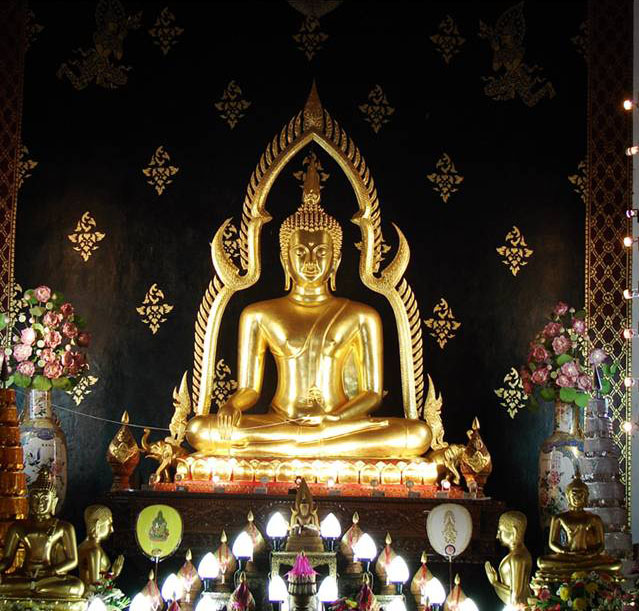
The main object of veneration is Phra Phuttha Kosai Siri Chai Maha Sakyamuni, Phrae's city-guardian Buddha image, recast in bronze in 1955 in the Chiang Saen-Sukhothai style with a lap width of about one wa five inches. The other highlight is Phra Chedi Ming Mueang, an old chedi said to enshrine a replica footprint of the Buddha — hence the "Phra Bat" (sacred footprint) in the temple's name.
- Highlights — Phra Phuttha Kosai city Buddha · Phra Chedi Ming Mueang · temple viharn and small museum
- Location — Centre of the old town, near the City Pillar Shrine; short walk from Wongburi House
- Best for — Those wanting to pay respects to the city's guardian Buddha and fans of Lanna architecture
Festival period
Around February–March each year the temple hosts the Wai Phra That Ming Mueang festival, which draws big crowds and a lively atmosphere. If you want a quieter visit with room to take photos, avoid that window or arrive early in the morning.
Want more out of Phrae? Book tours & activities
Booking online ahead on Klook or GetYourGuide is usually cheaper than the gate and skips the queue. Pick only the experiences you actually want — prices and availability are shown live on each site.
Wat Sa Bo Kaeo — Shan Viharn in the Heart of Town
A short walk on brings you to a temple that looks nothing like a typical Thai wat. Wat Sa Bo Kaeo — originally called Wat Jong Klang — was built around 1876 by Shan and Burmese settlers who came to Phrae during the teak-concession and gem-mining era. The viharn follows the same Burmese-Shan style as Wat Jom Sawan: a single multi-function building combining chapel, sala, and monks' quarters under one roof, with steeply tiered gables and intricate fretwork decorating every edge.
The name Sa Bo Kaeo refers to a year-round pond that once occupied the site, ringed with pikul trees (kaeo). The principal Buddha image inside was brought from Mandalay, Myanmar. The other crowd-pleaser for photos is Phra That Ku Kong Kham, a gilded chedi in the compound. The architecture here photographs particularly well, especially with morning light raking across the layered viharn facade.
- Highlights — Single multi-function Shan viharn · principal Buddha from Mandalay · Phra That Ku Kong Kham golden chedi
- Location — Along the moat road on the Nam Khue side, within the old city walls
- Best for — Architecture fans and anyone looking for a distinctive Shan-Burmese photo angle
Shoes off
The Shan viharn has polished wooden floors — shoes must come off before entering. Wear socks or bring a small bag to carry your shoes rather than leaving them outside; it makes moving between buildings much easier.
Wat Phong Sunan — Outdoor Reclining Buddha and a Courtyard of White Chedis
The last stop on the route is the most photogenic of the three. Wat Phong Sunan — formerly Wat Pong Sanook — lay abandoned until 1929, when Luang Phong Phibun (Phraya Buri Rat Jao Phrom) and Chao Mae Sunanta Wongburi led a major restoration. The temple name fuses both patrons' names, and it has served as the Wongburi family temple ever since. It sits directly next to Wongburi House and Khumm Chompu, so combining them is effortless.
The first thing you see from outside the walls is a large outdoor reclining Buddha, gilded gold, resting along the compound wall. Inside you'll find a 19-spired ceremonial gateway and Phra That Phong Sunan Mongkhon, a reliquary chedi housing Buddha relics. The shot most visitors go after is the glass chapel and the all-white chedi courtyard, with 108 white chedi spires enclosed by a transparent-ball fence. It reads clean and bright in almost any light.
- Highlights — Outdoor golden reclining Buddha · 19-spired ceremonial gate · courtyard of 108 white chedis · Phra That Phong Sunan Mongkhon
- Location — Adjacent to Wongburi House and Khumm Chompu, within the old city walls; easy to extend into a heritage walk
- Best for — Photographers and families wanting a scenic temple stroll without much walking
Easy add-ons
Wat Phong Sunan is right next to Wongburi House and Khumm Chompu — step out of the temple and you're already at the teak mansion. If you're visiting on a Saturday evening, the Phrae walking street along Kham Lue Road is nearby for a leisurely finish.
Half-Day Temple Walking Route
All three temples sit within the original city walls, reachable on foot within a few hundred metres of each other. Starting in the morning lets you avoid the midday heat and catch better light for photos.
Three Temples + Heritage Walk
If you have more than half a day, add Wat Jom Sawan (another Shan-Burmese viharn) to the route, or save the afternoon for Wat Phra That Cho Hae outside town — the provincial chedi associated with the Year of the Tiger.
Good to Know Before You Go
- Admission — All three temples are free to enter; donation boxes are available inside
- Opening hours — Wat Phong Sunan is roughly 08:00–17:00; Wat Phra Bat Ming Mueang and Wat Sa Bo Kaeo follow similar daytime hours. Aim to finish by 16:00 for the best light
- Dress code — Temples require modest dress; avoid very short shorts or sleeveless tops. Remove shoes before entering the Shan viharn at Wat Sa Bo Kaeo
- Getting around — All three temples are in the old town and walkable from each other; parking is available at the temples and on surrounding streets
- Best time to visit — Morning to mid-morning for good light and cooler temperatures; weekdays are less crowded than weekends
Make the most of the area
This neighbourhood is the core of Phrae's old town. Three temples, Wongburi House, the Chao Luang Mansion, and several old-town cafes are all within easy reach of each other. Block out half a day here and keep the other half for teak-house exploration or the indigo-dyeing community at Thung Hong.
Looking for a hotel within easy walking distance of Phrae's old town?
See Top 10 Hotels in Phrae →