🔄 Updated 21 Jun 2026
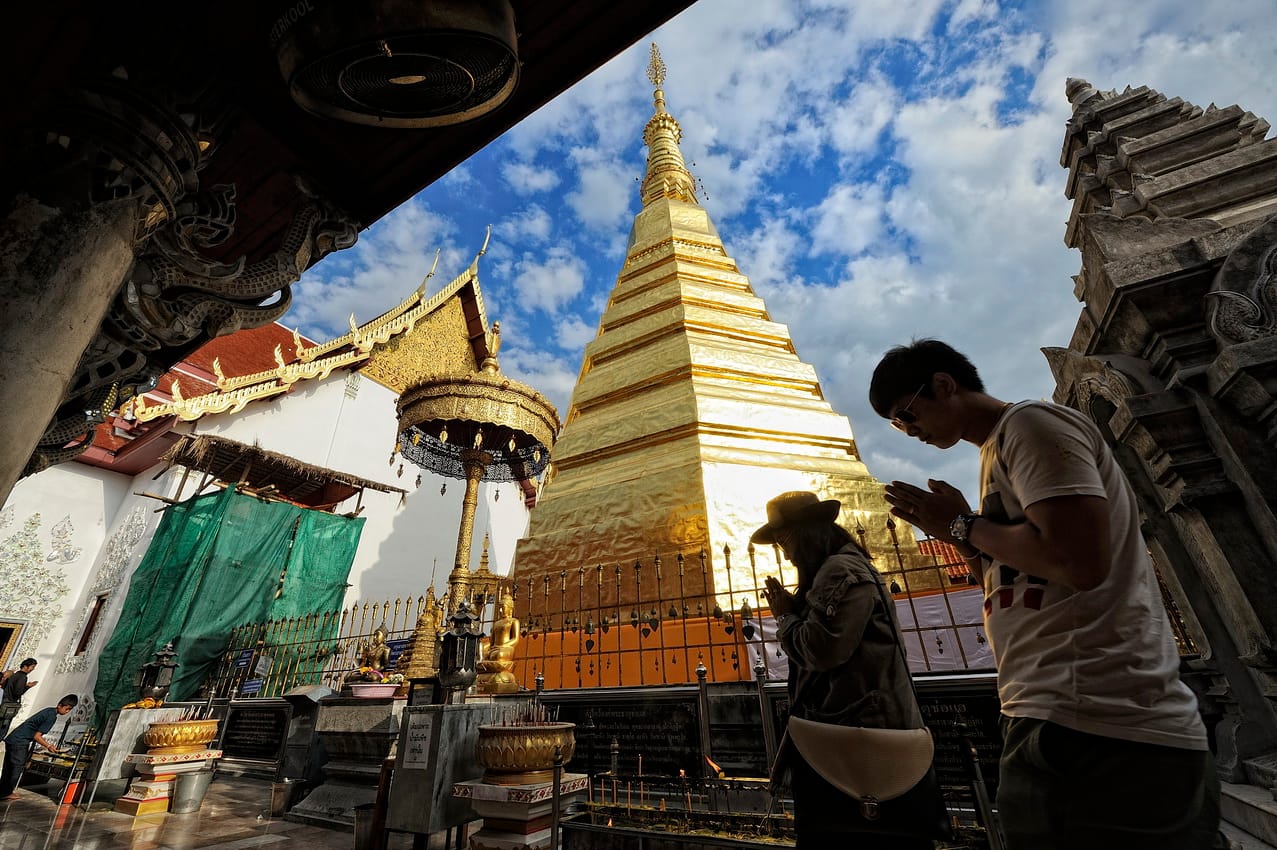
Wat Phra That Cho Hae sits in Cho Hae sub-district, Mueang Phrae district, and was raised to the status of a royal temple in 2006. The stupa itself is an octagonal Chiang Saen-style chedi, 33 metres tall, on a square base measuring 11 metres per side, clad in shimmering gold-coloured copper plating. Inside it enshrines a relic of the Buddha's left elbow and a hair relic. By legend it dates back to the Sukhothai era, and it was restored in 1924 with Khruba Sriwichai playing a major part in the work.
Why Cho Hae, and why the Year of the Tiger
The name "Cho Hae" comes from the fine silk cloth that villagers used to tie around the stupa as an offering. In the northern dialect, silk cloth is called "hae" — and that's where the name Phra That Cho Hae comes from, right up to today. The zodiac belief, meanwhile, comes from the Lanna tradition of "chu that," which pairs each major stupa with a birth year. Phra That Cho Hae is the stupa of the Year of the Tiger, so people born in that year make a point of coming to pay respects at least once for good fortune. In truth, though, anyone can come and pay respects no matter what year they were born — it isn't only for those born in the Year of the Tiger.
The three-coloured silk cloth
There's a belief that draping the stupa with three-coloured silk cloth as an offering helps strengthen protection and ward off bad things. You can buy the cloth from the shops at the temple, so there's no need to bring your own.
Want more out of Phrae? Book tours & activities
Booking online ahead on Klook or GetYourGuide is usually cheaper than the gate and skips the queue. Pick only the experiences you actually want — prices and availability are shown live on each site.
Where to pay respects inside the temple
A lot of people assume this temple is just the one stupa, but there are actually spots to pay respects spread across several corners of the grounds. Walking the full circuit takes about an hour. Here are the main stops people like to make.
The Phra That Cho Hae stupa
The heart of the temple — a 33-metre golden chedi on the hill. Walk clockwise around it three times, make your wish, then tie on a silk cloth as an offering. This is what everyone comes here for.
Luang Pho Than Jai (the wish-granting Buddha)
A gilded, lacquered Buddha image in the meditation pose. People come to ask for wishes they want granted quickly, then make a vow with flowers or return to fulfil it as promised.
Phra Phuttha Loka Nat Bophit
The principal Buddha image in the ordination hall, large and beautifully made. It's a good place to step inside, sit quietly and pay respects, away from the sun and the bustle outside.
The reliquary of Khruba Sriwichai
This holds the relics of Khruba Sriwichai, the revered Lanna monk who helped restore the stupa. Northern Thais hold him in high regard and often come to ask for blessings around their goals and success.
The reclining Buddha (Phra Chao Non)
A reclining Buddha image inside a viharn. People come to ask for blessings around health and peaceful rest. It's another corner that's quieter than the area around the main stupa.
The teakwood Buddha (Phra Chao Mai Sak)
A Buddha image carved from teak, a nod to Phrae's long-standing reputation for teakwood. It's a distinctive spot both for photos and for paying respects.
An easy order to pay respects
If you're not sure where to start, head up to the stupa first and walk clockwise around it three times. From there, work your way round to Luang Pho Than Jai, the principal Buddha in the ordination hall, and the other spots along the path. There's no fixed order — what matters is your intention.
Walk up, or take the lift
The stupa stands on a rise, reached by a naga staircase from the temple courtyard below. The steps aren't long but they are steep — fine for most people. For older visitors, anyone who finds walking difficult, or families with small children, the temple runs a lift for around 20 THB per person that takes you straight up to the stupa terrace, so there's no need to push yourself up the stairs.
Opening hours and what to wear
- Opening hours — daily, roughly 06:00–19:00. Mornings are quieter and cooler, and an easy time to pay respects.
- What to wear — this is a royal temple, so dress modestly: no spaghetti straps, no shorts above the knee. You'll need to remove your shoes to go inside the ordination hall.
- Entry fee — no admission charge. There are donation boxes at various spots, and the lift up to the stupa is around 20 THB.
- Time needed — about an hour to pay respects at every spot; allow 1.5–2 hours if you want to wander and take photos too.
Getting there from Phrae town
The temple is about 9 kilometres from Phrae town and very easy to reach. The main road is Cho Hae Road: start from the Ban Thung intersection in the centre of town and follow Cho Hae Road straight out, past Phrae Hospital and Phrae Airport. It's about a 15–20 minute drive, with clear signs the whole way.
Car / motorbike
The easiest way. There's a large car park in front of the temple, and from town you just follow Cho Hae Road straight there. Ideal if you've rented a vehicle to get around Phrae.
Songthaew / hired truck
Songthaews and hired trucks run the Cho Hae route from town. Ask about the pick-up point around the town market. A good option if you don't have your own vehicle.
Taxi / ride-hailing
You can sometimes catch a ride in Phrae town, but it's not as common as in big cities. It's worth asking your driver to wait and take you back, as finding a return ride at the temple can mean a wait.
What's around the temple
In front of the temple there's a row of shops selling souvenirs and gifts — woven cloth, silverware, local snacks like crispy pork rinds and chilli dips, plus flowers, incense and candles for paying respects. It's an easy place to pick up something to take home. The temple grounds also include more than 50 rai of shady natural forest, so an early visit comes with cool, pleasant air.
The Phra That Cho Hae festival and the Tung Luang procession
If you want to see the temple at its liveliest, come during the Phra That Cho Hae worship festival with the Phrae Tung Luang procession. It's held every year around February–March (the 9th waxing day of the 6th northern lunar month) and runs for 7 days, with the great Tung Luang banner procession, sermons, and people from all over town joining in to make merit. The atmosphere is lively but also very crowded — if you prefer it peaceful, skip this period and come on a regular day, when paying respects is far more relaxed.
Plan the rest of your Phrae trip after Phra That Cho Hae
See the Phrae travel guide →