📝 Written 2 Jul 2026 · ✅ Fact-checked 3 Jul 2026 · prices and schedules can change — check with the operator before booking
Before deciding where to go, think through three things first: how many days you have, whether you have your own vehicle, and what kind of atmosphere you're after — because Phrae's highlights are scattered in different directions. Phae Mueang Phi sits outside town to the north, about 12 kilometers away. Wat Phra That Cho Hae is to the southeast, about 9 kilometers out. The old teak houses, the old town, and Ban Thung Hong are all in or around the town center, reachable on foot or with a short drive. If you don't have your own vehicle, the old town and old-teak-house route is by far the most convenient — for Phae Mueang Phi and Cho Hae, you'll want a car or a rented motorbike.
Broadly speaking: if you want to see an unusual landscape and shoot nature photography, start at Phae Mueang Phi. If you love history and old wooden houses, the old teak houses — Khum Chao Luang and Vongburi House — are the heart of the town. If you're on a merit-making trip and want to pay respects at the province's guardian stupa, Wat Phra That Cho Hae is a must-visit. And if you want a relaxed stroll through the old town paired with some craft shopping, Phrae's old town and Ban Thung Hong's mo hom cloth can be covered in half a day. The table below sums up the overview, then we go into detail on each spot.
| Attraction | Style | Distance from town | Best time | Who it suits |
|---|---|---|---|---|
| Phae Mueang Phi | Nature — unusual earth pillars, photography | ~12 km (north of town) | Cool/late-rainy season, soft morning/evening light | Nature lovers who enjoy unusual landscapes and photography |
| Old teak houses (Khum Chao Luang + Vongburi House) | History and wooden architecture | In town (walkable) | Year-round, open during daytime hours | History fans who love old wooden houses and period-style photos |
| Wat Phra That Cho Hae | Temple visit — the year-of-the-tiger stupa | ~9 km (southeast) | Early morning · the stupa festival Feb–Mar | Merit-makers who enjoy paying respects and viewing Lanna architecture |
| Phrae old town + Ban Thung Hong mo hom cloth | Old-town walk, craft shopping | In town · Thung Hong ~4 km | Evening/night for the old town · daytime for the cloth shops | Time-poor travelers with no car who enjoy a relaxed walk and crafts |
Phae Mueang Phi — the strange earth-pillar forest park
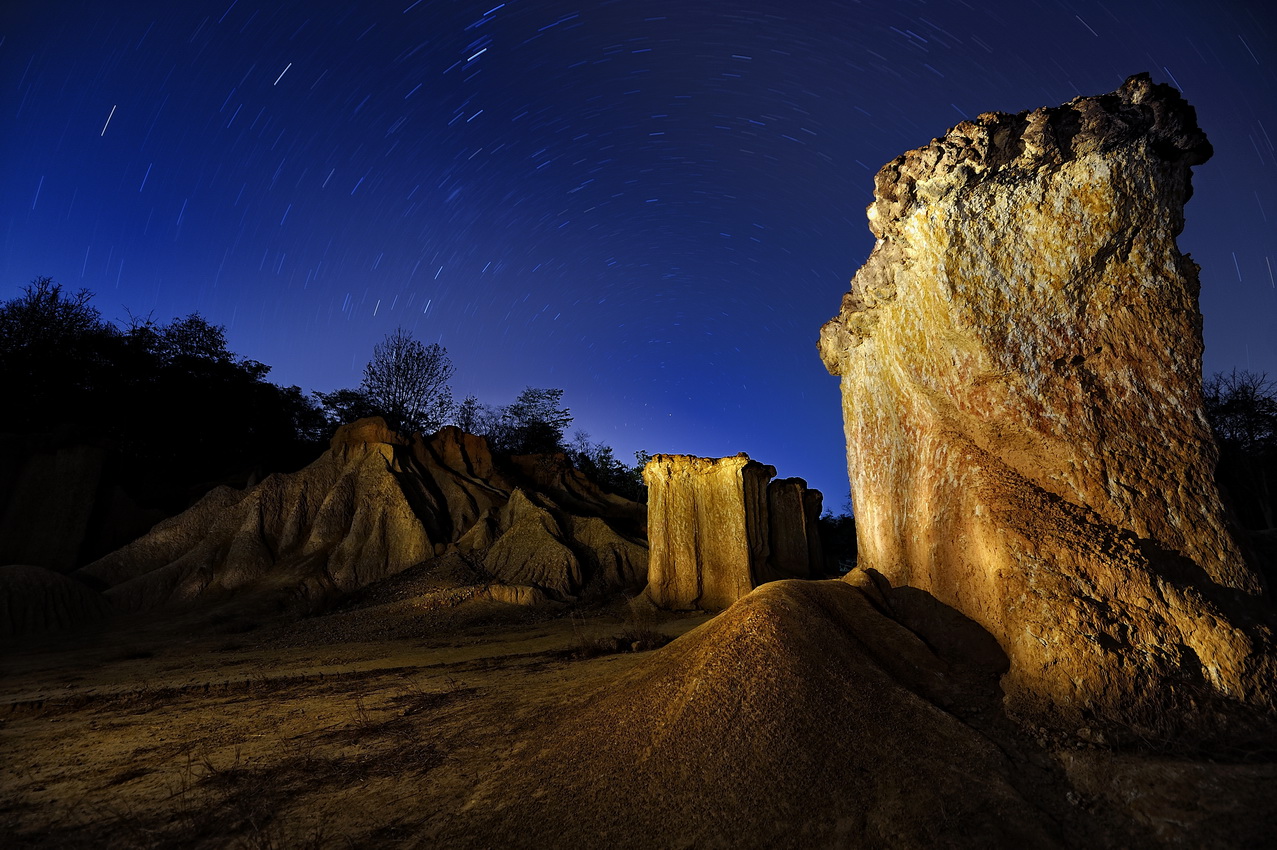
Phae Mueang Phi is the spot people mention most when Phrae comes up. It's a forest park with earth pillars and clay cliffs in strange shapes, formed when layers of soft soil and sandstone were worn down by rain and wind over a long stretch of time into sharp, pointed columns. Some pillars still carry a hard rock capstone on top, like a hat, which has protected the soil directly beneath it from eroding as fast as the soil around it. Walking into the area feels like stepping into a completely different landscape from the typical northern forest. The name "Phae Mueang Phi" (literally "ghost town scrubland") comes from a local word where "phae" means scrubland, combined with the site's eerie stillness, which led people in the past to describe it as frightening.
The walking trail is laid out as a loop, so a fairly short walk covers nearly all the highlights — the earth-pillar field, the tall clay cliffs, and a viewpoint overlooking a wide sweep of pillars. It suits anyone after unusual nature photography without a strenuous hike. Adults and older children can walk it comfortably, since most of the path is dirt track and built stairs. The best time is morning or evening, when angled sunlight gives the pillars more dimension and sharper shadows, while the soil color is most vivid right after the rainy season, before it fades from drying out.
A few practical things to know: Phae Mueang Phi sits about 12 kilometers outside town, and public transport doesn't reach it conveniently, so anyone without their own vehicle should rent a motorbike or charter a car. Midday sun is fairly strong with little shade across the pillar field, so bring a hat, water, and sunscreen. In the rainy season the dirt paths can get slippery and some sections are harder to walk, so wear shoes with good grip. Never climb on or touch the pillars — they're fragile and easily damaged, and doing so speeds up erosion that took nature a very long time to shape.
- A rare earth-pillar and eroded-cliff landscape that's become the visual signature of Phrae
- The loop trail is short enough to cover nearly all the highlights without a strenuous walk
- Great for nature photographers — morning/evening angled light gives shots more dimension
- Cheap entry, not too far from town, easy to fold into a Phrae itinerary as a stop
- About 12 km outside town with limited public transport, so you'll need to rent or charter a vehicle
- Little shade across the pillar field; midday sun is strong and hot, so bring sun protection and water
- In the rainy season the dirt paths get slippery in places, and the pillars are fragile — never climb or touch them
Old teak houses — Khum Chao Luang + Vongburi House

If you want to understand why Phrae is known for its old wooden houses, start at Khum Chao Luang, a two-story building in a European-meets-Lanna style built during the era of Phrae's last local lord. The structure itself is brick and plaster, but it's decorated with delicately carved wooden fretwork on the vents and verandas. Inside, it's now a museum where you can walk through displays of period belongings, old photographs, and rooms telling the story of Phrae. One detail people often mention is the space under the house once used to hold prisoners, giving the building a mix of beauty and historical weight.
A short walk or drive away is Vongburi House, a two-story pale-pink teak mansion built by one of the town's wealthy timber-trading families, considered one of the most complete and beautiful teak houses in Phrae. Its standout feature is the carved woodwork on the gables, vents, and eaves, detailed enough to look almost like lace. Inside, the house still holds the family's furniture, collectibles, and old documents on display. Many visitors particularly enjoy getting a tangible glimpse of how a wealthy northern family once lived, and it's a beautiful spot for period-style photos both outside and in.
The advantage of this route is that both sites sit within the old town district, an easy walk or short drive apart, making it ideal for anyone without a car and easy to cover in half a day. Worth knowing: both buildings are conservation sites, so the old wooden floors and staircases call for a light step, and some rooms don't allow photography or touching objects — follow the posted signs and staff instructions. Vongburi House charges a small entry fee and has set opening hours worth checking in advance, and midday to early afternoon is when the light inside the wooden house looks best for photos.
- See a fully intact teak mansion and a building from the era of the local lords, complete with artifacts and historical stories
- Khum Chao Luang and Vongburi House both sit in the old town, an easy walk or short drive apart, coverable in half a day
- Beautifully detailed carved fretwork on the gables, vents, and eaves make for great period-style photos
- Suits travelers without a car — both are in town, entry is inexpensive, and Khum Chao Luang is free
- Conservation buildings with old wooden floors and staircases — some rooms restrict photography or touching, so move gently
- Set opening hours mean visiting in the evening or on some holidays could find them closed — check ahead
- Fairly limited space, so during busy periods it can feel crowded and harder to move through comfortably
Wat Phra That Cho Hae — the province's year-of-the-tiger stupa

Wat Phra That Cho Hae is Phrae's guardian temple, one that nearly every visitor makes a point of stopping at. The main draw is the gold-clad Lanna-style chedi standing prominently on a rise within the temple grounds, surrounded by a fence and gateway for a circumambulation walk to pay respects. Phra That Cho Hae is also considered the guardian stupa for those born in the Year of the Tiger, following the belief in zodiac-year guardian relics, so people born in the tiger year traditionally make a point of visiting at least once in their life. The name "Cho Hae" comes from the silk cloth or flags devotees have traditionally offered to the stupa since ancient times.
Besides the chedi itself, the temple grounds also include an ordination hall and a viharn decorated with stucco work, gold patterning, and Lanna-style colored glass, all worth a walk-through. The overall atmosphere is a shaded temple on a rise, with a naga staircase leading up to the temple courtyard and spots to light incense and candles or ring bells as tradition dictates. The liveliest time is the Phra That Cho Hae merit-making festival, held roughly from February to March, when a procession draws large crowds from across the north.
Worth knowing: Cho Hae sits about 9 kilometers outside town. Some local shared taxis and hired vehicles run there, but having your own car or a rented motorbike is more convenient. As a sacred site, dress modestly, cover your shoulders and knees, and remove your shoes before entering the viharn. Early morning, before the heat sets in, is when it's coolest and least crowded, making it the easiest time to pay respects and take photos. During the festival period and long holidays, crowds are heavy, parking fills up fast, and the shops outside the temple get quite busy, so allow extra time and patience.
- Phrae's guardian stupa and the year-of-the-tiger relic, a key stop for merit-makers and anyone born in the Year of the Tiger
- A golden Lanna-style chedi alongside an ordination hall and viharn decorated with beautiful stucco work and colored glass
- Not too far from town, about 9 km, easy to add as a stop on a Phrae trip
- During the Feb–Mar merit-making festival, the atmosphere is lively with a bustling procession
- About 9 km outside town with limited public transport — rent a motorbike or charter a car if you don't have your own
- During the festival and long holidays, crowds are heavy, parking fills fast, and the temple front gets busy
- As a sacred site, modest dress is required and shoes must come off before entering the viharn
Phrae old town + Ban Thung Hong mo hom cloth

If you want an easygoing trip without much driving, the old town and mo hom cloth route is the answer. Start in Phrae's old town, still ringed by its old moat and earthen city walls. Wandering through, you'll find Pratu Chai, the old city gate, important temples like Wat Phra Non and Wat Chom Sawan with their Burmese-style chedis and wooden viharns, plus old wooden houses and cafés set up in former homes. The charm of Phrae's old town is that it's still uncrowded compared to major tourist cities — you can wander at a slow pace and see genuine local life mixed with traces of history.
The craft long associated with Phrae is mo hom cloth, a deep indigo-blue cotton textile that the Tai Phuan people of Ban Thung Hong have made for generations. The name "mo hom" comes from the "mo" (pot) used for dyeing and the "hom" (indigo) plant that gives the blue color. Ban Thung Hong sits about 4 kilometers from town, with rows of cloth shops selling shirts, scarves, and home décor items. Many shops also offer hands-on dyeing workshops, where you tie a pattern and dip the cloth in the indigo vat yourself, taking home a one-of-a-kind piece — ideal for anyone who wants a hands-on activity and a souvenir with a story behind it.
The advantage of this route is that it flexes to whatever time you have — an old-town walk alone fills half a day, or add the mo hom workshop for a full day, and since most of it is in or near town, you don't need a car at all. Worth knowing: some cloth shops and workshops are best booked by phone in advance, especially on weekdays or quieter periods. Natural indigo dye stains hands and clothing easily, so wear something you don't mind getting dirty for the dyeing session, and genuinely indigo-dyed cloth may bleed some color at first, so wash it separately the first few times. For the old-town walk, midday sun is strong, so evening is recommended when the air cools and the light looks better.
- Phrae's old town is still uncrowded, with a relaxed stroll past the old city gate, old temples, and wooden houses at an easy pace
- Ban Thung Hong's mo hom cloth is a signature indigo-dyeing craft of Phrae, making for a souvenir with real character
- Many shops offer hands-on dyeing workshops, letting you take home a one-of-a-kind piece of cloth
- Mostly in or near town, so no car needed, and it's easy to scale up or down between half a day and a full day
- Some cloth shops and workshops are best booked ahead by phone, especially on weekdays or quieter periods
- Natural indigo dye stains hands and clothing easily, so wear something you don't mind getting dirty for the workshop
- Midday sun is strong for the old-town walk, so it's best to avoid it and go in the morning or evening instead
Book activities & tickets ahead
Phrae city tours and mo hom dyeing workshops fill up fast on holidays — booking ahead is more convenient.
Where to stay in Phrae?
Pick a hotel in the old town or central Phrae for an easy walk to sights and a good base for trips outside town. Compare prices across 3 sites before booking.
Search hotels on AgodaQuick summary: where to go in Phrae
Love nature and unusual landscape photography? Choose Phae Mueang Phi. Go in the morning or evening when angled light gives the pillars more dimension. You'll need a car or rented motorbike since it's outside town.
Love history and old wooden houses? Choose the old teak houses. Walk from Khum Chao Luang to Vongburi House in the old town, doable in half a day, no car needed.
On a merit-making trip and want to pay respects at the guardian stupa? Choose Wat Phra That Cho Hae, especially if you're born in the Year of the Tiger. Go in the morning when it's quieter and cooler.
Short on time, no car, and want a relaxed walk plus crafts? Choose Phrae's old town and Ban Thung Hong's mo hom cloth. Walk the old town in the evening, then add a dyeing workshop for a hands-on souvenir.
How to plan a trip that covers every highlight
If you have 2 days, spend the first day in town — walk the old town, see the old city gate and old temples, then visit the teak houses at Khum Chao Luang and Vongburi House, and in the evening head to the cloth shops or do a mo hom workshop in Ban Thung Hong. On the second day, head out of town, starting early at Wat Phra That Cho Hae before the crowds arrive, then on to Phae Mueang Phi in the evening when the angled light makes for great photos. If you only have one day and no car, focus on the in-town route — the old town, the teak houses, and mo hom cloth — and save Cho Hae and Phae Mueang Phi for a return trip when you have a vehicle.
Once you've picked the right Phrae highlight, don't forget to book a well-located hotel as your trip base. See hotels with prices already compared here.
See well-located Phrae hotels →