🔄 Updated 21 Jun 2026
The Phraya Phichai Dab Hak Monument isn't just a statue downtown — it's the one spot that tells you who Uttaradit is. People here call themselves "descendants of Phraya Phichai," and once you know who he was and what he did, standing in front of the monument means a lot more. So we wanted to cover the whole thing in one article: his story, how to make the most of a visit, and what to walk to nearby.
Who was Phraya Phichai?
Phraya Phichai was originally named Thongdee, born late in the Ayutthaya period at Ban Huai Kha in the town of Phichai (today's Phichai district, Uttaradit province). He loved Muay Thai and swordplay from childhood and trained until he was skilled at both. He later entered the service of the governor of Tak — who would go on to become King Taksin the Great — and became one of his most trusted lead warriors.
The event that earned him the name "Dab Hak" (Broken Sword) happened in 1773. The Burmese marched on the town of Phichai, and he led the defense so fiercely that the enemy was routed and forced to retreat. During the fighting, one of his two swords snapped in his hand, but he kept fighting until he won. That feat is why people have called him "Phraya Phichai Dab Hak" ever since.
Why this matters to Uttaradit
The historical town of Phichai is part of present-day Uttaradit province, so people here count him as their full-fledged local hero. The broken sword shows up all over town — on the provincial seal, on government signs, and on souvenirs.
Want more out of Uttaradit? Book tours & activities
Booking online ahead on Klook or GetYourGuide is usually cheaper than the gate and skips the queue. Pick only the experiences you actually want — prices and availability are shown live on each site.
The monument and the city hall plaza
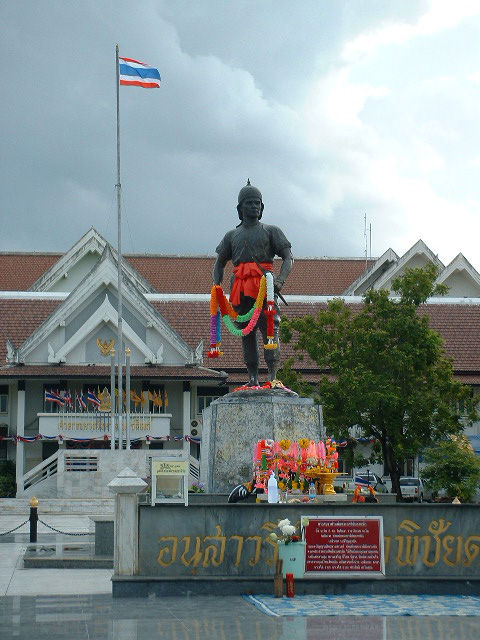
The monument stands in the middle of a wide plaza outside Uttaradit's provincial city hall, within the town municipality. It's easy to reach because it sits right in the center of town. The bronze figure shows Phraya Phichai standing with a sword in each hand, designed and cast by the Fine Arts Department, with its official unveiling held on February 20. It sits high on a raised pedestal and can be seen from a distance.
Around the base you'll often see flowers, incense, candles and replica swords left as offerings after a vow has been fulfilled, because locals believe in his sacred power and strength. Come in the late afternoon when the sun softens and the plaza fills with people exercising and strolling — an easy-going scene that photographs well both by day and once the lights come on.
- Admission — free; it's a public space in the middle of town, open any time
- Best time to come — early morning before the sun gets harsh, or late afternoon 4:30–6:00 PM when the light is nice and the air is comfortable
- Parking — there's space around the plaza and along the roads near city hall; it can get crowded on weekday mornings
- Dress — this is a place locals respect, so dress modestly and be respectful when paying your respects
The museum behind the monument
A lot of people take a photo in front of the monument and leave, even though there's a Phraya Phichai Dab Hak museum right behind it worth walking into. Inside, his story is laid out in detail, along with tools, weapons and accounts of the battles — which makes the picture in your head much clearer than the short plaque at the base. It's great for families bringing kids who want them to take some knowledge home.
Time it right
The indoor exhibits usually keep office hours, roughly 8:30 AM–4:00 PM, and may close on some days. If you're specifically coming to see the museum, aim for the morning to early afternoon on a weekday to be safe.
The annual Phraya Phichai Dab Hak festival
If you want to see the whole town gather in one place, come in January — Uttaradit holds the Phraya Phichai Dab Hak and Red Cross fair here every year, roughly January 7–18. It's the province's biggest event, with reenactments of his heroic deeds, processions, market stalls, local food and rides. The whole town turns out. If you love a full-on temple-fair atmosphere, this is the time.
The rest of the year the monument plaza is quieter and calmer — better if you want to wander, take photos and visit the museum without the crowds. Pick the time that suits the kind of trip you want.
Nearby spots to walk to
The good thing about this spot is that it's downtown, so it's easy to walk or drive on to other places. It works well as the starting point for a day around town.
Wat Tha Thanon
An old hometown temple on the Nan River, home to Luang Pho Phet, an important Buddha image. Not far from the town center — an easy stop to pay your respects.
Uttaradit Municipal Market
A fresh market in the middle of town where you can find local eats and souvenirs, with a genuine local feel.
Uttaradit Railway Station
An old station building still in use and an important junction on the northern line — a classic photo spot for train fans.
With more time and a car, head out of town to Laplae old town, the Sirikit Dam, or Ban Nam Phi — the home of Nam Phi iron, believed to have been used to forge ancient swords, which ties in nicely with the Phraya Phichai story.
A half-day plan around the monument
If you only have half a day in town, this plan works easily — relaxed, no rushing.
History + breakfast
Temple + lunch
Who this trip suits
Great for anyone stopping in Uttaradit on the way north, or with limited time in town, who wants history, a temple and good food all in one go.
Good to know before you go
- It's downtown — outside city hall, easy to find; just drop a pin for "Phraya Phichai Dab Hak Monument" on the map
- Free and always open — the plaza is accessible any time, while the indoor museum keeps office hours
- Bring an umbrella and hat — the plaza is open and the sun is strong from late morning into the afternoon
- Respect the site — it's a place locals revere, so be respectful and dress modestly if you pay your respects
- Allow extra time in January — during the annual fair, traffic around town is heavier than usual
Plan a full Uttaradit trip, in town and beyond
See the Uttaradit travel guide →